How Is the Electric Field Calculated for a Point Outside a Charged Ring?

Click For Summary

Homework Help Overview

The discussion revolves around calculating the electric field due to a thin circular ring of charge for points outside the plane of the ring. The original poster seeks clarification on the validity of their proposed expression for the electric field and the implications of approximating the ring as a point charge when the distance from the ring is large compared to its radius.

Discussion Character

  • Exploratory, Conceptual clarification, Mathematical reasoning, Assumption checking

Approaches and Questions Raised

  • Participants explore the approximation of a charged ring as a point charge at large distances and discuss the necessity of justifying this assumption. There are inquiries about the implications of higher-order terms in the series expansion of the electric field and the setup of integrals for calculating the electric field.

Discussion Status

The discussion is ongoing, with participants providing insights into the setup of integrals and the use of Taylor series for approximating the electric field. Some participants express uncertainty about the next terms in the series and the relevance of higher-order terms, while others emphasize the importance of understanding the behavior of the electric field in various limits.

Contextual Notes

Participants mention the need to consider the distance from the center of the ring relative to its radius when calculating the electric field, as well as the potential complexity of obtaining higher-order terms in the series expansion.

MatinSAR
Messages
673
Reaction score
204
Thread moved from the technical forums to the schoolwork forums
Hi ...
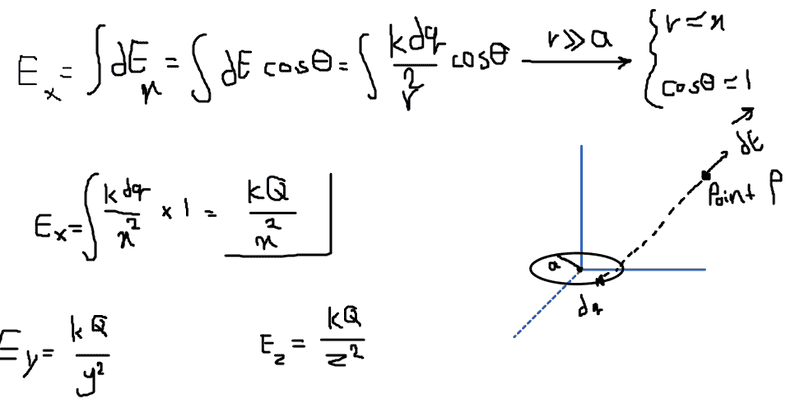
How can I find the electric field due to a thin circular ring of radius a and charge q for points outside the plane of the ring?
The distance from the center of the ring to the point of the electric field is large compared to the radius of the ring.

I have answered it but I don't know if it's true or not.
Untitled.png
I think the answer is : kQ/x^2 i + kQ/y^2 j + kQ/z^2 k
Is it true ?
 
Physics news on Phys.org
In other words, from far enough away a ring can approximated by a point charge?
 
  • Like
Likes   Reactions: MatinSAR
PeroK said:
In other words, from far enough away a ring can approximated by a point charge?
Thank you for your help and time ...
I have asked about it and this was the answer :
Use r>>a(The distance from the center of the ring to the point of the electric field is large compared to the radius of the ring) to calculate integrals without difficulties ... and don't consider it as a point charge ...
 
MatinSAR said:
Thank you for your help and time ...
I have asked about it and this was the answer :
Use r>>a(The distance from the center of the ring to the point of the electric field is large compared to the radius of the ring) to calculate integrals without difficulties ... and don't consider it as a point charge ...
It might be considered too easy simply to assume that the first approximation is that of a point charge. You may need to justify that and possibly give the next term in order of ##\frac 1{r^3}##.
 
  • Like
Likes   Reactions: vanhees71 and MatinSAR
PeroK said:
It might be considered too easy simply to assume that the first approximation is that of a point charge. You may need to justify that and possibly give the next term in order of ##\frac 1{r^3}##.
Could you give me a little more guidance on this whenever you have the time? I am sorry but I didn't understand what did you mean by 1/r^3.
 
Setup the integral for a ring of charge... the integrand is important part.

First, consider a ring broken up into [crudely modeled by] (say) 8 point charges...
how do you find the electric field at a given point [say, along the axis]
due to one point charge?
Then, what happens when you add up the contributions of all 8 point charges?

https://www.glowscript.org/#/user/m...tterandinteractions/program/15-E-ring-demo-dE

Now, generalize to "infinitesimal [teeny-tiny] point charges".

For points on the axis, the integral can be setup and done exactly.

One could then approximate the exact answer by using the approximation that r>>a .
Series expansion may be a useful technique.

You expect that in the extreme limit, you get zero (infinitely far away from a point charge).
If you keep the next term (as a function of r), you expect a point charge.
If you keep the next term, you expect something more complicated than a point-charge...
(distorted point charge that suggests that your original charge distribution is not a point charge)...
...this is likely what is being sought.
 
  • Like
Likes   Reactions: MatinSAR
MatinSAR said:
Could you give me a little more guidance on this whenever you have the time? I am sorry but I didn't understand what did you mean by 1/r^3.
Most things in physics can be expanded into a Taylor series, in this case in powers of ##r## or ##1/r##. This idea will come up a lot in EM.

The electric field of a point charge is a simple ##k/r^2##. The field for a ring must be a power series of the form:
$$a_2\frac 1 {r^2} + a_3\frac 1 {r^3} \dots$$
You could generate this series from your integral. If ##r## is large, the first term dominates, hence the field is approximately that of a point charge. But, there will be higher terms representing the next order of approximation.
 
  • Like
Likes   Reactions: MatinSAR
Perhaps I shouldn't have used ##a_2## etc for the coefficients. They will depend on ##a## and the angle above the plane of the ring..
 
  • Like
Likes   Reactions: MatinSAR and hutchphd
robphy said:
Setup the integral for a ring of charge... the integrand is important part.
PeroK said:
Most things in physics can be expanded into a Taylor series, in this case in powers of ##r## or ##1/r##. This idea will come up a lot in EM.
Thank you for taking the time to do this🙏🙏🙏
 
  • #10
I think getting the next term in the series will be complicated. They probably want you to set up the integral and neglect higher order terms

That seems a little pointless to me as it's mathematically obvious what will happen!
 
  • Like
Likes   Reactions: MatinSAR
  • #11
PeroK said:
I think getting the next term in the series will be complicated. They probably want you to set up the integral and neglect higher order terms

That seems a little pointless to me as it's mathematically obvious what will happen!
Yes, there's no point to it.
It's a ring of charge. :-p

But seriously... I think the point is to setup the exact integral (when one can),
then see that it has the expected behavior in the limits when it's a very small radius ring,
when observed from very far away, etc...

...then maybe it becomes obvious.

Then, for a general point off-axis, ... that might be a little trickier.

(One could also attempt to write the electric potential as a function of position.
Then compute the minus-the-gradient at the point of interest.
Note that one needs more than just the potential's value at the point of interest,
one needs to compute the gradient of the potential there.)
 
  • Like
Likes   Reactions: MatinSAR
  • #12
For a ring of charge ##Q## and radius ##R##, the potential at an arbitrary point in cylindrical coordinates is given by
$$V(\rho,z)=\frac{kQ}{2\pi}\int_0^{2 \pi } \frac{d\phi}{\sqrt{\rho ^2+R^2-2 \rho R \cos\!\phi +z^2}} \, .$$This is an elliptic integral that does not have an analytic expression. Writing expressions for the electric field ##z## and ##\rho## component results in more elliptic integrals.
 
  • Like
Likes   Reactions: vanhees71 and MatinSAR

Similar threads

Replies
4
Views
3K
Replies
5
Views
759
  • · Replies 2 ·
Replies
2
Views
2K
  • · Replies 2 ·
Replies
2
Views
1K
  • · Replies 4 ·
Replies
4
Views
1K
  • · Replies 2 ·
Replies
2
Views
2K
  • · Replies 6 ·
Replies
6
Views
845
  • · Replies 6 ·
Replies
6
Views
2K
  • · Replies 68 ·
3
Replies
68
Views
8K
  • · Replies 2 ·
Replies
2
Views
4K