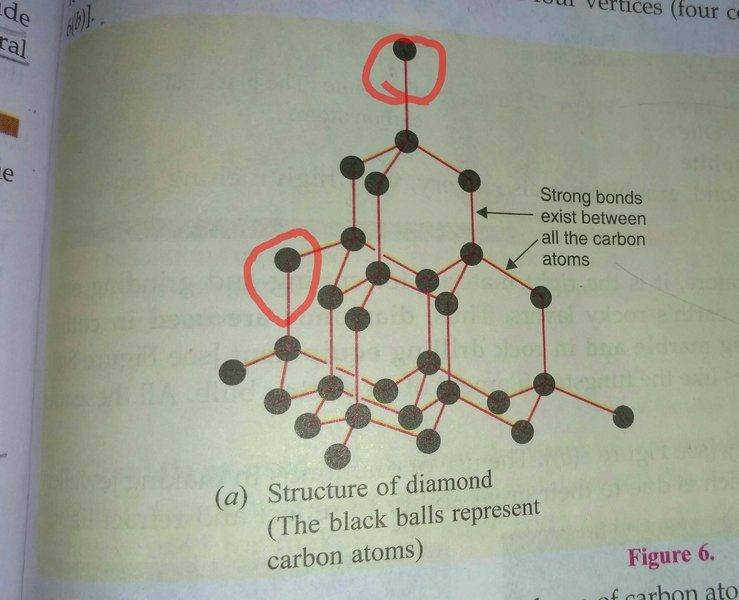
How is this diagram of the structure of diamond correct?

Click For Summary
SUMMARY

The discussion centers on the structural representation of diamond, specifically addressing the misconception that carbon atoms in diamond should always bond with four other carbon atoms. Participants clarify that the diagram in question depicts only a portion of the diamond structure, which is a crystal lattice. They explain that while surface atoms may appear to have fewer bonds, this does not imply a lack of bonding in the overall structure. The presence of surface atoms does not significantly contribute to electrical conductivity due to the nature of electron mobility and bonding.

PREREQUISITES
  • Understanding of covalent bonding in carbon atoms
  • Familiarity with crystal structures and lattice arrangements
  • Basic knowledge of electrical conductivity and conduction bands
  • Awareness of surface chemistry and its effects on material properties
NEXT STEPS
  • Research the concept of crystal lattices in materials science
  • Study the principles of electrical conductivity in non-metals
  • Explore the role of surface chemistry in semiconductor materials
  • Learn about the conduction band and its significance in solid-state physics
USEFUL FOR

Students studying chemistry and materials science, educators explaining diamond structure, and professionals interested in the electrical properties of non-metallic materials.

navneet9431
see this diagram of the structure of diamond given in my textbook-
pe4zYC4.jpg

I have read in my textbook that each carbon atom in a Diamond crystal is attached to four other carbon atoms by strong covalent bonds.But, in the diagram above I can see that some of the carbon atoms are not attached to 4 carbon atoms(see the red circle).
So, I want to know, Is this diagram of the structure of Diamond incorrect?
If not, then please explain to me why?
I will be thankful for any help!
Note: I am a high school student and English is my second language.
 

Attachments

  • pe4zYC4.jpg
    pe4zYC4.jpg
    48.6 KB · Views: 2,962
Chemistry news on Phys.org
Clearly this is not an entire diamond. Inside the diamond, it is true that each atom has bonds to four neighbouring ones. This is impossible to depict in an image in a textbook and so they show you a small part of it. That there are atoms with only one bond in your picture does not mean that they would have only one bond in the diamond. The neighbours just are not in the picture. It is not like a depiction of a water molecule where you see the entire molecule - the pattern goes on and on, it is a crystal.
 
Note that no diamond is infinite - it ends somewhere, and for obvious reasons atoms on the surface can't have the same number of neighbors as atoms inside.
 
Borek said:
Note that no diamond is infinite - it ends somewhere, and for obvious reasons atoms on the surface can't have the same number of neighbors as atoms inside.
Thanks!
I also agree that no diamond is infinite.So, it must end somewhere, so atoms on the surface can't have the same number of neighbours as atoms inside.
But, I have a few doubts which contradict this thought.
If the atoms on the surface of diamond do not have the same number of neighbours as atoms inside, then it means that the carbon atoms on the surface of the diamond have some free electrons and this will make the diamond a good conductor of electricity.But, a Diamond is a BAD conductor of electricity. so, where is my explanation wrong?
Now,
pe4zYC4.jpg

see the carbon atom in the green circle. As you can see it is bonded to only 3 carbon atoms.Can you please locate or mark the fourth carbon atom in the diagram with which this carbon atom should be bonded?
I will be thankful for help!
 

Attachments

  • pe4zYC4.jpg
    pe4zYC4.jpg
    49.9 KB · Views: 1,275
1. Just having electrons on the surface is not enough to conduct electricity.

2. In reality there are no free bonds on the surface - they are taken by hydrogen or oxygen, just the amount of these elements (compared with the amount of carbon in the bulk of the crystal) is negligible.

3. The 3-bond carbon you marked with a green circle is on the surface, if anything, the fourth bond would be sticking to the outside.

Actually there is no carbon that is strictly inside on this image (even those with four bonds are technically on the surface), however, the structure can be easily extended in every direction. Trying to draw more atoms would just make the picture more difficult to understand.
 
  • Like
Likes   Reactions: navneet9431
Borek said:
1. Just having electrons on the surface is not enough to conduct electricity.

2. In reality there are no free bonds on the surface - they are taken by hydrogen or oxygen, just the amount of these elements (compared with the amount of carbon in the bulk of the crystal) is negligible.

3. The 3-bond carbon you marked with a green circle is on the surface, if anything, the fourth bond would be sticking to the outside.

Actually there is no carbon that is strictly inside on this image (even those with four bonds are technically on the surface), however, the structure can be easily extended in every direction. Trying to draw more atoms would just make the picture more difficult to understand.
Thank you so much!Now more than half of my confusion is clear. I have one last question.
You have just that having electrons on the surface is not enough to conduct electricity.
But,why electrons on the surface are not sufficient to conduct electricity?

Also,can you please provide me a link of image or video of the structure of diamond which shows covalent bonding of carbons atoms in the interior of diamond?

I will be thankful for help!
 
Conductivity is not just about free electrons, it is about electrons on the conduction band - to conduct they have to be free to travel through the structure, not free in terms of not being used by bonds.

It is pretty easy to extend the given structure in every direction, simply try do do that. Every carbon with four bonds looks exactly like the ones inside of the larger structure.
 
Borek said:
Conductivity is not just about free electrons, it is about electrons on the conduction band - to conduct they have to be free to travel through the structure, not free in terms of not being used by bonds.

It is pretty easy to extend the given structure in every direction, simply try do do that. Every carbon with four bonds looks exactly like the ones inside of the larger structure.
Till now,i have not been taught anything about "conduction band".Can you give an intuitive definition of this conduction band?

Also,if electrons on the surface of diamond are free then they will be able to move with the surface of the diamond and hence conduct electricity. But,you just said that electron should be able to pass **through** the diamond in order to conduct electricity. Why is it important for electrons to pass through the diamond in order to conduct electricity?

Thanks in advance!
 
  • #10
navneet9431 said:
Till now,i have not been taught anything about "conduction band".Can you give an intuitive definition of this conduction band?

"Free to travel through the structure" is the best "intuitive" definition I can think of, without delving into details.

Also,if electrons on the surface of diamond are free then they will be able to move with the surface of the diamond and hence conduct electricity.

Not necessarily, depends on what you mean by "free". Electron can be "free" because it is not part of a bond, but it can be still "attached" to its original atom strong enough that it can't move away.

But,you just said that electron should be able to pass **through** the diamond in order to conduct electricity. Why is it important for electrons to pass through the diamond in order to conduct electricity?

Technically electrons traveling just on the surface could be able to conduct electricity, just their amount is very low, so the current is very low as well. In conductors amount of electrons in the bulk is orders of magnitude larger, which means the resistivity is much lower (or conductivity much higher).

Disclaimer: this is all very handwavy.
 
  • Like
Likes   Reactions: navneet9431
  • #11
Borek said:
"Free to travel through the structure" is the best "intuitive" definition I can think of, without delving into details.
Not necessarily, depends on what you mean by "free". Electron can be "free" because it is not part of a bond, but it can be still "attached" to its original atom strong enough that it can't move away.
Technically electrons traveling just on the surface could be able to conduct electricity, just their amount is very low, so the current is very low as well. In conductors amount of electrons in the bulk is orders of magnitude larger, which means the resistivity is much lower (or conductivity much higher).

Disclaimer: this is all very handwavy.
Thank you!
At,last my all doubts have been cleared.
 
  • #12
Borek said:
2. In reality there are no free bonds on the surface - they are taken by hydrogen or oxygen, just the amount of these elements (compared with the amount of carbon in the bulk of the crystal) is negligible.

There could be a dangling bond for diamond surface, if I remember correctly.
 
  • #13
HAYAO said:
There could be a dangling bond for diamond surface, if I remember correctly.

This is chemistry, exceptions are everywhere :smile: and definitely not all surfaces are equal.
 
  • Like
Likes   Reactions: navneet9431
  • #14
Borek said:
This is chemistry, exceptions are everywhere :smile: and definitely not all surfaces are equal.
  • All surfaces are created equal.
  • ...
  • ...
  • ...
  • Some surfaces are more equal than others.
(Sorry, I had to) :smile:
 
  • #15
Orodruin said:
All surfaces are created equal.

Actually they are not, which is a reason why NaCl sometimes crystallizes in cubic, and sometimes in octahedral form.

(Yes, the reference is crystal clear.)
 

Similar threads

  • · Replies 10 ·
Replies
10
Views
3K
  • · Replies 3 ·
Replies
3
Views
5K
Replies
2
Views
2K
  • · Replies 1 ·
Replies
1
Views
4K
  • · Replies 2 ·
Replies
2
Views
2K
  • · Replies 1 ·
Replies
1
Views
2K
  • · Replies 2 ·
Replies
2
Views
8K
  • · Replies 1 ·
Replies
1
Views
2K
  • · Replies 2 ·
Replies
2
Views
7K
  • · Replies 1 ·
Replies
1
Views
2K