How Is Time Factored Into the Derivation of the Ideal Gas Law?

Click For Summary
The discussion focuses on the role of time in deriving the ideal gas law, particularly in the context of momentum change during particle collisions with container walls. The original question raised confusion about why the time considered is the travel time for a particle to reach the opposite wall and back, rather than the time of collision. It is clarified that the time between collisions is calculated as distance divided by speed, specifically 2x/u, where x is the distance to the wall and u is the particle's speed. The explanation emphasizes that the particle interacts with the wall intermittently, and the derived force must represent the effect of these intermittent collisions as if it were continuous. Ultimately, the clarification resolves the initial confusion regarding the time factor in the derivation.
eddywalrus
Messages
25
Reaction score
0
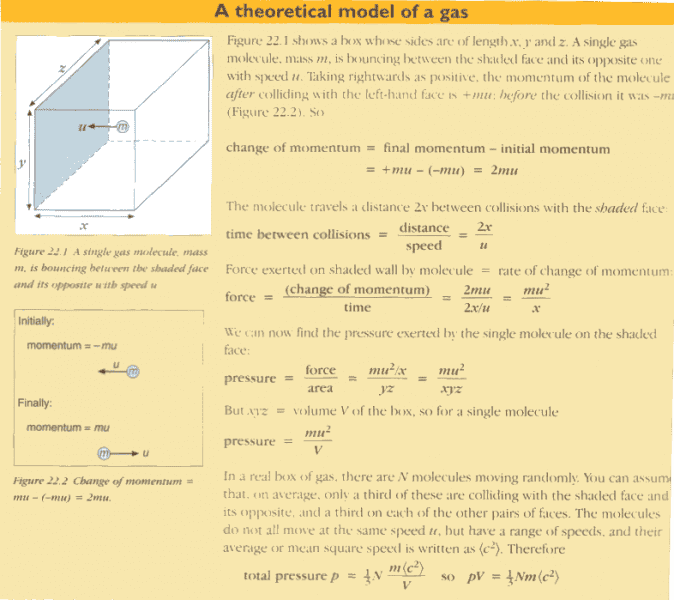
Here is a screenshot from a page from a textbook that explains how to derive the ideal gas law:
upload_2015-3-18_12-7-52.png


In the third bold line, I don't understand how "time" in force = (change of momentum)/(time) is equal to 2x/u (the time it takes for the particle to travel to the opposite face and back again) -- I always assumed that:

impulse = Force x time
change in momentum = Force x time
where time in this case refers to the time of contact between the two colliding objects? Furthermore, since the particle doesn't change its momentum over the duration of traveling to the opposite face and back again (but instead changes momentum during its collision with the container wall), shouldn't the "time" in this case refer to the time of collision?

Thank you so much for all your help!
 
Physics news on Phys.org
I'm pretty sure you can derive (change of momentum)/(time) from some basic formulas.

F = ma
a = Δv/Δt
Δp = mΔv

F = ma and a = Δv/Δt gets you F = mΔv/Δt

F = mΔv/Δt and Δp = mΔv gets you F = Δp/Δt
 
Evanish said:
I'm pretty sure you can derive (change of momentum)/(time) from some basic formulas.

F = ma
a = Δv/Δt
Δp = mΔv

F = ma and a = Δv/Δt gets you F = mΔv/Δt

F = mΔv/Δt and Δp = mΔv gets you F = Δp/Δt

Thank you for your help, but I think you misunderstood my question -- I probably should have made it clearer. My bad, sorry.

I get how you would derive force = (change in momentum)/(time), but I'm unsure of why "time" in this instance is the time it takes for the particle to travel to the other face and back instead of the time of collision or contact between the particle and the container wall.

Thank you!
 
eddywalrus said:
the time of collision or contact between the particle and the container wall

Already considered in the statement,
+mu - (-mu) = 2mu
for the particle interacting with the wall.

eddywalrus said:
time it takes for the particle to travel to the other face and back
As in the textbook,
time between collisions = distance /speed = 2x/u

The particle interacts with the wall only once every interval, and not continuously during the interval.
So we want to find a force, that if acting continuously, would give the same force on the wall as from the intermittent collisions of the particle with the wall.
 
256bits said:
Already considered in the statement,
+mu - (-mu) = 2mu
for the particle interacting with the wall.As in the textbook,
time between collisions = distance /speed = 2x/u

The particle interacts with the wall only once every interval, and not continuously during the interval.
So we want to find a force, that if acting continuously, would give the same force on the wall as from the intermittent collisions of the particle with the wall.

Thank you very much for your explanation -- I understand it now!
 
I do not have a good working knowledge of physics yet. I tried to piece this together but after researching this, I couldn’t figure out the correct laws of physics to combine to develop a formula to answer this question. Ex. 1 - A moving object impacts a static object at a constant velocity. Ex. 2 - A moving object impacts a static object at the same velocity but is accelerating at the moment of impact. Assuming the mass of the objects is the same and the velocity at the moment of impact...

Similar threads

  • · Replies 1 ·
Replies
1
Views
3K
Replies
2
Views
5K
  • · Replies 9 ·
Replies
9
Views
4K
  • · Replies 7 ·
Replies
7
Views
3K
  • · Replies 6 ·
Replies
6
Views
2K
  • · Replies 2 ·
Replies
2
Views
2K
  • · Replies 14 ·
Replies
14
Views
2K
  • · Replies 1 ·
Replies
1
Views
2K
  • · Replies 1 ·
Replies
1
Views
2K
  • · Replies 109 ·
4
Replies
109
Views
8K