How long does it take for the disk to stop rotating?

Click For Summary

Homework Help Overview

The discussion revolves around a physics problem related to the rotational motion of a solid disk, specifically focusing on how long it takes for the disk to stop rotating. Participants are analyzing the moment of inertia and angular acceleration in the context of this problem.

Discussion Character

  • Mathematical reasoning, Assumption checking, Problem interpretation

Approaches and Questions Raised

  • Participants are attempting to identify errors in the original poster's calculations, particularly concerning the moment of inertia and the substitution of values. Questions are raised about the correct value of the coefficient of friction and the implications of algebraic errors in the calculations.

Discussion Status

There is ongoing clarification regarding the calculations and assumptions made by the original poster. Some participants have provided guidance on identifying specific errors, while others have noted the difficulty in reading the original poster's work. The discussion is active, with multiple interpretations being explored, but no explicit consensus has been reached.

Contextual Notes

Participants have pointed out that the original poster's handwriting is difficult to read, which may be contributing to misunderstandings. There is also a focus on the importance of correctly identifying the moment of inertia for the solid disk in the calculations.
Istiak
Messages
158
Reaction score
12
Homework Statement
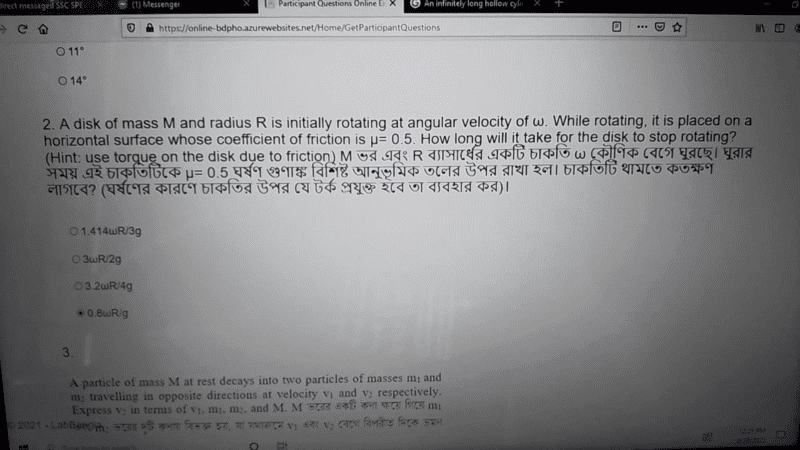
A disk of masses M and radius R is initially rotating at angular velocity \omega. While rotating, it is placed on a horizontal surface whose coefficient of friction is \mu =0.5 How long take for the disk to stop rotating?
Relevant Equations
\tau = r . F
Question :

1625401961807.png


Solution attempt :

1625401977600.png
for
 
Physics news on Phys.org
Are you asking us to check your working because it does not give one of the answers in the list?

Your writing/working is difficult to read and follow. But as far as I can tell you have made a simple error: you appear to have substituted μ=1 rather than μ=0.5
 
  • Like
Likes   Reactions: Delta2
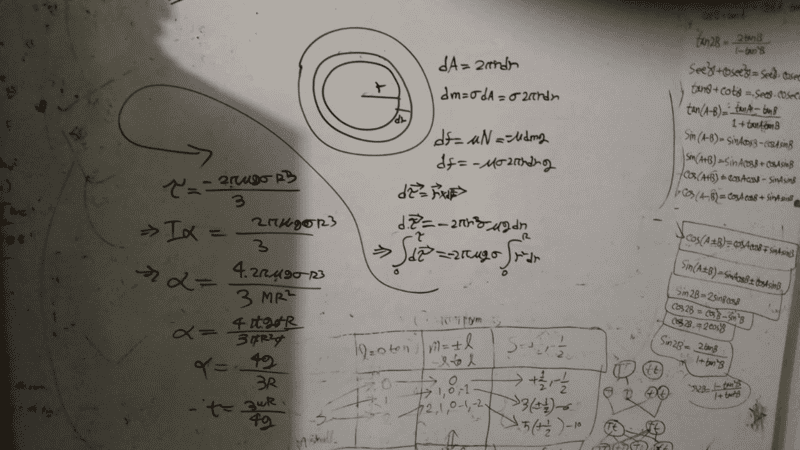
You have made a simple algebraic error. The moment of inertial of a solid disk with respect to the z-axis is ##\frac{1}{2}MR^2##. So when you divide by this to find the angular acceleration you should get $$a=\frac{4\pi\mu g\sigma R^3}{3MR^2}$$, but you have keep an additional factor of 2 (which later you get rid by replacing ##\mu=0.5##). So after simplifications you actually get $$a=\frac{2g}{3R}$$ which lead you to one of the available options.
 
  • Like
Likes   Reactions: Steve4Physics
Steve4Physics said:
Are you asking us to check your working because it does not give one of the answers in the list?

Your writing/working is difficult to read and follow. But as far as I can tell you have made a simple error: you appear to have substituted μ=1 rather than μ=0.5
2×0.5=1
 
Delta2 said:
You have made a simple algebraic error. The moment of inertial of a solid disk with respect to the z-axis is ##\frac{1}{2}MR^2##. So when you divide by this to find the angular acceleration you should get $$a=\frac{4\pi\mu g\sigma R^3}{3MR^2}$$, but you have keep an additional factor of 2 (which later you get rid by replacing ##\mu=0.5##). So after simplifications you actually get $$a=\frac{2g}{3R}$$ which lead you to one of the available options.
1625411680313.png
 
Your error is one line above from where your green arrow is pointing. You write that $$a=\frac{4 \cdot 2 \pi\mu g\sigma R^3}{3MR^2}$$ while the correct is (as i said at my earlier post) that $$a=\frac{4\pi\mu g\sigma R^3}{3MR^2}$$
 
  • Like
Likes   Reactions: Steve4Physics
Let me ask you one straight question, what do you take it to be the moment of inertia of the solid disk? $$\frac{1}{2}MR^2$$ OR $$\frac{1}{4}MR^2$$?
MoI around the z axis (perpendicular to the plane of the disk) is the first, while MoI around x or y-axis is the second...
 
Delta2 said:
Your error is one line above from where your green arrow is pointing. You write that $$a=\frac{4 \cdot 2 \pi\mu g\sigma R^3}{3MR^2}$$ while the correct is (as i said at my earlier post) that $$a=\frac{4\pi\mu g\sigma R^3}{3MR^2}$$
Why there won't be 4 times 2?
 
Istiakshovon said:
Why there won't be 4 times 2?
Because the Moment of Inertia of the solid disk (around the z-axis perpendicular to xy plane-the plane of the disk) is ##I=\frac{1}{2}MR^2## so you actually have ##2\cdot 2=4## there and NOT ##4\cdot 2=8##...
 
  • #10
Istiakshovon said:
2×0.5=1
So I believe.

You have made an error involving a factor of 2. It might be (as @Delta2 notes) something to do with the ½ in ½MR², or as I note, something to do with the value of μ (=0.5). Maybe it's a mixture of the two - e.g. incorrectly mixing the two ½s.

For me, the main problem is that your hand-writing is very difficult to read, so it's hard to be certain exactly what you've done.

But the only 2 things you now need to do are:
1) carefully repeat your working (say from 'Iα =' onwards) to locate your mistake;
2) click 'Likes' for @Delta2 and me to acknowledge the time/effort/help we have supplied!
 
  • Like
Likes   Reactions: Delta2
  • #11
Steve4Physics said:
So I believe.

You have made an error involving a factor of 2. It might be (as @Delta2 notes) something to do with the ½ in ½MR², or as I note, something to do with the value of μ (=0.5). Maybe it's a mixture of the two - e.g. incorrectly mixing the two ½s.

For me, the main problem is that your hand-writing is very difficult to read, so it's hard to be certain exactly what you've done.

But the only 2 things you now need to do are:
1) carefully repeat your working (say from 'Iα =' onwards) to locate your mistake;
2) click 'Likes' for @Delta2 and me to acknowledge the time/effort/help we have supplied!
1625413468631.png


Is it OK now?
 
  • Like
Likes   Reactions: Delta2
  • #13
Istiakshovon said:
View attachment 285452

Is it OK now?
That's the same answer as I get - so I'd say yes! The important thing is that you found/understood where you made the mistake.
 
  • Like
Likes   Reactions: Istiak

Similar threads

  • · Replies 19 ·
Replies
19
Views
4K
  • · Replies 3 ·
Replies
3
Views
2K
Replies
3
Views
1K
  • · Replies 10 ·
Replies
10
Views
3K
Replies
5
Views
1K
  • · Replies 25 ·
Replies
25
Views
2K
Replies
30
Views
3K
Replies
28
Views
4K
Replies
9
Views
3K
  • · Replies 2 ·
Replies
2
Views
2K