How many spikes does it take to build a wall?

  • Thread starter Thread starter DaveC426913
  • Start date Start date
  • Tags Tags
    Build Wall
Click For Summary

Discussion Overview

The discussion revolves around the construction of a wall using spikes to secure timber sections together. Participants explore the number of spikes required for stability and structural integrity, considering various arrangements and techniques. The conversation includes practical applications and technical reasoning related to construction methods.

Discussion Character

  • Technical explanation
  • Debate/contested
  • Exploratory

Main Points Raised

  • Some participants suggest that initially only one spike was thought necessary, but two or three are actually required for stability.
  • One participant argues that staggering the upper and lower sections could reduce the number of spikes needed to two.
  • Another participant contends that to immobilize the ends of each timber effectively, four spikes may be necessary, while others maintain that three spikes could suffice.
  • There is a discussion about the implications of using different arrangements, with some asserting that the design must prevent pivot points to ensure structural integrity.
  • Participants debate the effectiveness of different configurations, with some claiming that their designs secure all ends while others point out potential weaknesses in the arrangements.
  • One participant reflects on a previous experience building a wall on a slope, noting that it allowed for simpler construction with fewer spikes.

Areas of Agreement / Disagreement

Participants express differing views on the number of spikes required, with no consensus reached. Some argue for three spikes, while others suggest four may be necessary. The discussion remains unresolved regarding the optimal configuration for securing the wall.

Contextual Notes

Participants highlight the importance of preventing pivot points and ensuring that all timber ends are secured, but there are varying interpretations of how many spikes are needed to achieve this. The discussion also touches on the aesthetic considerations of different construction methods.

DaveC426913
Gold Member
2025 Award
Messages
24,445
Reaction score
8,678
When I first started this, I thought I'd need only one spike to stitch the 6x6s together and to fix it to the ground.

But OK, I need two after all.

Having finished two, I realized it's still not secure!

How did I end up needing three spikes to stitch one section of wall? What did I do wrong??
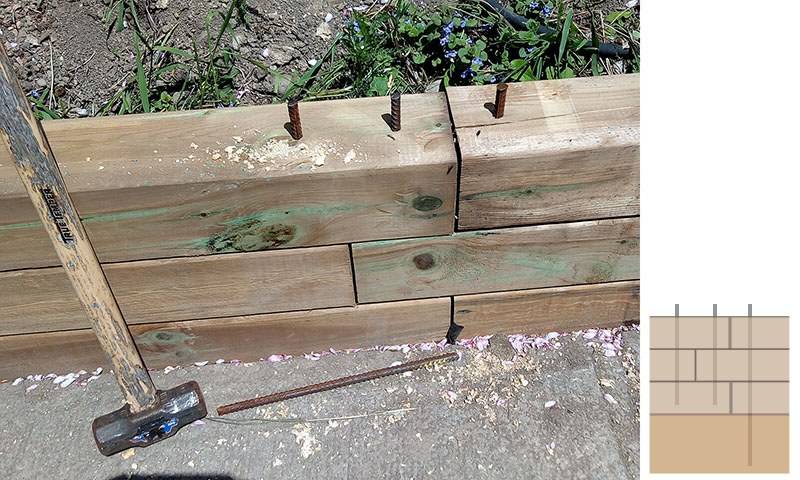
spikes.jpg
 
Engineering news on Phys.org
You lapped the upper and lower sections identically. If you had staggered them successively, you could have used just 2 spikes

244497


You don't want to line them up identically, because then you have a pivot point(*) where they line up. The way I've shown it, there is no single pivot point. It's not a LOT better than lining them up but it IS somewhat better.

* or what you might think of as a push point
 
Last edited:
  • Like
  • Informative
Likes   Reactions: anorlunda and Bystander
[size=small]added in edit.[/size]
How did I end up needing three spikes to stitch one section of wall?

Or worded differently: You needed to immobilize the ends of each timber.
 
Last edited:
Tom.G said:
Or worded differently: You need to immobilize the ends of each timber.
No, that's too vague. His technique did that, but he used 3 spikes. To really immobilize the ends of each timber, you'd need 4 spikes. Dave's goal was to reduce it to 2 spikes.
 
Three spikes are required if he wants to insure that the wall sections act as a continuous structure.
 
  • Like
Likes   Reactions: russ_watters
JBA said:
Three spikes are required if he wants to insure that the wall sections act as a continuous structure.
Seems to me it would be 4. How do you get 3?
 
The three spikes fix the relative position of all bars along the direction of the wall.

Proof that you need three as soon as you have two layers and if you cannot use the ground: Layer 1 has two elements, they both need a spike through them. To fix their relative position these two need to go through the same element in a different layer. But then the second element in that layer doesn’t have a spike going through it - we need one more spike.
 
phinds said:
You lapped the upper and lower sections identically. If you had staggered them successively, you could have used just 2 spikes

View attachment 244497

You don't want to line them up identically, because then you have a pivot point(*) where they line up. The way I've shown it, there is no single pivot point. It's not a LOT better than lining them up but it IS somewhat better.

* or what you might think of as a push point
Sure, but I could have done the same two spikes with my staggered arrangement: #1 and #3 would have immobilized the ends, just like yours:
spikes2.png
Thing is: both your and my 2-spike implementation have the same flaw: the two sides are not stitched to each other - only to the ground. If you pushed inward on one side or the other, the stitch would still shear.EDIT: OK, I see you qualified it, recognizing that there is still some give in your joint, just not as much as in mine.
 
phinds said:
Seems to me it would be 4. How do you get 3?
I see 3 as well. How do you get 4?
In my initial diagram, all ends are secure.
 
  • #10
The design I used on the original wall only required one spike. I was making curved wall, so a single pivot was desirable.
spikes3.png

This time the walls are straight. I made what I thought was a minor change without fully considering the consequences.
 
  • #11
DaveC426913 said:
I see 3 as well. How do you get 4?
In my initial diagram, all ends are secure.
Yeah, but your upper and lower on the right can pivot around the spike. You'd need another spike over there to make it such that every beam has 2 spikes, so that it cannot pivot.
 
  • #12
phinds said:
Yeah, but your upper and lower on the right can pivot around the spike. You'd need another spike over there to make it such that every beam has 2 spikes, so that it cannot pivot.
But they cannot pivot since they're secure at the other end.
 
  • #13
DaveC426913 said:
But they cannot pivot since they're secure at the other end.
Ah, well in that case two spikes should be fine as in your post #8. I had not realized that you needed them stitch to each other, thus my post #2. With that caveat, your post #10 shows a good solution except for the obvious extra work of making the lap joints.
 
  • #14
phinds said:
I had not realized that you needed them stitch to each other
One winter of ground heave would put them out of true if they weren't secure.

phinds said:
your post #10 shows a good solution except for the obvious extra work of making the lap joints.
And that it's much less pretty.
 
  • #15
DaveC426913 said:
And that it's much less pretty.
Oh, I think that's in the eye of the beholder, but since you are the beholder ...
 
  • #16
You appear to be making chains of links.
You seem to require the ends of all bars to be pinned.

The left pin correlates all the bars of the left link.
The right pin correlates all the bars of the right link.
The middle pin is a hinge pin that joins the interlocked fingers of two links.

Avoid the situation where finger joints are irregular and not alternately aligned.
 
  • #17
Why not over lap more? Cut one of the 6x6 in half, go from there.

244590
 

Attachments

  • 1559669480188.png
    1559669480188.png
    250 bytes · Views: 341
  • #18
A couple of years ago I built a similar wall, on a slope. The slope enables almost every length to be a single timber, with one pin at each end, progressively stepping down.

But at the bottom there is a corner, which if I remember correctly matches your 3-pin configuration.
 

Similar threads

Replies
40
Views
5K
Replies
3
Views
3K
  • · Replies 1 ·
Replies
1
Views
2K
  • · Replies 86 ·
3
Replies
86
Views
10K
  • · Replies 11 ·
Replies
11
Views
3K
  • · Replies 10 ·
Replies
10
Views
4K
  • · Replies 59 ·
2
Replies
59
Views
3K
  • · Replies 28 ·
Replies
28
Views
15K
Replies
5
Views
2K
  • · Replies 15 ·
Replies
15
Views
4K