Discussion Overview
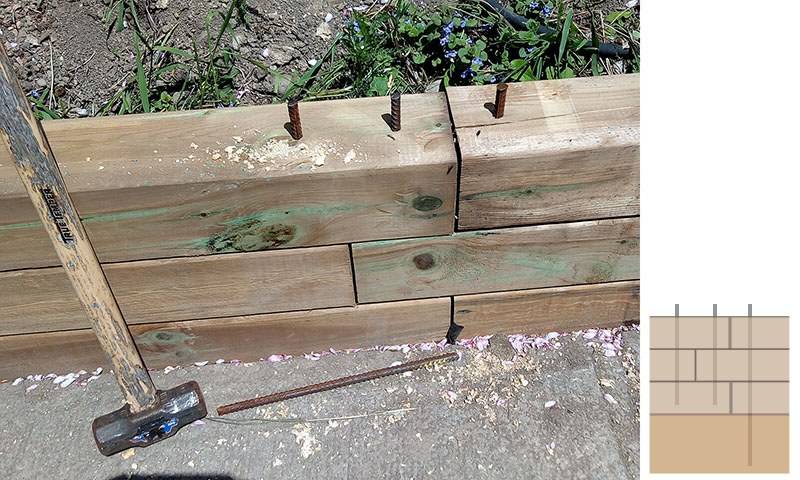
The discussion revolves around the construction of a wall using spikes to secure timber sections together. Participants explore the number of spikes required for stability and structural integrity, considering various arrangements and techniques. The conversation includes practical applications and technical reasoning related to construction methods.
Discussion Character
- Technical explanation
- Debate/contested
- Exploratory
Main Points Raised
- Some participants suggest that initially only one spike was thought necessary, but two or three are actually required for stability.
- One participant argues that staggering the upper and lower sections could reduce the number of spikes needed to two.
- Another participant contends that to immobilize the ends of each timber effectively, four spikes may be necessary, while others maintain that three spikes could suffice.
- There is a discussion about the implications of using different arrangements, with some asserting that the design must prevent pivot points to ensure structural integrity.
- Participants debate the effectiveness of different configurations, with some claiming that their designs secure all ends while others point out potential weaknesses in the arrangements.
- One participant reflects on a previous experience building a wall on a slope, noting that it allowed for simpler construction with fewer spikes.
Areas of Agreement / Disagreement
Participants express differing views on the number of spikes required, with no consensus reached. Some argue for three spikes, while others suggest four may be necessary. The discussion remains unresolved regarding the optimal configuration for securing the wall.
Contextual Notes
Participants highlight the importance of preventing pivot points and ensuring that all timber ends are secured, but there are varying interpretations of how many spikes are needed to achieve this. The discussion also touches on the aesthetic considerations of different construction methods.