How much force will be experienced by the sidewall?

  • Context: Engineering 
  • Thread starter Thread starter qnach
  • Start date Start date
  • Tags Tags
    Force Inelastic
Click For Summary

Discussion Overview

The discussion revolves around the forces experienced by the sidewalls of a V-shaped depression filled with inelastic but deformable material when a force is applied from above. Participants explore the relationship between the applied force and the forces acting on the sides, considering the material properties and geometry involved.

Discussion Character

  • Technical explanation
  • Mathematical reasoning
  • Debate/contested

Main Points Raised

  • One participant describes the setup involving a V-shaped depression filled with inelastic but deformable material and queries the force experienced by the sides when pressed from above.
  • Another participant proposes a relationship where the force experienced by the sides is given by the equation ##F = 2N \sin\theta##, with ##N## being the force from a side and ##\theta## the angle from the vertical.
  • A participant questions the definition of "inelastic but deformable," suggesting that the force applied is not large enough to cause significant deformation, thus justifying the inelastic classification.
  • Concerns are raised about the validity of using ##\sin\theta## in the force equation, with a suggestion that the applied force should be denoted as ##P## instead of ##F##.
  • Another participant asks about the distribution of the remaining force for various angles and depths, indicating a need for clarification on how forces balance in this scenario.
  • A later reply introduces the concept of pressure integration over the side area to derive the force ##N##, represented as ##\mathbf{N} = \int p \ d\mathbf{S}##.

Areas of Agreement / Disagreement

Participants express differing views on the definitions and implications of the material properties, the validity of the mathematical relationships proposed, and the distribution of forces, indicating that the discussion remains unresolved with multiple competing perspectives.

Contextual Notes

There are limitations in the discussion regarding the assumptions made about the material behavior, the definitions of terms used, and the mathematical steps involved in deriving the forces acting on the sidewalls.

qnach
Messages
154
Reaction score
4
Homework Statement
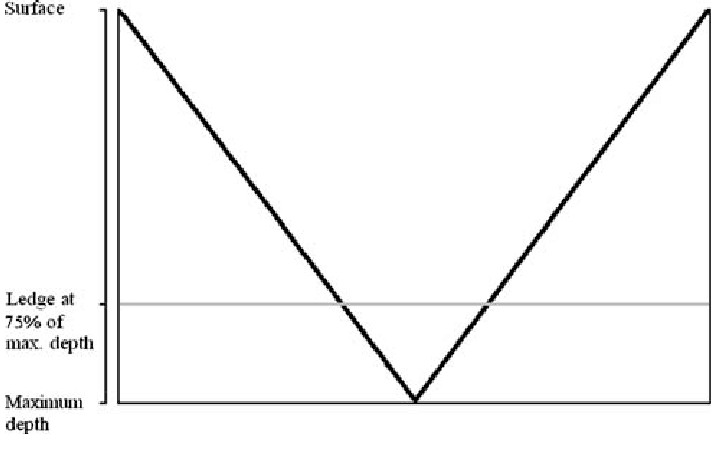
I have a V-shape depression (2-dimensional) with inelastic but deformable material filled.
If the material is pressed atop, how much force will be experienced by the sides?
Relevant Equations
none.
I have a V-shape depression (2-dimensional) with inelastic but deformable material filled.

If the material is pressed atop, how much force will be experienced by the sides?

Schematic-of-a-V-shaped-dive-including-the-ledge-of-the-dive-This-V-dive-does-not-have.png
 
Physics news on Phys.org
Hi.
Say F is force atop, it is equal to ##2N\ sin\theta## where ##\theta## is angle of both the sides from vertical line and N is force from a side.
[tex]N=\frac{F}{2 \sin\theta}[/tex]
 
qnach said:
Homework Statement:: I have a V-shape depression (2-dimensional) with inelastic but deformable material filled.
If the material is pressed atop, how much force will be experienced by the sides?
Relevant Equations:: none.

I have a V-shape depression (2-dimensional) with inelastic but deformable material filled.

If the material is pressed atop, how much force will be experienced by the sides?

View attachment 274375
What do you define as "inelastic but deformable?"
 
Chestermiller said:
What do you define as "inelastic but deformable?"

Yes, your criticism is correct. The force is not large, therefore will not result in large deformation hence can be considered as inelastic. Deformation, such as sands are deformable but inelastic.
 
mitochan said:
Hi.
Say F is force atop, it is equal to ##2N\ sin\theta## where ##\theta## is angle of both the sides from vertical line and N is force from a side.
[tex]N=\frac{F}{2 \sin\theta}[/tex]
How did you got the result? I am not sure about the [tex]\sin \theta[/tex], but the force F should be P presumably.
 
Please find attached sketch to show balance of vertical forces.
 

Attachments

  • img20201220_11054639.jpg
    img20201220_11054639.jpg
    31.5 KB · Views: 178
mitochan said:
Hi.
Say F is force atop, it is equal to ##2N\ sin\theta## where ##\theta## is angle of both the sides from vertical line and N is force from a side.
[tex]N=\frac{F}{2 \sin\theta}[/tex]
Then where does the rest of the force go, for all angles and depths?
 
Tom.G said:
Then where does the rest of the force go, for all angles and depths?
N comes from area integration of pressure on a side
[tex]\mathbf{N}=\int p \ d\mathbf{S}[/tex]
 

Similar threads

  • · Replies 2 ·
Replies
2
Views
3K
  • · Replies 2 ·
Replies
2
Views
1K
  • · Replies 7 ·
Replies
7
Views
2K
Replies
5
Views
4K
Replies
5
Views
10K
Replies
8
Views
3K
  • · Replies 1 ·
Replies
1
Views
2K
  • · Replies 3 ·
Replies
3
Views
2K
  • · Replies 5 ·
Replies
5
Views
4K
  • · Replies 3 ·
Replies
3
Views
3K