How to apply Lenz' law if we don't know what to oppose?

  • Context: High School 
  • Thread starter Thread starter Frigus
  • Start date Start date
  • Tags Tags
    Apply Law Lenz
Click For Summary
SUMMARY

This discussion focuses on applying Lenz's Law to determine the direction of induced current in loops subjected to changing magnetic flux. The participants analyze three loops with varying magnetic field conditions, concluding that the induced current flows counter-clockwise for an increasing magnetic field and clockwise for a decreasing field. The right-hand rule is emphasized as a method to ascertain the direction of current flow based on the induced magnetic field's opposition to the change in flux. Additionally, the significance of understanding the integral forms of Faraday's Law is highlighted for deeper comprehension.

PREREQUISITES
  • Understanding of Lenz's Law and its implications in electromagnetism
  • Familiarity with magnetic flux and its positive and negative representations
  • Knowledge of the right-hand rule for determining current direction
  • Basic concepts of Faraday's Law of electromagnetic induction
NEXT STEPS
  • Study the integral forms of Faraday's Law and its application in electromagnetism
  • Learn about the right-hand rule and its applications in determining current direction
  • Explore the concept of magnetic flux and its calculations in various scenarios
  • Review line integrals and their relevance in physics, particularly in work done by forces
USEFUL FOR

Students and educators in physics, particularly those studying electromagnetism, electrical engineering, and anyone seeking to understand the principles of induced currents and magnetic fields.

Frigus
Messages
337
Reaction score
163
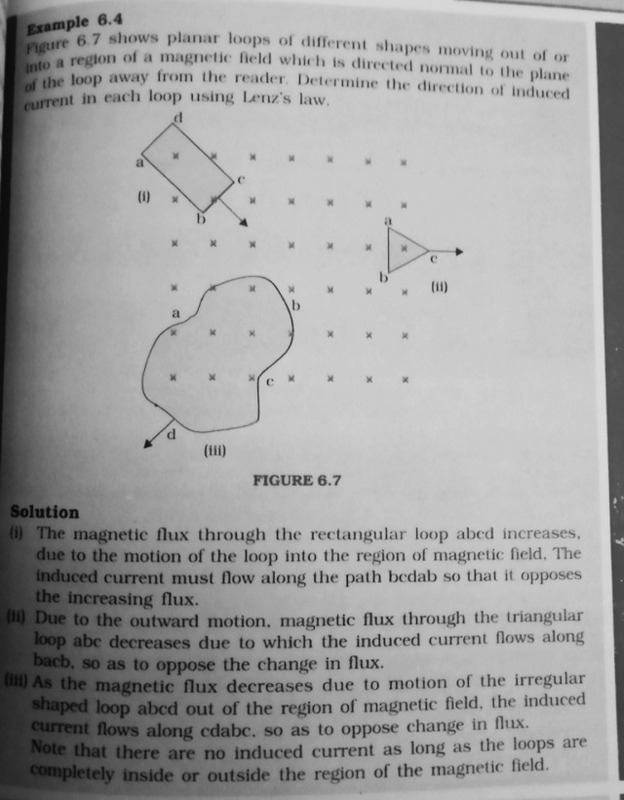
In this question
38c182da5dc74991a245b6ad3b30e60ca212da60.jpg

I can't understand how the loop is opposing the change in flux,
I can solve it by simply imagining a bar magnetic with south pole pointing outwards placed inside the plane of image but how do I know that it is the same case as that of bar magnet?
What if their is a case in which the phenomenon is opposed if induced dipole moment is directed along the magnetic field?
 
Physics news on Phys.org
(1) look at the direction of the flux through the loop (ignore any component of the field across the loop). In this case it is into the loop for all loops.

(2) determine if the field is increasing or decreasing (if it is neither increasing nor decreasing then stop, there is no induced current). For loop (i) it is increasing and for loops (ii) and (iii) it is decreasing.

(3) the change in the flux is in the same direction as the field (step 1) if it is increasing (step 2) or it is in the opposite direction if it is decreasing (step 3). For loop (i) the change in the flux is into the loop and for loops (ii) and (iii) it is out of the loop.

(4) the induced current will produce a field in the direction opposite the change in flux. For loop (i) that is out of the loop and for loops (ii) and (iii) it is into the loop.

(5) use the right hand rule to determine which direction the current needs to flow to produce that field (step 4). For loop (i) that is counter-clockwise and for loops (ii) and (iii) it is clockwise.
 
  • Like
Likes   Reactions: Frigus
Dale said:
(1) look at the direction of the flux through the loop (ignore any component of the field across the loop). In this case it is into the loop for all loops.
Please forgive me if I am going to do some highly stupendous thing,
Isn't flux a directionless quantity?
 
Hemant said:
Please forgive me if I am going to do some highly stupendous thing,
Isn't flux a directionless quantity.
No. It is not a vector, so it doesn't have a direction in the meaning of a vector, but it can be positive or negative and so it does have a sense. There is a difference between a positive flux and a negative flux, one representing flux one way through the loop and the other representing flux in the opposite sense.
 
  • Like
Likes   Reactions: etotheipi and Frigus
Dale said:
(1) look at the direction of the flux through the loop (ignore any component of the field across the loop). In this case it is into the loop for all loops.

(2) determine if the field is increasing or decreasing (if it is neither increasing nor decreasing then stop, there is no induced current). For loop (i) it is increasing and for loops (ii) and (iii) it is decreasing.

(3) the change in the flux is in the same direction as the field (step 1) if it is increasing (step 2) or it is in the opposite direction if it is decreasing (step 3). For loop (i) the change in the flux is into the loop and for loops (ii) and (iii) it is out of the loop.

(4) the induced current will produce a field in the direction opposite the change in flux. For loop (i) that is out of the loop and for loops (ii) and (iii) it is into the loop.

(5) use the right hand rule to determine which direction the current needs to flow to produce that field (step 4). For loop (i) that is counter-clockwise and for loops (ii) and (iii) it is clockwise.
Got it.
I think I was just making my life complex.
Thanks for the help😃.
 
  • Like
Likes   Reactions: Dale
I wonder if seeing how to obtain the integral forms of Faraday's law would help you to understand the directions. Take the differential form, ##\nabla \times \vec{E} = -\partial_t \vec{B}##, then integrate both sides like$$\int_S (\nabla \times \vec{E}) \cdot d\vec{S} = - \int_S \partial_t \vec{B} \cdot d\vec{S}$$and use Stokes' theorem$$\int_C \vec{E} \cdot d\vec{x} = - \frac{d}{dt} \int_S \vec{B} \cdot d\vec{S} = - \frac{d}{dt} \int_S \vec{B} \cdot \hat{n}dS$$Now ##\mathcal{E} = \int \vec{E} \cdot d\vec{x}## is the EMF, whilst ##\Phi = \int \vec{B} \cdot d\vec{S}## is the magnetic flux. Notice how, like @Dale mentioned, its sign depends on how you choose to orient the vector ##d\vec{S}##. The vector ##d\vec{x}## is in a direction given by the right hand rule, with your thumb in the direction of ##\hat{n}##. That means that if ##\mathcal{E} < 0##, the induced electric field (and by extension, the current) is going the opposite direction to your fingers. And the current loop results in a dipole moment ##\vec{\mu} = i\vec{S}##, where again the positive direction of ##i## is consistent with the right hand rule with your thumb along ##\vec{S}##.
 
Last edited by a moderator:
  • Like
  • Informative
Likes   Reactions: vanhees71, Frigus and Dale
etotheipi said:
I wonder if seeing how to obtain the integral forms of Faraday's law would help you to understand the directions. Take the differential form, ##\nabla \times \vec{E} = -\partial_t \vec{B}##, then integrate both sides like$$\int_S (\nabla \times \vec{E}) \cdot d\vec{S} = - \int_S \partial_t \vec{B} \cdot d\vec{S}$$and use Stokes' theorem$$\int_C \vec{E} \cdot d\vec{x} = - \frac{d}{dt} \int_S \vec{B} \cdot d\vec{S} = - \frac{d}{dt} \int_S \vec{B} \cdot \hat{n}dS$$Now ##\mathcal{E} = \int \vec{E} \cdot d\vec{x}## is the EMF, whilst ##\Phi = \int \vec{B} \cdot d\vec{S}## is the magnetic flux. Notice how, like @Dale mentioned, its sign depends on how you choose to orient the vector ##d\vec{S}##. The vector ##d\vec{x}## is in a direction given by the right hand rule, with your thumb in the direction of ##\hat{n}##. That means that if ##\mathcal{E} < 0##, the induced electric field (and by extension, the current) is going the opposite direction to your fingers. And the current loop results in a dipole moment ##\vec{\mu} = i\vec{S}##, where again the positive direction of ##i## is consistent with the right hand rule with your thumb along ##\vec{S}##.
I get stroke by listening to words like strokes theorem :nb) ,
These highly fancy things are beyond the scope of our course.
 
  • Wow
Likes   Reactions: etotheipi
Hemant said:
I get stroke by listening to words like strokes theorem :nb) ,
These highly fancy things are beyond the scope of our course.

It's not too fancy, but it is quite neat! It just tells you that, choose any curve ##C## and any surface ##S## which is bounded by that curve. Then the line integral of a vector field around ##C## equals the surface integral of the curl of that same vector field around the surface. That is$$\int_C \vec{F} \cdot d\vec{x} = \int_S (\nabla \times \vec{F}) \cdot d\vec{S}$$You'll notice that the surface integral of any vector field that can be expressed as the curl of another vector field, is the same for all surfaces with the same bounding curve! Since ##\vec{B} = \nabla \times \vec{A}##, the magnetic flux depends only on the bounding curve!
 
Last edited by a moderator:
  • Like
  • Informative
Likes   Reactions: vanhees71, Frigus and Dale
etotheipi said:
It's not too fancy, but it is quite neat! It just tells you that, choose any curve ##C## and any surface ##S## which is bounded by that curve. Then the line integral of a vector field around ##C## equals the surface integral of the curl of that same vector field around the surface. That is$$\int_C \vec{F} \cdot d\vec{x} = \int_S (\nabla \times \vec{F}) \cdot d\vec{S}$$You'll notice that the surface integral of any vector field that can be expressed as the curl of another vector field, is the same for all surfaces with the same bounding curve! Since ##\vec{B} = \nabla \times \vec{A}##, the magnetic flux depends only on the bounding curve!
Thanks ethopei,
I tried to understand what you have written and I got a mild sense of what you are trying to make me understand.
I have seen a video about line integral on Khan academy but i didn't worked too hard to understand it as it was out of my course.
Can you please tell me what concepts are required to understand this post so I can watch them on Khan academy to understand.
 
  • #10
If it's not relevant to your course then don't fret too much about it, it's more important to practice the theory you need for your exams.

The classic example for a line integral is work done by a force. Imagine that a particle moves along some trajectory under the influence of a force ##\vec{F}##. You could think about calculating the incremental works done by the force over lots of little incremental steps, each of say ##\Delta \vec{x}_i##. You would find that$$W = \sum_i \vec{F} \cdot \Delta \vec{x}_i$$The limiting case of such a process is an integral,$$W = \int_C \vec{F} \cdot d\vec{x}$$where ##C## is a curve that represents the trajectory of the particle.

If you do want to learn a bit more, you can try here:
https://tutorial.math.lamar.edu/classes/calciii/calciii.aspx
 
  • Like
Likes   Reactions: vanhees71 and Frigus

Similar threads

  • · Replies 6 ·
Replies
6
Views
6K
  • · Replies 1 ·
Replies
1
Views
1K
  • · Replies 20 ·
Replies
20
Views
6K
  • · Replies 7 ·
Replies
7
Views
4K
  • · Replies 1 ·
Replies
1
Views
2K
  • · Replies 7 ·
Replies
7
Views
4K
  • · Replies 3 ·
Replies
3
Views
2K
  • · Replies 2 ·
Replies
2
Views
2K
  • · Replies 24 ·
Replies
24
Views
4K
  • · Replies 2 ·
Replies
2
Views
2K