How to Calculate Fermi Energy for a 1D Lattice with 2 Electrons per K-State

Click For Summary
SUMMARY

This discussion focuses on calculating the Fermi energy for a one-dimensional lattice with two electrons per k-state. The key formula derived is the Fermi wavevector, k_F = 3\pi/a, based on the electron density and lattice length. The Fermi energy is calculated using E_F = \hbar^2 k_F^2 / (2m_e), where m_e is the mass of an electron, not the mass of aluminum. The choice of boundary conditions—periodic or fixed—affects the k-state spacing, which is 2\pi/L for periodic and \pi/L for fixed conditions.

PREREQUISITES
  • Understanding of Fermi energy and wavefunctions in quantum mechanics
  • Knowledge of k-space and its significance in solid-state physics
  • Familiarity with boundary conditions in quantum systems
  • Basic concepts of electron density and its relation to lattice structure
NEXT STEPS
  • Study the implications of periodic vs. fixed boundary conditions in quantum mechanics
  • Learn about the derivation of Fermi energy in 2D and 3D systems
  • Explore the concept of electron density in various lattice structures
  • Investigate the role of k-space in the behavior of conduction electrons
USEFUL FOR

Students and researchers in condensed matter physics, particularly those studying electronic properties of materials and quantum mechanics. This discussion is beneficial for anyone looking to deepen their understanding of Fermi energy calculations in different dimensional systems.

Sekonda
Messages
201
Reaction score
0
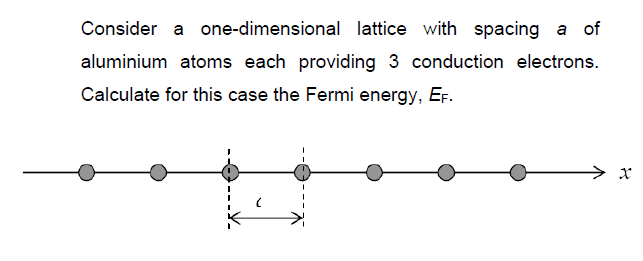
Hey I have a question pictured below:
frXNP.png


I always seem to struggle with questions like these, my understanding is we know the spacing of K-states throughout the lattice is given by

\frac{2\pi}{L}

Such that the fermi wavevector divided by this spacing and multiplied by 2 due to the fact there are 2 electrons per k-state gives us the total number of electrons:

N=\frac{k_{F}}{\frac{2\pi}{L}}\times 2

We also know that the total no. of electrons is given by the electron density multiplied by the the length of the lattice

N=nL=\frac{3L}{a}

Where I have said the electron density is equal to 3 conduction electrons divided by the unit cell length.

Equating the expressions to eliminate 'N' I attain

k_{F}=\frac{3\pi}{a}

Which to find the fermi energy I think I'd just use this equation but I'm not sure?

E_{F}=\frac{\hbar^{2}k_{F}^{2}}{2m_{al}}

Where 'm_al' is the mass of an aluminium atom?

Though I'm not sure I've done this correctly... I think I may need to have the fermi wavevector divided by 2 for it to be correct - not sure why I would need to do this though.


Anyway thanks for any help!
SK
 
Physics news on Phys.org
You want to use the mass of the electron rather than the mass of the aluminum atom since you are considering the energy states of conduction electrons.

Electrons can travel both ways on the lattice, so the allowed states cover negative as well as positive values of k. So, the range of k will be from ##-k_F## to ##+k_F##. Maybe this will fix your missing factor of 2.

[EDIT: I was assuming periodic boundary conditions for the lattice so you are dealing with running waves that can have + or - k. If you are using fixed boundary conditions so that you are dealing with standing waves, then you will have only positive values of k. But then the spacing for k will be ##\pi/L## rather than ##2\pi/L##.]
 
Last edited:
Ahh yes this makes more sense, Cheers man

SK
 
I'm a bit confused due to in previous examples to do with modelling the 2-Dimensional electron gas and the (3D) free fermion gas we used k-state spaced by 2pi/L

Though in my notes they seem to use pi/L, I'm rather confused, not sure why they would be different?

Like you said if we are assuming standing waves then the k-range is only positive and so we use pi/L but for running wave from -k to k have twice as many k-states so we use 2pi/L as the spacing.

How do I know if we are using running or standing waves and hence the spacing pi/L or 2pi/L

Thanks man,
SK
 
It can get confusing. The two ways just correspond to a different choice of boundary conditions. Both boundary conditions lead to the same result for anything important such as the Fermi energy.

For periodic boundary conditions, you require an integer number of wavelengths to fit into the length L. That makes the spacing of levels in k-space ##2\pi/L##. But you can have waves running in both directions (+ and - k).

For fixed boundary conditions, you have standing waves and so you need an integer number of half-wavelengths to fit into L. The spacing in k-space is now ##\pi/L##. But for standing waves, +k and -k give the same state, so you only count the +k states.

Anyway, you can use either boundary condition as long as you are consistent with your choice. Hope this helps.
 
Indeed it does, considering the choice of boundary conditions is independent of the result then since I have chose 2pi/L in the above what have I done wrong/what would I need to do and why to correct it?

Sorry if you've basically told me the answer already, I'm just confused because I'm looking at these other examples our professor has done for 2D and 3D and I have done exactly the same thing for 1D so I'd of thought the above result should be right... I'd of liked that :P

Thanks again,
SK
 
Overall, your calculation looks good to me except that if you are going to use periodic boundary conditions so that the k-spacing is ##2\pi/L## then the range of ##k## will be from ##-k_F## to ##+k_F##. So, the extension in k-space is ##2k_F##. Then your equation ##N = \frac{k_F}{2\pi/L}\times 2## would become ##N = \frac{2k_F}{2\pi/L}\times 2##.
 
I understand now what I was doing wrong, thanks again for walking me through this!

Thanks!
SK
 

Similar threads

  • · Replies 5 ·
Replies
5
Views
3K
  • · Replies 20 ·
Replies
20
Views
2K
Replies
1
Views
2K
  • · Replies 1 ·
Replies
1
Views
3K
  • · Replies 7 ·
Replies
7
Views
2K
  • · Replies 3 ·
Replies
3
Views
2K
  • · Replies 1 ·
Replies
1
Views
4K
  • · Replies 2 ·
Replies
2
Views
2K
  • · Replies 1 ·
Replies
1
Views
2K