How to calculate the energy of an arbitrary pulse

  • Context: Undergrad 
  • Thread starter Thread starter Abimbola1987
  • Start date Start date
  • Tags Tags
    Energy Pulse
Click For Summary
SUMMARY

This discussion focuses on calculating the energy of an arbitrary AC pulse using numerical integration techniques. Participants confirm that energy can be derived by integrating the product of voltage and current, emphasizing the importance of considering the DC component or average power at the fundamental frequency. The conversation highlights that for sinusoidal waves, the integration of voltage and current must account for their phase relationship to avoid miscalculating energy as zero. The use of Python for numerical integration is also mentioned as a practical approach for handling complex waveforms.

PREREQUISITES
  • Understanding of AC power concepts
  • Familiarity with numerical integration techniques
  • Basic knowledge of Python programming
  • Knowledge of waveforms and their properties
NEXT STEPS
  • Learn about integrating voltage and current waveforms in Python
  • Study the principles of rectification in AC circuits
  • Explore the use of Rogowski coils for current measurement
  • Investigate the calculation of average power in AC systems
USEFUL FOR

Electrical engineers, students studying AC circuits, and anyone involved in power analysis and waveform integration.

Abimbola1987
Messages
83
Reaction score
13
Dear Sirs,

I need to calculate the energy of the below pulse, as I'm new to dealing with AC I have some doubts on how to calculate it? I think I remember that in order to obtain energy one has to integrate the power, but I'm not sure.

Also I'm not sure how to deal with the calculation of average power as it is arbitrary AC?
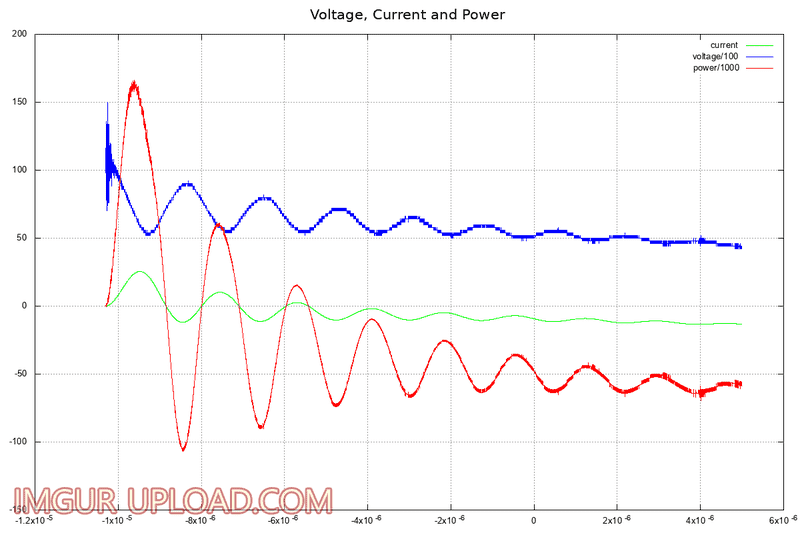
results.png


ps. the power trace is calculated not measured.

Thank you in advance.
 

Attachments

  • results.png
    results.png
    24.9 KB · Views: 776
Physics news on Phys.org
Yes, just integrate voltage times current.

But you may want just the DC component, or the average AC at the fundamental frequency. If so, you must be more specific.
 
Last edited:
  • Like
Likes   Reactions: Abimbola1987 and sophiecentaur
+1

It's the same as it would be for a sin wave AC, it's just that the integral (area under the curve) is easier to work out for a sin wave.

If really stuck with the integral you can even use squared paper to work it out!
 
  • Like
Likes   Reactions: sophiecentaur
Dear anorlunda and CWatters,

Thank you very much for your reply. I do have the data for the wave forms so I have written a small Python script to do the numerical integration.

For the purpose of my understanding; if the wave had a pure sine and you did numerical integration on that, it would equal zero as the negative areas would cancel out the positive, which would imply that the energy is zero? I which case my logic would dictate that the wave had to be offset in some way or have to be calculated with absolute values of y? The same conceptual pondering goes for average power, power is still power even if it's negative?
 
Yes the absolute value. Aka rectification.
 
  • Like
Likes   Reactions: Abimbola1987
Dear CWatters,

Thank you very much for clearing my uncertainty.

I wish you all the best.
Abimbola
 
Abimbola1987 said:
For the purpose of my understanding; if the wave had a pure sine and you did numerical integration on that, it would equal zero as the negative areas would cancel out the positive,

Which wave?

If V and I are both sin waves and in-phase with each other, then when they are +, V*I is +. When they are both -, V*I is + again. So the average of V is zero, the average of I is zero but the average of V*I is not zero.
 
anorlunda said:
Which wave?

I meant an imaginary sine wave e.g. the voltage of 220V AC

anorlunda said:
If V and I are both sin waves and in-phase with each other, then when they are +, V*I is +. When they are both -, V*I is + again. So the average of V is zero, the average of I is zero but the average of V*I is not zero.

Yes, I appreciate that, it seems logical.

Now that I have your attention, could I ask another question regarding integration of Rogowski coil output? Or should I create another post?
 
Abimbola1987 said:
Now that I have your attention, could I ask another question regarding integration of Rogowski coil output? Or should I create another post?

A new thread would be better.
 

Similar threads

  • · Replies 2 ·
Replies
2
Views
14K
Replies
7
Views
2K
  • · Replies 4 ·
Replies
4
Views
2K
Replies
19
Views
3K
  • · Replies 40 ·
2
Replies
40
Views
4K
  • · Replies 10 ·
Replies
10
Views
2K
  • · Replies 10 ·
Replies
10
Views
2K
  • · Replies 15 ·
Replies
15
Views
5K
  • · Replies 1 ·
Replies
1
Views
2K
  • · Replies 18 ·
Replies
18
Views
2K