How to calculate this 4 bit DAC

  • Thread starter Thread starter michael1978
  • Start date Start date
  • Tags Tags
    Bit
Join the discussion
Ask a follow-up here, or get your own question answered by working scientists, mathematicians and engineers — people, not an autocomplete.
Real named experts · corrections over time · the nuance an AI answer skips
8 replies · 3K views
michael1978
Messages
434
Reaction score
19
< Mentor Note -- thread moved to HH from the technical forums, so no Homework Help Template is shown >[/color]

please can somebody help me, how to calculate this 4 bit dac,
i know this one if input 1.1.1.1 5/2, 5/4 5/8 5/16 voltage

i don't understand nothing i search on the internet but i don't find some useful example,
my english is not so good...
please one more time can somebody explain me how to calculate, for formula thanks
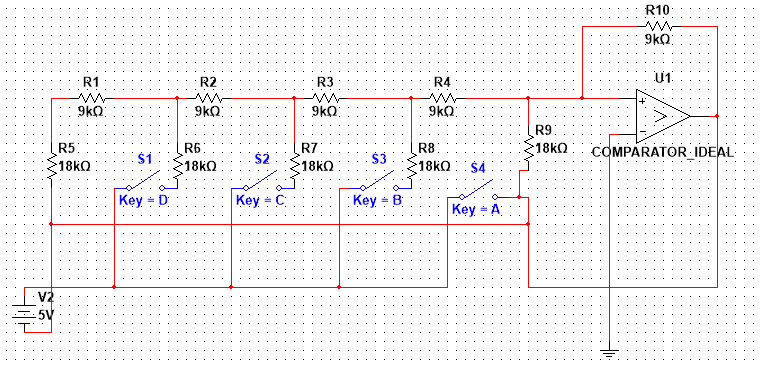
ice_screenshot_20170630-161958.png
 
Last edited by a moderator:
Physics news on Phys.org
michael1978 said:
i search on the internet but i don't find some useful example,
Try again, using the search terms R-2R ladder DAC.

After you have done that reading, try again to work your schoolwork problem and post your work here so we can check it.
 
BTW, can you check your circuit, as I think the op-amp has the inputs reversed.

Berkeman beat me to the rest of the comment.
 
  • Like
Likes   Reactions: berkeman
Merlin3189 said:
BTW, can you check your circuit, as I think the op-amp has the inputs reversed.
Good catch!
 
Merlin3189 said:
BTW, can you check your circuit, as I think the op-amp has the inputs reversed.

Berkeman beat me to the rest of the comment.
thank you a lot , it help me, thanks...
have nice night.
 
Also, you show the output component as a Comparator. It should be a Op-Amp, not a Comparator.
 
You really should look up another version of the R 2R ladder.
-1 if key A is closed, the positive supply is short circuited to the output of the op-amp. That won't end well.
2 R1 shouldn't be there.
3 The ampiflier you connect the R-2R ladder to should have infinite (much larger than R) imput resistance.
4 The inputs should be connected to either 0 or 5 volts, and not left unconnected.

The last point is essential to make make the superposition principle work. If you have a network of resistors and voltage sources, you can calculate the effect of a single voltage source by replacing all the other voltage sources with a wire. You can than sum those indivudual effects to get the output voltage. Replacing the voltage sources by open circuits won't work.
 
  • Like
Likes   Reactions: Merlin3189 and berkeman
willem2 said:
You really should look up another version of the R 2R ladder.
-1 if key A is closed, the positive supply is short circuited to the output of the op-amp. That won't end well.
2 R1 shouldn't be there.
3 The ampiflier you connect the R-2R ladder to should have infinite (much larger than R) imput resistance.
4 The inputs should be connected to either 0 or 5 volts, and not left unconnected.

The last point is essential to make make the superposition principle work. If you have a network of resistors and voltage sources, you can calculate the effect of a single voltage source by replacing all the other voltage sources with a wire. You can than sum those indivudual effects to get the output voltage. Replacing the voltage sources by open circuits won't work.
Good Morning

i solve all the problme with voltage divider i find all the values.
but the problem is, when i push key D, the voltage of D is the same(like i find it with voltage divider), but the voltage on c,b,a they have other value?
how do i calculate ?because i draw the circuit in gsm (every circuit)
thanks...
 
The circuit in post #1 is a weird mix of several ideas.
Please post your revised circuit diagram.
 

Attachments

  • R-2R-Imode-Vmode.png
    R-2R-Imode-Vmode.png
    23.3 KB · Views: 598
Last edited:
  • Like
Likes   Reactions: Merlin3189