How to determine angular velocity about a certain axis?

Click For Summary
SUMMARY

The discussion centers on determining the angular velocity of a crawling insect on a rotating disk. The angular velocity is defined as the rate of change of angular displacement, represented mathematically as ##\dfrac {d\theta} {dt}##. It is established that the insect shares the same angular velocity as the disk, denoted as ##\omega##, due to their identical angular displacements during any time interval. The relationship between tangential speed and angular velocity is also confirmed through the equation ##v = \omega \, r##, reinforcing that the insect's angular velocity matches that of the disk.

PREREQUISITES
  • Understanding of angular velocity and its mathematical representation
  • Familiarity with polar coordinates and their application in physics
  • Knowledge of tangential speed and its relationship to angular velocity
  • Basic principles of rotational motion
NEXT STEPS
  • Study the mathematical derivation of angular velocity in polar coordinates
  • Explore the relationship between tangential speed and angular velocity in depth
  • Learn about rotational dynamics and its applications in real-world scenarios
  • Investigate the effects of varying radius on angular velocity in rotating systems
USEFUL FOR

Students and professionals in physics, mechanical engineering, and robotics who are interested in understanding rotational motion and angular velocity concepts.

vcsharp2003
Messages
913
Reaction score
179
Homework Statement
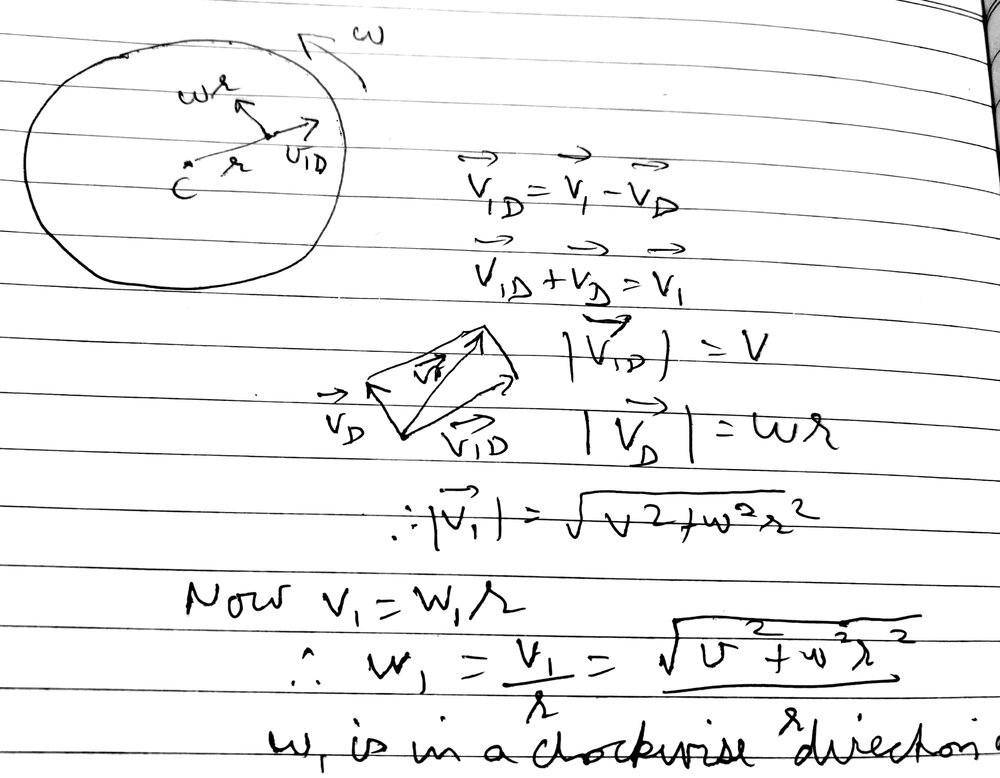
A disk is rotating counter clockwise at an angular speed of ##\omega## in a horizontal plane about its center. A small insect at its center starts to crawl outwards at a constant speed of ##v## relative to disk in a radial direction. What will be the angular velocity ( i.e. magnitude and direction) of the crawling insect at any instant?
Relevant Equations
v=wr
If the crawling insect were stationary at a certain instant of time, then it would have the same angular velocity as that of disk, which is w in a clockwise direction. But now it's velocity at any instant is the vector sum of velocity due to rotation and the velocity it crawls at. My attempt is as shown below.
CamScanner 04-24-2021 14.01.jpg
 
Physics news on Phys.org
What's the definition of angular velocity? How it is represented in polar coordinates?
 
PeroK said:
What's the definition of angular velocity?

The definition is as below.

Angular velocity = ##\dfrac {d\theta} {dt} ##

PeroK said:
How it is represented in polar coordinates?

This part is not clear. I know the polar coordinates at any instant for insect will be ##(r,\theta)##.
 
vcsharp2003 said:
The definition is as below.

Angular velocity = ##\dfrac {d\theta} {dt} ##
Isn't that your answer? That is using polar coordinates.
 
PeroK said:
Isn't that your answer? That is using polar coordinates.

Yes, since ##\theta## is one of the polar coordinates.
 
PeroK said:
Isn't that your answer? That is using polar coordinates.

It seems that the radius vector ##\vec r## is rotating at the angular velocity of the disk.
So the insect will also be having an angular velocity of w in a counter clockwise direction.
Is that the correct logic?
 
vcsharp2003 said:
It seems that the radius vector ##\vec r## is rotating at the angular velocity of the disk.
So the insect will also be having an angular velocity of w in a counter clockwise direction.
Is that the correct logic?
It must be.
 
  • Like
Likes   Reactions: vcsharp2003
vcsharp2003 said:
It seems that the radius vector ##\vec r## is rotating at the angular velocity of the disk.
So the insect will also be having an angular velocity of w in a counter clockwise direction.
Is that the correct logic?
Can I chip-in? - as it sounds like you may not be entirely convinced/confident.

Imagine a radius drawn on the disc and the insect walks along this radius.

During any time-interval Δt, the angular displacements of the disc and insect must be identical - because they are both the same as the angular displacement of the radius, Δθ.
 
  • Like
Likes   Reactions: vcsharp2003 and hutchphd
Steve4Physics said:
Imagine a radius drawn on the disc and the insect walks along this radius.

Yes, that makes it easier to understand since the drawn radius undergoes the same angular displacement as the disk. Very neat!
 
Last edited:
  • Like
Likes   Reactions: Steve4Physics
  • #10
PeroK said:
It must be.
I am trying an alternative approach as explained below. It seems correct to me.

In the formula, ##v ={\omega} \, r##, can we say that ##v## must always be the tangential speed at a distance ##r## from center of a rotating point?

If yes, then using the relative velocity vector diagram shown in my attempted solution, it can be said that ## V_{d}## is the tangential component of ##V_{i}##. Hence ##V_{d} = {\omega}_{i} \, r ##. It then follows that ##{\omega}_{i} = \dfrac {V_{d}} {r}=\dfrac { {\omega} \, r} {r} = {\omega} ##.
 
Last edited:
  • #11
vcsharp2003 said:
I am trying an alternative approach as explained below. It seems correct to me.

In the formula, ##v ={\omega} \, r##, can we say that ##v## must always be the tangential speed at a distance ##r## from center of a rotating point?

If yes, then using the relative velocity vector diagram shown in my attempted solution, it can be said that ## V_{d}## is the tangential component of ##V_{i}##. Hence ##V_{d} = {\omega}_{i} \, r ##. It then follows that ##{\omega}_{i} = \dfrac {V_{d}} {r}=\dfrac { {\omega} \, r} {r} = {\omega} ##.

The above fact of ##v## being tangential speed is absolutely correct according to some textbooks I consulted. Therefore, my approach as mentioned in post#10 is correct and an alternative approach to proving that angular velocity of insect at any instant is the same as angular velocity of disk.
 

Similar threads

Replies
67
Views
4K
  • · Replies 45 ·
2
Replies
45
Views
4K
  • · Replies 17 ·
Replies
17
Views
980
Replies
25
Views
2K
Replies
11
Views
2K
  • · Replies 11 ·
Replies
11
Views
2K
  • · Replies 9 ·
Replies
9
Views
2K
  • · Replies 32 ·
2
Replies
32
Views
2K
Replies
27
Views
3K
  • · Replies 40 ·
2
Replies
40
Views
4K