How to Express the Electric Field of a Dipole Along the Perpendicular Axis?

Click For Summary

Homework Help Overview

The discussion revolves around expressing the electric field of an electric dipole as a function of the perpendicular distance from the dipole axis. Participants are attempting to derive the electric field in terms of the electric dipole moment.

Discussion Character

  • Exploratory, Mathematical reasoning, Problem interpretation

Approaches and Questions Raised

  • Participants are discussing the derivation of the electric field expression, questioning the role of the x-component, and exploring the implications of calculating the electric field at a point along the x-axis. There are attempts to clarify the vector components of the electric field from the dipole charges.

Discussion Status

There is active engagement with various interpretations of the problem. Some participants are providing guidance on how to approach the vector addition of electric fields from the dipole's charges, while others express confusion about specific components and the overall direction of the resultant electric field.

Contextual Notes

Participants are working under the constraints of a homework assignment, which may limit the information they can use or the methods they can apply. There is an emphasis on understanding the resultant electric field rather than just the x-component.

pleasehelpme6
Messages
62
Reaction score
0
Electric Dipole Electric Field.. URGENT

Homework Statement


For the electric dipole shown in the figure, express the magnitude of the resulting electric field as a function of the perpendicular distance x from the center of the dipole axis in terms of the electric dipole moment, p.
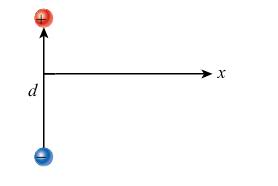
dipole.jpg

Homework Equations


E = Fq
P = qd
E = kq/(r^2)

The Attempt at a Solution


R = sqrt[(d/2)^2 + x^2]
q = P/d

Thus,

E = kP/{d*[sqrt(d/2)^2+x^2]^2}

Since I'm looking for the x-component, multiply E by the cos(theta), which in this case is x/R, or...

cos(theta) = x/sqrt[(d/2)^2+x^2]

so the answer i get is...

E = kP/{d*[sqrt(d/2)^2+x^2]^2} * x/sqrt[(d/2)^2+x^2]

which comes out to be...

E = kP/[sqrt(d/2)^2+x^2]^(3/2) * x/d
The final answer is actually...

E = kP/[sqrt(d/2)^2+x^2]^(3/2)

So my question is, what happens to the x/d?
 
Physics news on Phys.org


pleasehelpme6 said:

Homework Statement


For the electric dipole shown in the figure, express the magnitude of the resulting electric field as a function of the perpendicular distance x from the center of the dipole axis in terms of the electric dipole moment, p.

dipole.jpg


Homework Equations


E = Fq
P = qd
E = kq/(r^2)


The Attempt at a Solution


R = sqrt[(d/2)^2 + x^2]
q = P/d

Thus,

E = kP/{d*[sqrt(d/2)^2+x^2]^2}

Since I'm looking for the x-component, multiply E by the cos(theta), which in this case is x/R, or...

cos(theta) = x/sqrt[(d/2)^2+x^2]

so the answer i get is...

E = kP/{d*[sqrt(d/2)^2+x^2]^2} * x/sqrt[(d/2)^2+x^2]

which comes out to be...

E = kP/[sqrt(d/2)^2+x^2]^(3/2) * x/d


The final answer is actually...

E = kP/[sqrt(d/2)^2+x^2]^(3/2)

So my question is, what happens to the x/d?

You are not "looking for the x-component" (Quiz Question -- why not?)

You are looking for the net electric field as a function of the distance out on the x-axis. What direction is the resultant E field pointing?


The resultant E field would be a curved path, clockwise from the + to the - charge.

We're looking for the E field as a function of the perpendicular distance, but what does that mean if it's not the x-component?

And then, how do you go about solving for it?


pleasehelpme6 said:
The resultant E field would be a curved path, clockwise from the + to the - charge.

We're looking for the E field as a function of the perpendicular distance, but what does that mean if it's not the x-component?

And then, how do you go about solving for it?

They ask only for the E-field on the x-axis. That means you will solve for E(x). You do that by going to a point x on the x-axis, and adding up the two E-field vectors from the two point charges. Some of those vector components will cancel when they are added, and others will give a non-zero resultant.

On the figure shown, go to a point out on the x-axis to the right, and draw the two E-field vectors for the two point charges (only at that point). What would you get when you add those two vectors?


This is what I've come up with.

dipole2.jpg


but now I'm completely lost.


This is what else I've come up with...

EXred = red*cos(theta) --theta being the angle between the red vector and x-axis
EYred = red*sin(theta)

EXblue = blue*cos(theta) --angle between the blue vector and the x-axis
EYblue = blue*sin(theta)

so you add the X and Y directions, the X cancels out, and youre left with only Y?


pleasehelpme6 said:
This is what else I've come up with...

EXred = red*cos(theta) --theta being the angle between the red vector and x-axis
EYred = red*sin(theta)

EXblue = blue*cos(theta) --angle between the blue vector and the x-axis
EYblue = blue*sin(theta)

so you add the X and Y directions, the X cancels out, and youre left with only Y?

Very good! Now use the formula for E-field as a function of distance (the distance to the point x for each is the hypoteneus of each triangle, right?), and add up the y-components. You're almost there. Be sure to express the sum as a vector, saying which direction in y the resultant points.
 

Similar threads

  • · Replies 28 ·
Replies
28
Views
1K
Replies
1
Views
3K
  • · Replies 6 ·
Replies
6
Views
1K
Replies
3
Views
1K
  • · Replies 25 ·
Replies
25
Views
2K
Replies
2
Views
3K
  • · Replies 11 ·
Replies
11
Views
2K
  • · Replies 10 ·
Replies
10
Views
1K
Replies
7
Views
2K