How to find period of a SHM concerning a cube and spring?

Click For Summary
SUMMARY

The discussion focuses on calculating the period of simple harmonic motion (SHM) for a 4.00 kg cube connected to a spring (k = 1400 N/m) when rotated at an angle of 4.00°. The relevant equations include the moment of inertia (I = (1/6)Md²), restoring force (F = -kx), and the relationship between angular frequency (ω) and period (T = 2π/ω). The participants emphasize the importance of deriving the correct differential equation for angular motion and applying the small angle approximation for sine to simplify calculations.

PREREQUISITES
  • Understanding of simple harmonic motion (SHM) principles
  • Knowledge of rotational dynamics and torque
  • Familiarity with moment of inertia calculations
  • Ability to derive and solve differential equations
NEXT STEPS
  • Learn how to derive the differential equation for angular motion in SHM
  • Study the small angle approximation and its application in oscillatory motion
  • Explore the relationship between torque and angular frequency in rotational systems
  • Investigate the moment of inertia for various shapes and its impact on rotational dynamics
USEFUL FOR

Students studying physics, particularly those focusing on mechanics and oscillatory motion, as well as educators seeking to clarify concepts related to SHM and rotational dynamics.

Ari
Messages
3
Reaction score
0
1. Homework Statement
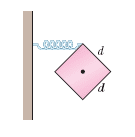
The 4.00 kg cube in the figure has edge lengths d = 8.00 cm and is mounted on an axle through its center. A spring ( k = 1400 N/m ) connects the cube's upper corner to a rigid wall. Initially the spring is at its rest length. If the cube is rotated 4.00° and released, what is the period of the resulting SHM?
bvCDWNW.png


m = 4 kg
d = .08 m
k = 1400 N/m
Θ = 4°
T = ?

2. Homework Equations
I = (1/6)Md2
F = ma
F = -kx = -(mω2x)
k = mω2
τ = -d(FgsinΘ)

3. The Attempt at a Solution
Restoring force is:
F = -kx while x = dsinΘ so...
F = -kdsinΘ
F = -(1400)(.08)sin(4°)
F = -7.8127 N

Newton's 2nd Law gives:
F = ma = F/m
a = (-7.8127)/4 = -1.9532

Using k = mω:
k = mω
ω = k/m = 1400/4 = 350

Using F = -kx:
x = F/-k
x = (-7.8127)/(-1400) = .00558 m

Restoring torque is:
τ = -dmgsinΘ while τ = Iα so...
Iα = -dmgsinΘ
α = -(.08)(4)(9.81)sin(4°) = -.219

Rotational to linear:
a = αr , r = .1131 m
a = -.0248

I'm not sure where to go with this further, and to be honest, not even sure if I'm going in the right direction.
Another thing is I'm not sure whether I'm supposed to use T = 2π √(m/k) or another equation, since that equation is for SHM of springs, but I can't seem to get anywhere with it.
 

Attachments

  • bvCDWNW.png
    bvCDWNW.png
    994 bytes · Views: 1,566
Physics news on Phys.org
The equation of motion for a mass suspended by a spring is a = d^2 y/dt^2 = (k/m) y which leads to a period, T = 2 pi sqrt(m/k) What you want to set up is an equation for alpha (the angular acceleration) (the second derivative of theta with respect to time) in terms of theta. You can then find the period in terms of the coefficient of theta analogous to the simple spring-mass problem.
 
Ari said:
x = dsinΘ
Check that.
Ari said:
the cube's upper corner
That does not match the picture, which shows one edge uppermost, not one corner. I would guess the diagram is as intended.
Ari said:
If the cube is rotated 4.00°
Is this relevant? In SHM, does the frequency depend on the amplitude?
Ari said:
Using k = mω:
That is for a mass moving linearly on the end of a spring. It does not apply here. What kind of motion is this? Do you know any frequency formula for this kind of motion? If not, can you derive the differential equation for the motion?
 
haruspex said:
Check that.

That does not match the picture, which shows one edge uppermost, not one corner. I would guess the diagram is as intended.

Is this relevant? In SHM, does the frequency depend on the amplitude?

That is for a mass moving linearly on the end of a spring. It does not apply here. What kind of motion is this? Do you know any frequency formula for this kind of motion? If not, can you derive the differential equation for the motion?

This would be a rotational motion I believe, since you are applying a force that causes the cube to turn, which would be angular frequency ω.
The only equation I know relating to angular frequency ω would be ω = 2π/T = 2πf.

And for the diagram, the cube's upper corner would be concerning the corner attached to the spring I believe.
 
Ari said:
The only equation I know relating to angular frequency ω would be ω = 2π/T = 2πf
Need to be careful with use of ω in rotational oscillation. The displacement is an angle,θ say. It is common to write ω for ##\dot\theta## in other contexts, but this is different from the ω in the sin(ωt) in SHM, so better not to do that here.
θ is analogous to the x in linear oscillation, so ##\dot\theta## is like ##\dot x##. Stick to the ##\dot\theta## and ##\ddot\theta## notation.
Think about torque and angular acceleration and try to write the differential equation for θ.*
Ari said:
And for the diagram, the cube's upper corner would be concerning the corner attached to the spring I believe.
Yes, but the diagram does not show an upper corner of a cube so attached, it shows the middle of one edge attached, or maybe a corner of a square lamina. Suspend a cube by one corner and view it from the side. Does it look like the diagram?

*Edit: Actually, you almost had it in post #1, but you made the mistake of plugging in the initial angle instead of leaving it as a general equation relating θ to α (##=\ddot\theta##).
And as Dr Dr news posts, you need to use the small angle approximation for sine. You have come across that with pendulums, I would think.
 
Last edited:
The point is that having solved one differential equation say d^2 x/dt^2 = -(k/m) x, x = A sin ϖt, ω = sqrt(k/m) Any other differential equation of the same form say d^ θ/dt^2 = -(τ/I) θ will have a similar solution. θ = A sin ωt , ϖ = sqrt(τ/I) , τ is the restoring torque and I is the moment of inertia. one other consideration, the restoring torque is proportional to sin θ which for small θ, can be approximated by θ.
 
Last edited:

Similar threads

Replies
3
Views
1K
Replies
24
Views
4K
  • · Replies 17 ·
Replies
17
Views
4K
  • · Replies 4 ·
Replies
4
Views
3K
  • · Replies 8 ·
Replies
8
Views
3K
  • · Replies 20 ·
Replies
20
Views
2K
  • · Replies 1 ·
Replies
1
Views
1K
  • · Replies 6 ·
Replies
6
Views
2K
  • · Replies 14 ·
Replies
14
Views
2K
Replies
12
Views
11K