How to get to this KVL expression

  • Thread starter Thread starter nhrock3
  • Start date Start date
  • Tags Tags
    Expression Kvl
Click For Summary

Discussion Overview

The discussion revolves around the application of Kirchhoff's Voltage Law (KVL) in a specific circuit, focusing on the derivation of a KVL expression. Participants are examining the relationships between voltages across various components and the correct formulation of the KVL equation.

Discussion Character

  • Technical explanation
  • Debate/contested
  • Mathematical reasoning

Main Points Raised

  • One participant presents a KVL equation derived from a circuit diagram but questions its correctness, particularly regarding the interpretation of voltage terms.
  • Another participant points out that the last term in the proposed KVL equation is in units of current, not voltage, suggesting a misunderstanding in the formulation.
  • There is a discussion about the definitions of voltages V_L, V_C, and V_R, with some participants asserting that these should represent voltage drops across components rather than node voltages.
  • One participant emphasizes the importance of referencing voltages to ground and clarifies that V_C should represent the voltage drop across the capacitor, while V_R represents the voltage drop across the resistor.
  • Several participants express confusion about the correct KVL equation and seek clarification on how to properly apply KVL to the circuit in question.

Areas of Agreement / Disagreement

Participants do not reach a consensus on the correct KVL equation. There are competing interpretations of how voltages should be defined and applied in the context of KVL.

Contextual Notes

Participants highlight that the definitions of voltages and their references to ground are critical to correctly applying KVL. There is an unresolved issue regarding the specific relationships between the voltages across circuit elements and the formulation of the KVL equation.

nhrock3
Messages
403
Reaction score
0
in this photo there is the circuit and the KVL of the solution
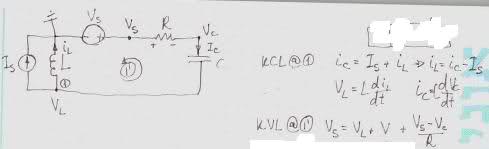
5aov46.jpg


but when i tried to do the KVL
i go from the arc(3 lines represents potential zero)
in counter clockwise direction
so i get[tex]V_L + V_C+V_R-V_s=0[/tex]
when i go against the direction of a current the voltage is on PLUS
when in the voltage source i go from + to - we have -V_s

so where is my mistake
i can't figure out how to get to the expression they got from my expression
?
 
Last edited:
Physics news on Phys.org
Are you saying that the KVL equation you have drawn in that picture is the solution you should arrive to? The equation looks incorrect as the last term is in units of current, not voltage. The summation of voltages should never equal units of current.

The solution aside I would recommend you look at what you are defining as VL, and VC. These values are just assigned to particular nodes in the circuit. They don't describe the voltage drop across elements.

See this circuit below for the difference. It's not the node voltage at the "+" end of the capacitor that's important, it's the voltage at the "+" end of the capacitor relative to the "-" end of the capacitor. Same applies for the inductor and the resistor.

http://img6.imageshack.us/img6/7553/0210001730.jpg"
 
Last edited by a moderator:
yes you are correct its current not a voltagedoes my logic in finding the KVL correct?
 
Last edited:
nhrock3 said:
what do you mean "as the last term is in units of current, not voltage"
the last is just VS its not a curent

Sorry for any confusion, I was referring to the KVL equation in the image you posted. The equation reads:

[tex]V_S=V_L+V+\frac{V_S-V_C}{R}[/tex]​

V/R gives a current, that's all I was saying.
 
nhrock3 said:
does my logic in finding the KVL correct?

No the logic you have used in finding the equation, [tex]V_L+V_C+V_R-V_S=0[/tex] is incorrect.


The voltage V_c does not represent the voltage drop across the resistor that is needed for the KVL loop. It is the voltage at that node relative to ground. So it is the voltage across the resistor plus the voltage supplied by the voltage source.

Take a look at the image I linked to earlier. The voltages in that image are the voltages across each circuit element rather then the voltage at a particular node relative to ground. Do a KVL loop of that circuit and substitute the values of each voltage with the corresponding equation I listed with the image. Your KVL equation should give you a second order differential equation in terms of I_L and I_c. Use the KCL equation you showed in your image in the OP and you can get the differential equation in terms of either I_L or I_c with respect to V_S and I_S.
 
"V_c does not represent the voltage drop across the resistor"

V_c represents the drop accros the capacitor

V_r represent the voltage drop across the resistor
 
In your drawing the node V_c is labeled as a the voltage level at a particular node. With the location of the ground in your circuit one would assume that unreferenced node voltages are referenced to ground. This would make V_c the voltage drop across the resistor and the voltage source, not the capacitor even though that's what you really want V_c to be. Look how the circuit I drew is different.
 
"V_c is the voltage across the resistor plus the voltage supplied by the voltage source"
i agree.
so what is the correct KVL?
 
what is the correct KVL equation you think?
 
  • #10
anyone??
i can't understand what is the right kvl
?
 

Similar threads

Replies
0
Views
2K
  • · Replies 6 ·
Replies
6
Views
2K
  • · Replies 3 ·
Replies
3
Views
2K
  • · Replies 1 ·
Replies
1
Views
2K
Replies
1
Views
2K
  • · Replies 11 ·
Replies
11
Views
5K
  • · Replies 2 ·
Replies
2
Views
2K
  • · Replies 7 ·
Replies
7
Views
2K
  • · Replies 2 ·
Replies
2
Views
4K
  • · Replies 4 ·
Replies
4
Views
3K