How Do You Determine Node Voltage in a Circuit with Identical BJTs?

Click For Summary

Discussion Overview

The discussion revolves around determining node voltages in a circuit containing identical bipolar junction transistors (BJTs). Participants explore various methods for calculating the reference voltage (Vref) and the implications of using Kirchhoff's Voltage Law (KVL) in their analyses. The conversation includes conceptual clarifications and personal reflections on understanding node voltages.

Discussion Character

  • Exploratory
  • Technical explanation
  • Conceptual clarification
  • Debate/contested
  • Mathematical reasoning

Main Points Raised

  • One participant suggests that Vref should be treated as a voltage source for circuit analysis, but questions arise about the validity of this approach.
  • Another participant expresses uncertainty about the results obtained from KVL and questions whether a test source could affect the outcomes.
  • There is a discussion about the relationship between Vref and the base-emitter voltages (Vbe), with some participants asserting that Vref equals 2Vbe based on their understanding of voltage drops.
  • Several participants reflect on their confusion regarding node voltages, proposing that node voltage should be viewed as a measurement between two points, specifically referencing the use of a voltmeter.
  • One participant shares a personal strategy of using a voltage divider to clarify their understanding of node voltages and how changing the reference point affects voltage measurements.

Areas of Agreement / Disagreement

Participants express varying levels of confidence in their methods for determining node voltages, with some agreeing on the relationship between Vref and Vbe, while others remain uncertain about the application of KVL and the use of test sources. The discussion does not reach a consensus on the best approach to find Vref.

Contextual Notes

Participants highlight potential limitations in their understanding of node voltages and KVL, including the impact of reference points and the role of test sources in circuit analysis. There is an acknowledgment of the complexity involved in these concepts.

Who May Find This Useful

This discussion may be useful for students or individuals seeking to deepen their understanding of node voltage analysis in circuits, particularly those involving BJTs and KVL. It may also benefit those grappling with conceptual challenges related to voltage measurements and reference points.

Boltzman Oscillation
Messages
233
Reaction score
26
Homework Statement
All the BJTs are the same, prove Vref = 2Vbe
Relevant Equations
KVL, ohms law, BJT properties
I am given that all the BJTs are the same.

First of all, when finding node voltages like Vref should I make the node voltage a voltage source first and then do circuit analysis? If so then I would use KVL but that does not give me Vref = 2Vbe.

I do know that Vref = Vb1 = Vb2. What am I doing wrong here? How would you find Vref?
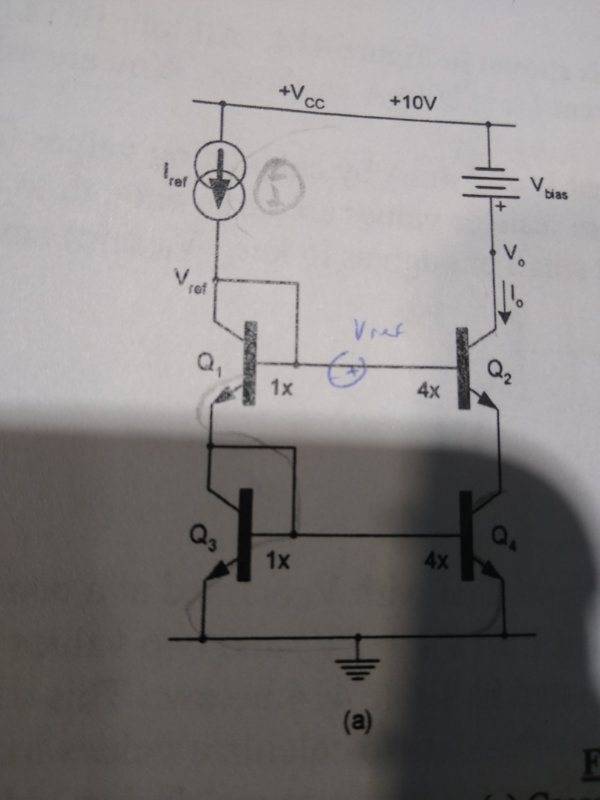
IMG_20200411_011228657.jpg
 
Physics news on Phys.org
What is KVL giving you? I apologize if I'm being silly, but at a first glance I would say ##2V_{be}## too.

edit:

I was thinking about your test source. I'm not confident with that approach. Couldn't the test source have a nonzero current affect your results? You can use KVL just as it is.
 
Last edited:
Joshy said:
What is KVL giving you? I apologize if I'm being silly, but at a first glance I would say ##2V_{be}## too.

edit:

I was thinking about your test source. I'm not confident with that approach. Couldn't the test source have a nonzero current affect your results? You can use KVL just as it is.

Yeah I can't use KVL around the entire circuit unless I take into consideration the current source. I am almost sure now that the node voltage was found by adding all of the voltage drops between Vref and ground. That would be the Vbe1 and Vbe3. Since they are the same then they add up to 2Vbe.
Nodes are still confusing to me but hopefully this cleared things up for myself. Thanks for the help.
 
If you don't mind me asking: What's confusing or makes you feel uneasy about nodes?

It use to confuse me too. I think it's totally okay, but it's good to remove this confusion as early as possible.
 
Joshy said:
If you don't mind me asking: What's confusing or makes you feel uneasy about nodes?

It use to confuse me too. I think it's totally okay, but it's good to remove this confusion as early as possible.
I don't quite understand how to find a voltage of a node. I think maybe I should think as a node voltage as two points instead of one. I should mentally connect the positive end if a voltmeter to the node and the negative end of the voltmeter to what my reference is, in this case it is ground. Thus my node voltage can be found using KVL if I just take the voltmeter connections and the circuit it makes as its own closed circuit. For example, here I would connect the positive end of the voltmeter to Vref, negative end to ground and then I would do KVL going counterclockwise through the voltmeter, the Vbe1 and Vbe3.
 
  • Like
Likes   Reactions: Jody
Boltzmann Oscillation said:
I don't quite understand how to find a voltage of a node. I think maybe I should think as a node voltage as two points instead of one. I should mentally connect the positive end if a voltmeter to the node and the negative end of the voltmeter to what my reference is, in this case it is ground. Thus my node voltage can be found using KVL if I just take the voltmeter connections and the circuit it makes as its own closed circuit. For example, here I would connect the positive end of the voltmeter to Vref, negative end to ground and then I would do KVL going counterclockwise through the voltmeter, the Vbe1 and Vbe3.
Alternative I could go around Vbe2 and Vbe4 instead and get the same answer.
 
I don't think I could have said it better. You're right: The voltage is not a measurement of something at one point; it's a measurement with respect to a reference (ground), and so you need two points. The voltmeter was a perfect example because I'm sure you've swapped the red (+) and black (-) probes before and got the negative answer of what you were expecting, but it didn't break your circuit; you only moved your reference and so you were looking up instead of down.

Something that helped me clear this up was trying ideas on circuits I was more comfortable with. That would be a voltage divider for me. What I did is I "broke" the voltage divider by moving the reference (ground) to where I normally like to see ##V_{out}##. What I saw is the voltage across each element did not change. To solve this "broken" voltage divider I thought of ##V_{out}## as the voltage across ##R_2## and you'll get the exact same answer even though the voltage at my preferred node is now ##0##. The node above ##V_{in}## with this configuration is also no longer ##V_{in}## because ##0## was no longer right beneath it (however the voltage across ##V_{in}## is still ##V_{in}##).

voltagedivider.jpg
 

Similar threads

Replies
15
Views
3K
  • · Replies 10 ·
Replies
10
Views
4K
  • · Replies 3 ·
Replies
3
Views
3K
  • · Replies 4 ·
Replies
4
Views
2K
  • · Replies 8 ·
Replies
8
Views
2K
  • · Replies 2 ·
Replies
2
Views
2K
  • · Replies 3 ·
Replies
3
Views
2K
  • · Replies 1 ·
Replies
1
Views
2K
  • · Replies 2 ·
Replies
2
Views
2K
  • · Replies 5 ·
Replies
5
Views
2K