How to identify series and parallel elements in circuits

8 replies · 2K views · last reply
dlacombe13
Messages
100
Reaction score
3
How exactly do you tell if two elements are in series or parallel? I know that if two elements share two of the same extraordinary nodes then they are in parallel:
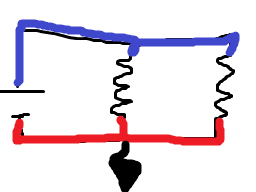
Hand-drawn circuit schematic with two resistors drawn as zigzags in parallel branches, joined by a blue top wire and a red bottom wire, with a ground symbol below.

But in this example I do not see that. I know for certain that the answer for Rt is:
[ ( (R1 || R2) + R3) || R4 ] + R5
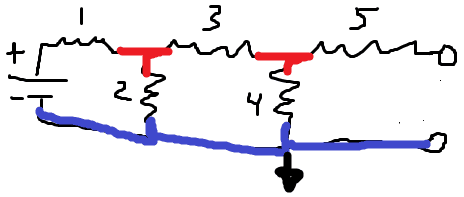
Hand-drawn circuit schematic with a battery on the left and resistors labeled 1 through 5 in a network, with red and blue wire connections between nodes.
 
To find RThevenin you must short-circuit the voltage source. Do that and redraw. See if things make sense then.
 
Oh okay, that makes sense now, it would look like this:
Circuit schematic with three resistors drawn as zigzags: two in parallel between a top and bottom wire, and a third in series after them, with a red highlighted loop and a blue T-junction marking the nodes.

And so the reason R3 is in series with (R1 || R2 ) is because they do not share the same two extraordinary nodes, right?
 
The drawing is not quite right. You are showing that R1 is being "shorted out" which is not the case. When you short the voltage source, you simply replace it with a wire.
 
You are right about why R3 is in series with R1||R2.

Here's what I mean about your drawing:
Code:
 +--R1---+--...
 |       |
 |       |
(|)      R2
 |       |
 |       |
 +-------+--...

Which is the same as:

 +-------+--...
 |       |
 |       |
 R1      R2
 |       |
 |       |
 +-------+--...
 
Right, that makes sense, here is my drawing now, which I think is correct:
Hand-drawn circuit schematic with five resistors numbered 1 to 5, with the wires traced in red, green and blue to show node connections.

So in this drawing, the reason R3 is in series with (R1 || R4) and then that whole quantity (enclosed in the box) is parallel with R4 since they both share the Green and Blue nodes. R5 is then in series with all of this since it does not share any other nodes with the circuit other than the Green one.
 
Instead of "(R1 || R4)", you mean to say (R1 || R2).

Other than that, you are correct!
 
dlacombe13 said:
How exactly do you tell if two elements are in series or parallel?

If all the current that flows through one of them MUST flow through the other one too, they are in series. Current through them is the same.

If they are solidly connected together at both ends, they are in parallel. Voltage across them is the same.

Note that it is possible for them to be both in series and in parallel at the same time.
Draw yourself the simple circuit consisting of just a battery and lightbulb. It meets both those criteria.

old jim
 
  • Like
Likes   Reactions: lewando
dlacombe13 said:
How exactly do you tell if two elements are in series or parallel?
But in this example I do not see that. I know for certain that the answer for Rt is:
[ ( (R1 || R2) + R3) || R4 ] + R5

Hand-drawn circuit schematic with a battery on the left, a series chain of resistors numbered 1, 3 and 5 along the top, and resistors 2 and 4 hanging down to a blue bottom wire, with red junction marks.

Please note that in this example both resistors R1 and R2 appear in parallel because it was your task to find the total resistance while looking into the circuit from the output.
The situation is quite different for the total input resistance of the circuit as measured at the + node of the battery.
In this case we have Rin=R1 + [(R3+R4)||R2]
The resistor R5 has no influence as long as the output nodes are not loaded by any other resistor.