thegreengineer
- 54
- 3
Good afternoon people. I wanted to implement a physical system using control just to put into practice what I have learned in school. To be more specific: I would like to implement an inverted pendulum like the one on the photo
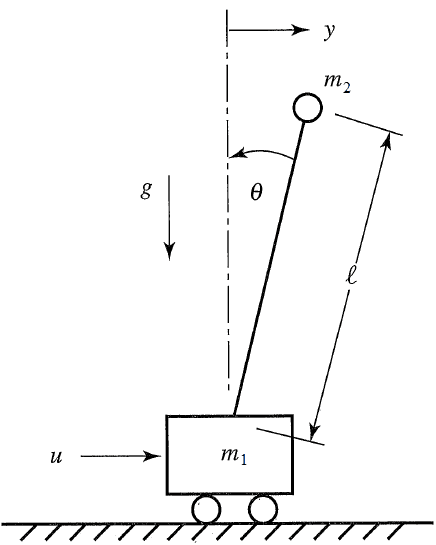
In this system a control input (a force u) drives the cart (mass m1) which moves the massless rod (with l) with a mass m2 attached at the end. The goal is to keep the mass m2 vertical by making the control output (an angle θ) zero.
The control paradigm I would like to use is modern control, which means I would require first to derive the differential equations of the system; then identify control input, control output, and state variables, in order to find the state and output equations we all know:
\mathbf{\dot{x}}=\mathbf{A}\mathbf{x}+\mathbf{B}u
\mathbf{y}=\mathbf{C}\mathbf{x}+\mathbf{D}u
The next series of steps would be determining controllability, observability. After that then building the gain matrix K and (if necessary) build the observer. The result would be a block diagram like this:
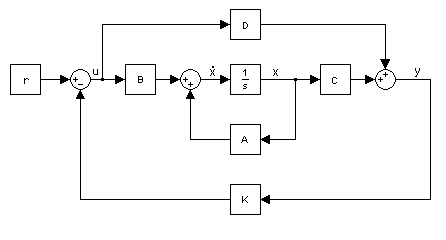
My main questions would be: where do other elements like sensors and actuators (like a rotary encoder and a motor) be in the block diagram? Would they be part of the plant (the inverted pendulum) block that includes the A, B, C and D matrices? or would they be treated outside the plant?
Also how would the controller be implemented? Is it an electrical network made of opamps? Is it a mechanical system? What is it? The same would be for how an observer would be implemented on a real system.
This is the main disadvantage I see about using modern control instead of classic control, since classic control deals with transfer functions and I could easily see where the sensor, the actuator, the plant and other signal conditioning blocks would fit:
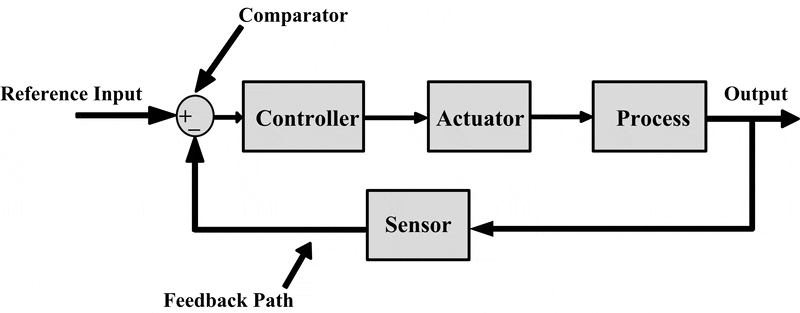
Easily the input could be a voltage (corresponding to the angle), the controller could be a PID controller made with op-amps, the actuator could be a motor, the process is the inverted pendulum, the sensor could be a rotary encoder or a potentiometer, and the output could be the output angle. Other elements like amplifiers, filters, and so on could be put between the controller and the actuator. Also the comparator could be an electronic op-amp since the input and feedback path signals are electrical in nature.
I would appreciate your answers to this problem.
In this system a control input (a force u) drives the cart (mass m1) which moves the massless rod (with l) with a mass m2 attached at the end. The goal is to keep the mass m2 vertical by making the control output (an angle θ) zero.
The control paradigm I would like to use is modern control, which means I would require first to derive the differential equations of the system; then identify control input, control output, and state variables, in order to find the state and output equations we all know:
\mathbf{\dot{x}}=\mathbf{A}\mathbf{x}+\mathbf{B}u
\mathbf{y}=\mathbf{C}\mathbf{x}+\mathbf{D}u
The next series of steps would be determining controllability, observability. After that then building the gain matrix K and (if necessary) build the observer. The result would be a block diagram like this:
My main questions would be: where do other elements like sensors and actuators (like a rotary encoder and a motor) be in the block diagram? Would they be part of the plant (the inverted pendulum) block that includes the A, B, C and D matrices? or would they be treated outside the plant?
Also how would the controller be implemented? Is it an electrical network made of opamps? Is it a mechanical system? What is it? The same would be for how an observer would be implemented on a real system.
This is the main disadvantage I see about using modern control instead of classic control, since classic control deals with transfer functions and I could easily see where the sensor, the actuator, the plant and other signal conditioning blocks would fit:
Easily the input could be a voltage (corresponding to the angle), the controller could be a PID controller made with op-amps, the actuator could be a motor, the process is the inverted pendulum, the sensor could be a rotary encoder or a potentiometer, and the output could be the output angle. Other elements like amplifiers, filters, and so on could be put between the controller and the actuator. Also the comparator could be an electronic op-amp since the input and feedback path signals are electrical in nature.
I would appreciate your answers to this problem.


