How to make my Kelvin's Water Dropper work?

  • Context: High School 
  • Thread starter Thread starter Ak394
  • Start date Start date
  • Tags Tags
    Water Work
Click For Summary
SUMMARY

The discussion revolves around troubleshooting Kelvin's Water Dropper, a device designed to generate electric charge through falling water. Users identified issues with insufficient charge separation and lack of sparks, attributing potential causes to humidity levels and the materials used, such as PVC and Styrofoam. Recommendations include using metal containers, adjusting the proximity of drip nozzles to inducers, and modifying sharp edges to reduce leakage currents. The conversation emphasizes the importance of insulation and humidity control for optimal performance.

PREREQUISITES
  • Understanding of electrostatic principles and charge separation
  • Familiarity with materials like stainless steel, PVC, and polycarbonate
  • Knowledge of humidity effects on static electricity
  • Basic electrical safety regarding high voltage systems
NEXT STEPS
  • Research the construction and operation of Wimshurst machines
  • Explore methods for reducing leakage currents in electrostatic devices
  • Investigate the effects of humidity on static charge retention
  • Learn about effective insulation materials for high-voltage applications
USEFUL FOR

This discussion is beneficial for hobbyists, educators, and students interested in electrostatics, as well as anyone attempting to build or troubleshoot electrostatic generators like Kelvin's Water Dropper.

Ak394
Messages
3
Reaction score
4
Hello,

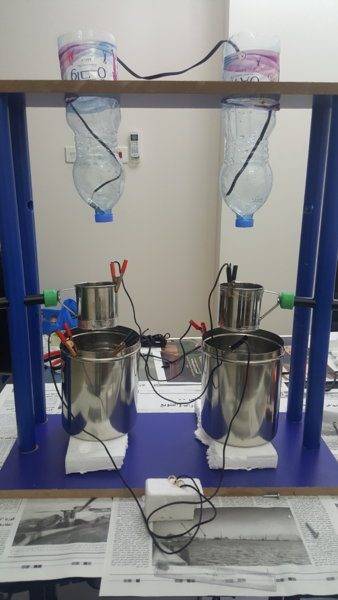
I've made a version of Kelvin's water dropper for a school project, but it is not charging up. I've made the supports with PVC and the base with plywood. The water collectors are placed on Styrofoam blocks and the water flows through holes made in 2 plastic bottles. The inducers and collectors are made of stainless steel.
20180823_193624.jpg

20180823_193812.jpg


Any tips on how I can make it work would be highly appreciated.
Thanks.
 

Attachments

  • 20180823_193812.jpg
    20180823_193812.jpg
    32 KB · Views: 763
  • 20180823_193624.jpg
    20180823_193624.jpg
    30.2 KB · Views: 1,012
  • Like
Likes   Reactions: Nik_2213
Physics news on Phys.org
Charging what up?

You may be able to generate a measurable voltage, but no enough power to charge a battery.

Tell us more about your project, what you are trying to accomplish, and why you say it is not working.
 
Um, I think he means it is not getting any electric charge separation.
IIRC, some rotary tribo-electric and Wimshurst-like machines generally self-start, while others need a priming charge, which they then boot-strap to sparks...

Been a while since I was interested in this field but, IIRC, the clue may lie in high seasonal humidity. Carpets vs doorknob sparks generally require low humidity.

( No way you could charge even an AAA battery thus, but storing a fair zap in a Leyden Jar is a different matter... )
 
  • Like
Likes   Reactions: sophiecentaur
anorlunda said:
Charging what up?

You may be able to generate a measurable voltage, but no enough power to charge a battery.

Tell us more about your project, what you are trying to accomplish, and why you say it is not working.

The 2 water collectors at the bottom are supposed to build opposite charges while the water is falling from the bottles at the top. These collectors are connected to 2 metal probes across which a spark should appear if the generator works properly.
In my model, the water collectors are not building up sufficient charges on them, and no sparks are being produced.

Nik_2213 said:
Um, I think he means it is not getting any electric charge separation.
IIRC, some rotary tribo-electric and Wimshurst-like machines generally self-start, while others need a priming charge, which they then boot-strap to sparks...

Been a while since I was interested in this field but, IIRC, the clue may lie in high seasonal humidity. Carpets vs doorknob sparks generally require low humidity.

( No way you could charge even an AAA battery thus, but storing a fair zap in a Leyden Jar is a different matter... )
It's quite dry here, actually. Dry summer. So humidity is not an issue.
I tried giving the collectors a start by holding a charged comb next to one, but even that didn't have an effect.
 
  • Like
Likes   Reactions: Nik_2213
Perhaps the blue paint is causing leakage? Try glass instead of styrofoam?
 
Ak394 said:
Any tips on how I can make it work would be highly appreciated.

It's been a few years since we've discussed one of these, so I'm a bit rusty on how they work. I eventually did build one, but also wasn't able to get it working, so I'm sure the nuances of the device are still eluding me.

One thing I notice in your image is that the interconnecting wires seem to be in contact with opposite polarity buckets. Although covered in insulation, the potentials are supposedly between 10,000 & 20,000 volts, so your insulation may not be effective.

Actually, care should be taken that opposite polarity wires aren't touching either.

kelvin.water.shorts.png


Just a guess, of course.
 

Attachments

  • kelvin.water.shorts.png
    kelvin.water.shorts.png
    99.2 KB · Views: 942
In addition to the good suggestions by @OmCheeto:

Try moving the drip nozzles much closer to the inducers. Also, using metal containers rather than plastic, or at least electrically connected metal drip nozzles may help.

[edit]
The inducers and collectors have somewhat sharp rims, and since sharp edges and points have a high electric field strength, there will be high leakage currents there. I suggest those edges either be covered with Styrofoam or re-formed to a larger radius. Reforming could be just rolling the edge toward the inside of the cylinder if you can do that without creating any ripples in the material. Any ripples will act as another sharp edge. The rolled edge does not need to be 360°, 180° is adequate when rolled inward. Rolled outward would need at least 270° though. This applies to both the top and bottem edges of bothe inducers and collectors, and also to the handles. (lots of sharp edges there!) Figure out a way to get rid of the handles and mount them with plastic. Any rough spots left after handle removal must be smoothed to avoid more small-radius points/edges.
[end edit]

For mounting the inducers, a polycarbonate plastic such as Plexiglas or Perspex will have good insulating properties, but do not paint it. If such a plastic is not available or desirable you could perhaps create a mounting using Styrofoam as an insulator.

Maintaining a static charge above above 50% Relative Humidity is problematic. You may have to place your apparatus in an enclosed low humidity environment.

Interesting project! Please keep us updated on your progress.

Cheers,
Tom

p.s. Here is a PDF document that investigates the device rather thoroughly; but it is a 95 page Masters Thesis.
https://essay.utwente.nl/68015/1/Knapen_MA_EEMCS.pdf
 
Last edited:
  • Like
Likes   Reactions: OmCheeto and Nik_2213
@OmCheeto @Tom.G
Thanks for the reply, I'll do some adjustments and post a reply if it all works out.
(Exams going on here, I'll find time to update this soon)
 
  • Like
Likes   Reactions: Nik_2213 and OmCheeto

Similar threads

  • · Replies 6 ·
Replies
6
Views
2K
  • · Replies 17 ·
Replies
17
Views
5K
  • · Replies 10 ·
Replies
10
Views
2K
  • · Replies 6 ·
Replies
6
Views
3K
  • · Replies 4 ·
Replies
4
Views
2K
  • · Replies 8 ·
Replies
8
Views
3K
  • · Replies 131 ·
5
Replies
131
Views
8K
  • · Replies 12 ·
Replies
12
Views
4K
  • · Replies 7 ·
Replies
7
Views
2K
  • · Replies 51 ·
2
Replies
51
Views
4K