How to predict the shape of the circle from any point of view?

  • Context: Graduate 
  • Thread starter Thread starter OFF_Smog
  • Start date Start date
  • Tags Tags
    Circle Point Shape
Click For Summary
SUMMARY

This discussion focuses on predicting the shape of a circle when viewed from an angle, which manifests as an ellipse. Key parameters include the angle of view (ө), the azimuth of the major axis (∞), and the camera rotation (€). The conversation explores how to determine the orientation of the major and minor axes and the axis ratio (b/a) using these angles, emphasizing the projection of the circle and the concept of cone cuts to calculate the camera's position relative to a fixed cone.

PREREQUISITES
  • Understanding of geometric projections
  • Familiarity with conic sections
  • Knowledge of camera angles and orientations
  • Basic principles of perspective in photography or computer graphics
NEXT STEPS
  • Research geometric projections in computer graphics
  • Study conic sections and their properties
  • Learn about camera transformations in 3D space
  • Explore mathematical modeling of perspective views
USEFUL FOR

Mathematicians, computer graphics professionals, and anyone interested in geometric projections and perspective transformations.

OFF_Smog
Messages
3
Reaction score
0
As we know a circle view at an angle appears as an ellipse,
as you see in the picture, the center of the camera aim to the center of the circle ,
the angle between the circle axis and the camera is ө,
the azimuth between mojor axis(a) and the camera is ∞,
the rotation of the camera is €,

1. How to predict an orientation of major and minor axis and the ratio of its axes(b/a)?? ,if we only know these ө,∞,€ angle, regardless of size of ellipses.

2. Is there any theory to apply this example?
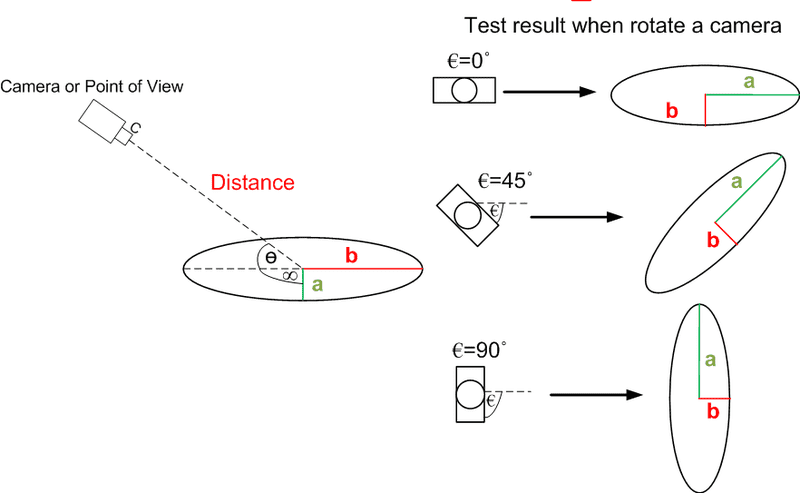
attachment.php?attachmentid=46615&stc=1&d=1335275219.png
 

Attachments

  • 1.png
    1.png
    19.4 KB · Views: 803
Last edited:
Physics news on Phys.org
Not sure what there is to predict. In general what the camera does is a projection of the circle, or if we consider cone cuts, the variation of the camera. So one could calculate the position of the camera with respect to a fixed cone.
 

Similar threads

  • · Replies 2 ·
Replies
2
Views
2K
  • · Replies 9 ·
Replies
9
Views
2K
  • · Replies 8 ·
Replies
8
Views
4K
  • · Replies 3 ·
Replies
3
Views
8K
  • · Replies 10 ·
Replies
10
Views
3K
  • · Replies 4 ·
Replies
4
Views
3K
  • · Replies 6 ·
Replies
6
Views
32K
  • · Replies 3 ·
Replies
3
Views
4K
  • · Replies 2 ·
Replies
2
Views
3K
  • · Replies 11 ·
Replies
11
Views
3K