How to predict the shape of the circle from any point of view

  • Context: Graduate 
  • Thread starter Thread starter OFF_Smog
  • Start date Start date
  • Tags Tags
    Circle Point Shape
Click For Summary
SUMMARY

This discussion focuses on predicting the shape of a circle when viewed from different angles, specifically how it appears as an ellipse. Key parameters include the angle of view (θ), azimuth (∞), and camera rotation (€). The conversation explores the relationship between these angles and the major and minor axes of the resulting ellipse, as well as the mathematical relationship governing the height of the shadow cast by a circle rotating around a hinge. The formula for the height of the shadow (b) is established as b = a * cos(φ), where a is the radius of the circle and φ is the angle of rotation.

PREREQUISITES
  • Understanding of geometric transformations and projections
  • Familiarity with basic trigonometry, specifically cosine functions
  • Knowledge of camera angles and perspective in photography
  • Concept of shadows and light sources in geometry
NEXT STEPS
  • Research the mathematical principles of conic sections, particularly ellipses
  • Explore geometric transformations in computer graphics
  • Study the effects of perspective projection in photography
  • Learn about the physics of light and shadow in geometric contexts
USEFUL FOR

Mathematicians, photographers, computer graphics designers, and anyone interested in the geometric properties of shapes and their projections.

OFF_Smog
Messages
3
Reaction score
0
As we know a circle view at an angle appears as an ellipse ,
as you see in the picture, the center of the camera aim to the center of the circle ,
the angle between the circle axis and the camera is ө,
the azimuth between mojor axis(a) and the camera is ∞,
the rotation of the camera is €,

1. How to predict an orientation of major and minor axis and the ratio of its axes(b/a) ,if we only know these ө,∞,€ angle, regardless of size of ellipses

2. Is there any theory to apply this example?
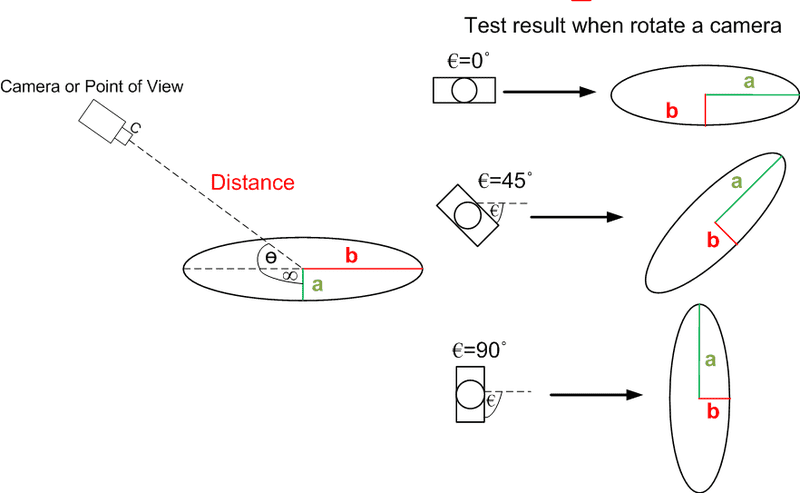
attachment.php?attachmentid=46615&d=1335275106.png
 
Science news on Phys.org
consider the simpler problem of a circle on a hinge along its horizontal diameter. The circle is oriented so that initially its plane is vertical. Let phi be the angle the plane of the circle makes with the vertical axis as we rotate it around the hinge.

now suppose we have a light source (at infinity) and look at the shadow cast by the circle on a nearby vertical plane. Initially (phi=0) the shadow is a circle of the same radius as the circle. As we rotate the circle on its hinge, the shadow changes to an ellipse in the same manner as the camera in your diagram viewing the circle from different angles.

The horizontal axis of the shadow corresponds to a in your diagram. It is constant and always equal to the radius of the circle. The height of the shadow (b) changes with phi and a simple diagram will show you that its value is

b=a\cos\phi

I will leave you to relate phi back to the angles in your diagram.
 
Last edited:
Hi,

We can apply the light source(at infinity) theory in case a camera rotating,
Thus the shadow of ellipses will rotate the same as the camera rotation(€) right?

One thing that i concern is how to find formula to apply this circumstance?


Thank you very much
 

Similar threads

  • · Replies 1 ·
Replies
1
Views
2K
  • · Replies 9 ·
Replies
9
Views
2K
  • · Replies 1 ·
Replies
1
Views
3K
  • · Replies 1 ·
Replies
1
Views
1K
  • · Replies 10 ·
Replies
10
Views
3K
  • · Replies 6 ·
Replies
6
Views
32K
  • · Replies 1 ·
Replies
1
Views
3K
  • · Replies 11 ·
Replies
11
Views
3K
  • · Replies 4 ·
Replies
4
Views
2K
  • · Replies 17 ·
Replies
17
Views
3K