Master1022
- 590
- 116
- Homework Statement
- How can I match the following Fourier series to match the initial condition for a PDE?
- Relevant Equations
- Fourier Series
Hi,
Question: If we have an initial condition, valid for -L \leq x \leq L:
f(x) = \frac{40x}{L} how can I utilise a know Fourier series to get to the solution without doing the integration (I know the integral isn't tricky, but still this method might help out in other situations)?
We are given the following Fourier series:
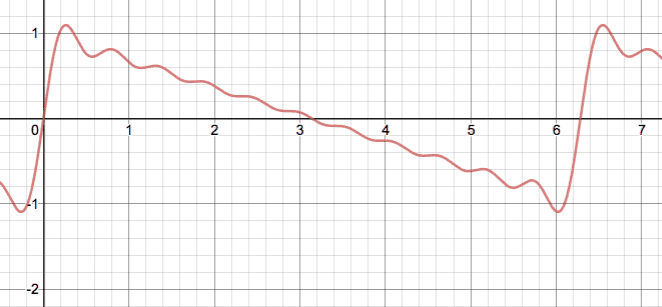
\frac{2A}{\pi} \left( sin(\phi) + \frac{1}{2} sin(2 \phi) + \frac{1}{3} sin(3\phi) + ... \right) where \phi = \frac{2 \pi x}{T} and A is the amplitude. This represents a function that looks like this (this would be sharper with more terms, but I just put a few into Desmos):
My attempt:
I think we want to do the following steps:
1. Reflect the series about the x-axis (multiply by -1)
2. Shift/scale the series have a zero at the origin and have a full period range from -L to L
It is the second step that confuses me and I am not completely sure how to do it, but this is how I approached it:
- we want the point where \pi is to shift to the origin (so \phi + \pi)
then we get that sin(\phi + \pi) = -sin(\phi).
- then we let T = 2L to get and A = 40 to get:
\frac{-2\times 40}{\pi} \left(-sin(\frac{\pi x}{L}) + \frac{1}{2} sin(\frac{2 \pi x}{L}) - \frac{1}{3} sin(\frac{3 \pi x}{L}) + ... +\frac{(-1)^n}{n}sin(\frac{n \pi x}{L}) \right)
Does this method seem correct?
However, what if there is a shift and scale required? How does that change the order of the transformation? Should we always do the shift first, for out the trig double angle simplification, and then do the scaling in the x-direction?
Any help is greatly appreciated.
Question: If we have an initial condition, valid for -L \leq x \leq L:
f(x) = \frac{40x}{L} how can I utilise a know Fourier series to get to the solution without doing the integration (I know the integral isn't tricky, but still this method might help out in other situations)?
We are given the following Fourier series:
\frac{2A}{\pi} \left( sin(\phi) + \frac{1}{2} sin(2 \phi) + \frac{1}{3} sin(3\phi) + ... \right) where \phi = \frac{2 \pi x}{T} and A is the amplitude. This represents a function that looks like this (this would be sharper with more terms, but I just put a few into Desmos):
My attempt:
I think we want to do the following steps:
1. Reflect the series about the x-axis (multiply by -1)
2. Shift/scale the series have a zero at the origin and have a full period range from -L to L
It is the second step that confuses me and I am not completely sure how to do it, but this is how I approached it:
- we want the point where \pi is to shift to the origin (so \phi + \pi)
then we get that sin(\phi + \pi) = -sin(\phi).
- then we let T = 2L to get and A = 40 to get:
\frac{-2\times 40}{\pi} \left(-sin(\frac{\pi x}{L}) + \frac{1}{2} sin(\frac{2 \pi x}{L}) - \frac{1}{3} sin(\frac{3 \pi x}{L}) + ... +\frac{(-1)^n}{n}sin(\frac{n \pi x}{L}) \right)
Does this method seem correct?
However, what if there is a shift and scale required? How does that change the order of the transformation? Should we always do the shift first, for out the trig double angle simplification, and then do the scaling in the x-direction?
Any help is greatly appreciated.