How to solve this to calculate the input impedance?

Click For Summary
The discussion revolves around calculating input impedance using complex numbers and Euler's formula. A user seeks assistance with a specific formula related to transmission line calculations and reflection at an impedance boundary. Key advice includes using the complex conjugate to simplify the denominator, transforming the equation into a more manageable form. The conversation highlights the importance of understanding rectangular and polar forms of complex numbers in this context. Overall, the thread provides a mathematical approach to solving impedance calculations in electrical engineering.
putrinh
Messages
1
Reaction score
0
How did you find PF?: Google search

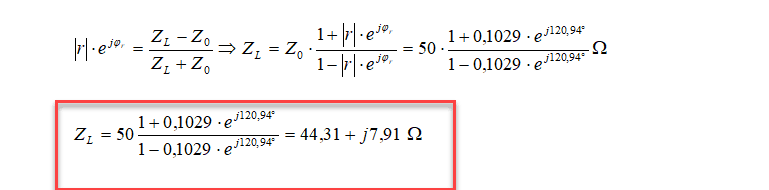
I got a problem, how to calculate this formula from euler to imajiner? or how calculate this case?
1586272604171.png
 
Mathematics news on Phys.org
Welcome to the PF. :smile:

It looks pretty straightforward, but it would help if you could define a few of the terms for us. It looks like a transmission line calculation for a reflection at an impedance boundary? Are you mainly asking for help understanding the rectangular/polar forms of the equations?

https://en.wikipedia.org/wiki/Reflection_coefficient
 
The trick to solving a problem with a ratio of complex numbers is to multiply the numerator and denominator by the complex conjugate of the denominator (this makes the denominator real). Let ##\alpha = 0.1029## and ##\beta=120.94##. We have,$$
Z_L=50\frac{(1+\alpha e^{j\beta}) }{(1-\alpha e^{j\beta})}$$I hope you can see that the complex conjugate of the denominator is ##1-\alpha e^{-j\beta}## Therefore,$$
Z_L=50\frac{(1+\alpha e^{j\beta} )}{(1-\alpha e^{j\beta})}\frac{(1-\alpha e^{-j\beta} )}{(1-\alpha e^{-j\beta})}\\
=50\frac{(1+\alpha (e^{j\beta}-e^{-j\beta})- \alpha^2)}{(1-\alpha (e^{j\beta}+e^{-j\beta})+ \alpha^2)}$$Recall that$$
\cos(\beta)=\frac{e^{j\beta}+e^{-j\beta}}{2}\\
\sin(\beta)=\frac{e^{j\beta}-e^{-j\beta}}{2j}$$
Thus we have,$$
Z_L=50\frac{(1-\alpha^2 + 2j\sin (\beta))}{(1+\alpha^2 - 2\cos (\beta))}$$
 
  • Informative
  • Like
Likes jim mcnamara and berkeman
Here is a little puzzle from the book 100 Geometric Games by Pierre Berloquin. The side of a small square is one meter long and the side of a larger square one and a half meters long. One vertex of the large square is at the center of the small square. The side of the large square cuts two sides of the small square into one- third parts and two-thirds parts. What is the area where the squares overlap?

Similar threads

  • · Replies 2 ·
Replies
2
Views
3K
  • · Replies 32 ·
2
Replies
32
Views
4K
  • · Replies 20 ·
Replies
20
Views
3K
  • · Replies 3 ·
Replies
3
Views
2K
Replies
10
Views
3K
  • · Replies 4 ·
Replies
4
Views
3K
  • · Replies 2 ·
Replies
2
Views
3K
  • · Replies 1 ·
Replies
1
Views
2K
  • · Replies 7 ·
Replies
7
Views
3K
Replies
1
Views
2K