How to test a Bi-Directional Triode Thyristor
Join the discussion
Registration is free. Ask a follow-up in this thread, or start your own.
151 replies · 20K views
Engineering news on Phys.org
Planobilly
Gold Member
- 451
- 118
Thanks Jim,
I understand where you are going with the light bulb idea.
I will set that up and give it a try.
Billy
I understand where you are going with the light bulb idea.
I will set that up and give it a try.
Billy
Salvador
- 505
- 70
ok here's an idea , . Maybe you have a variac (autotransformer) at your disposal ?
you could first connect the variac to the mains transformer of the Carver , then slowly turning it up and checking the secondary voltages until they match the description on the schematics , (probably at full mains input voltage, just probably Carver only himself knows if he hasn't forgot) this way you could check if the amp itself works and if all conditions are ok , also this would tell you whether the secondary side or the transformer is/was to blame for the triac or whether the triac simply gave up and retired itself early.
before I would attempt this I would check all the transistors down the line to see whether there isn't some obvious short in some device etc. also i would first disconnect the amp boards themselves simply to see does the secondary power supply voltage is at what it's supposed to be and f that turns out ok and the transformer isn't heating up or humming or else I would then proceed to try the amp itself.
for an amp like this i suspect there should be ways to disconnect each stage and test one at a time.
you could first connect the variac to the mains transformer of the Carver , then slowly turning it up and checking the secondary voltages until they match the description on the schematics , (probably at full mains input voltage, just probably Carver only himself knows if he hasn't forgot) this way you could check if the amp itself works and if all conditions are ok , also this would tell you whether the secondary side or the transformer is/was to blame for the triac or whether the triac simply gave up and retired itself early.
before I would attempt this I would check all the transistors down the line to see whether there isn't some obvious short in some device etc. also i would first disconnect the amp boards themselves simply to see does the secondary power supply voltage is at what it's supposed to be and f that turns out ok and the transformer isn't heating up or humming or else I would then proceed to try the amp itself.
for an amp like this i suspect there should be ways to disconnect each stage and test one at a time.
Science Advisor
Homework Helper
Dearly Missed
- 9,864
- 4,896
Well that SCR manual on Ebay sold.
Here's another
http://www.ebay.com/itm/SCR-Manual-Triacs-Thyristors-Fifth-Edition-General-Electric-1977-/172009065779?hash=item280c8a0d33:g:KakAAOSwf-VWVHtV
if you don't buy it i probably will.
This was the textbook for my high school transistor circuits class, still a good reference.
http://www.ebay.com/itm/VINTAGE-1964-GENERAL-ELECTRIC-TRANSISTOR-MANUAL-BOOK-GE-2N107-/322061121498?hash=item4afc56b7da:g:YDMAAOSwJblXABTs
Here's another
http://www.ebay.com/itm/SCR-Manual-Triacs-Thyristors-Fifth-Edition-General-Electric-1977-/172009065779?hash=item280c8a0d33:g:KakAAOSwf-VWVHtV
if you don't buy it i probably will.
This was the textbook for my high school transistor circuits class, still a good reference.
http://www.ebay.com/itm/VINTAGE-1964-GENERAL-ELECTRIC-TRANSISTOR-MANUAL-BOOK-GE-2N107-/322061121498?hash=item4afc56b7da:g:YDMAAOSwJblXABTs
Planobilly
Gold Member
- 451
- 118
I guess the one that sold is coming to me Jim. I ordered the first one.
Also thanks Salvador I have a variac an had in mind to do some testing along those lines.
Finding a 100 watt clear light bulb in today's world on the other hand is a bit hard to do..lol
Billy
Also thanks Salvador I have a variac an had in mind to do some testing along those lines.
Finding a 100 watt clear light bulb in today's world on the other hand is a bit hard to do..lol
Billy
Last edited:
Science Advisor
Homework Helper
Dearly Missed
- 9,864
- 4,896
Home Hardware, Krome and about N 6th... you'll love the place.Planobilly said:Finding a 100 watt clear light bulb in today's world on the other hand is a bit hard to do..lol
Ahhh, laughing. Good , it'll serve you well..I guess the one that sold is coming to me Jim. I ordered the first one.
Study up on holding current, gate characteristics, and protection for dv/dt and di/dt.
Then you'll have the basics.
Planobilly
Gold Member
- 451
- 118
I built the triac switching circuit and tested the old triac which tested good. Well...it worked the way the the schematic said to test it.
I am starting to think that perhaps there is no gate voltage for a reason. The triac is acting as a safety device based on some fault in the amp. How that would work I have no idea at the moment.
Diode D402 was shorted which is a 1n4002. I replaced it with a 1n4004 as I did not have a 4002 on hand. I don't think it matters much as the only difference is the max voltage.
I will study the schematic a bit more and do some testing tonight.
Billy
I am starting to think that perhaps there is no gate voltage for a reason. The triac is acting as a safety device based on some fault in the amp. How that would work I have no idea at the moment.
Diode D402 was shorted which is a 1n4002. I replaced it with a 1n4004 as I did not have a 4002 on hand. I don't think it matters much as the only difference is the max voltage.
I will study the schematic a bit more and do some testing tonight.
Billy
Bonkers
- 15
- 4
1N4004 is fine, strictly you should replace 403 with the same part (variations in Vf might affect the 50:50 purity of the triac conduction, resulting in DC then saturation in the transformer)
shouldn't matter much tough the thing is "digtally" driven, the opto-coupler here:
http://www.beck-elektronik.de/fileadmin/templates/beck_folder/opto/optokoppler-opic/PC401.pdf
is a digital output part, there is no linear control loop,
the opto is essentially blanked (LED is lit) for N% of a mains half-cycle, this inhibits the triac from firing, the output transistor of the opto shorts the bridge D401 out, no gate voltage, positive or negative.
(presumably,) under no-signal conditions, there would be a 120Hz pulse on the opto, the thyristor etc, to ensure some rail volts - there are at least 3 rails, the 12v supplies should be there the whole time, so there shoudl be some phase angle through the opto.
you should be seeing some 120Hz square waves on the input to the opto.
I suspect there arent, because the "DC fault protection" is active. - again the block diagram is detailed and useful.
plan then would be to power up first the +/-12V rails, with a lab supply, see if there is a DC fault declared.
then power the+/-30V supply with a 1A limited lab supply, see if a fault declares,
or, with only the +/- 12V, check there should be 120Hz signals at the opto input and output - this is telling the triac to pass some power. if the signal is present, then put the triac an all the mains stuff back in circuit and get back to me., ...
v then the 60V
check that with the triac out of circuit (to see if there are other sources for the rail supply) -
Then the control circuit ( the one controlling the power amp rail voltage)
shouldn't matter much tough the thing is "digtally" driven, the opto-coupler here:
http://www.beck-elektronik.de/fileadmin/templates/beck_folder/opto/optokoppler-opic/PC401.pdf
is a digital output part, there is no linear control loop,
the opto is essentially blanked (LED is lit) for N% of a mains half-cycle, this inhibits the triac from firing, the output transistor of the opto shorts the bridge D401 out, no gate voltage, positive or negative.
(presumably,) under no-signal conditions, there would be a 120Hz pulse on the opto, the thyristor etc, to ensure some rail volts - there are at least 3 rails, the 12v supplies should be there the whole time, so there shoudl be some phase angle through the opto.
you should be seeing some 120Hz square waves on the input to the opto.
I suspect there arent, because the "DC fault protection" is active. - again the block diagram is detailed and useful.
plan then would be to power up first the +/-12V rails, with a lab supply, see if there is a DC fault declared.
then power the+/-30V supply with a 1A limited lab supply, see if a fault declares,
or, with only the +/- 12V, check there should be 120Hz signals at the opto input and output - this is telling the triac to pass some power. if the signal is present, then put the triac an all the mains stuff back in circuit and get back to me., ...
v then the 60V
check that with the triac out of circuit (to see if there are other sources for the rail supply) -
Then the control circuit ( the one controlling the power amp rail voltage)
meBigGuy
Gold Member
- 2,325
- 406
D402 shorted is pretty serious.
I assume you have measured all the transistors and the bridge in the power-on circuit and measured the thermal protection devices and internal transformer fuse.
Also, the opto device.
Do you see any voltage across the power switch when it is open (before turning it on)? If not, suspect the thermal protection switches.
Do you see any discoloring in that vicinity?
WOW --- that is a tricky circuit.
I assume you have measured all the transistors and the bridge in the power-on circuit and measured the thermal protection devices and internal transformer fuse.
Also, the opto device.
Do you see any voltage across the power switch when it is open (before turning it on)? If not, suspect the thermal protection switches.
Do you see any discoloring in that vicinity?
WOW --- that is a tricky circuit.
Science Advisor
Homework Helper
Dearly Missed
- 9,864
- 4,896
Okay some USWAGS here, Unscientific-Wild-A**-Guesses ..
what the heck is this on the transformer ? Maybe others have a better idea..
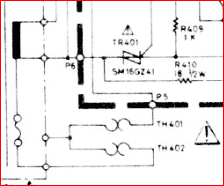
I think it's the source of gate current for the Triac.
D401 is a full wave bridge. Its AC corners are left and right, DC are the vertical ones.
Current through that bridge is allowed, disallowed, or modulated by PC401 above.
That current flows out the left corner of D401 into Q401 (or Q403 depending on which half cycle) ,
and on out through Q404 & D402(or Q402 &D403) into the gate.
Need about 50 ma of gate current to trigger the triac you linked.
http://www.datasheet.hk/view_online.php?id=1927120&file=0465\sm16gz41_6629879.pdf
So how does gate current get into that bridge's AC side ?
Here's the only way i can see...
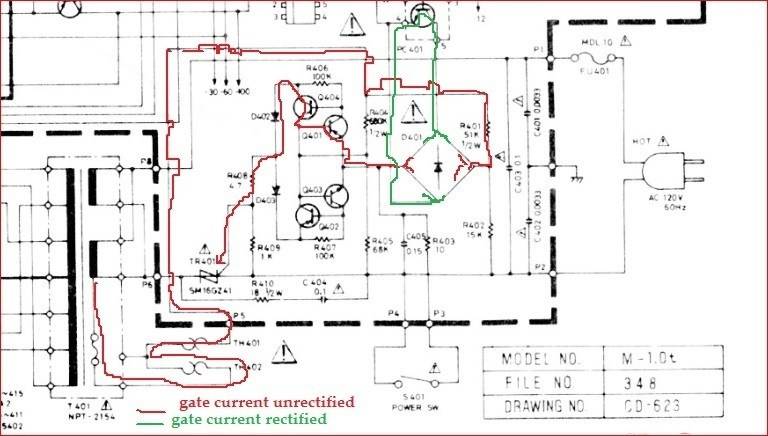
You can squeeze 50 ma peak through R401 if it's 5.1K but not if it's 51 K.
Is it green-brown-red or is it green-brown-orange?
Must tap into a transformer winding someplace ?
Aha ! Near its bottom would be like the test circuit you used...as soon as the triac fires, you no longer need gate drive that's how they get away with only 1/2 watt R401.
The thermal gizmo that looks like two shepherd's hooks, might shut down the amp in case of overheated transformer by removing gate drive.
Power switch does same thing by shorting gate drive to ground at bridge output?
LOL a power switch that's open to apply power ? Showoffs !
Anyhow that's my USWAG. I'll wait for comments from the guys who know this stuff better than me to chime in.
Gotta help Fair Anne with some stuff .. TTFN ...
old jim
what the heck is this on the transformer ? Maybe others have a better idea..
I think it's the source of gate current for the Triac.
D401 is a full wave bridge. Its AC corners are left and right, DC are the vertical ones.
Current through that bridge is allowed, disallowed, or modulated by PC401 above.
That current flows out the left corner of D401 into Q401 (or Q403 depending on which half cycle) ,
and on out through Q404 & D402(or Q402 &D403) into the gate.
Need about 50 ma of gate current to trigger the triac you linked.
http://www.datasheet.hk/view_online.php?id=1927120&file=0465\sm16gz41_6629879.pdf
So how does gate current get into that bridge's AC side ?
Here's the only way i can see...
You can squeeze 50 ma peak through R401 if it's 5.1K but not if it's 51 K.
Is it green-brown-red or is it green-brown-orange?
Must tap into a transformer winding someplace ?
Aha ! Near its bottom would be like the test circuit you used...as soon as the triac fires, you no longer need gate drive that's how they get away with only 1/2 watt R401.
The thermal gizmo that looks like two shepherd's hooks, might shut down the amp in case of overheated transformer by removing gate drive.
Power switch does same thing by shorting gate drive to ground at bridge output?
LOL a power switch that's open to apply power ? Showoffs !
Anyhow that's my USWAG. I'll wait for comments from the guys who know this stuff better than me to chime in.
Gotta help Fair Anne with some stuff .. TTFN ...
old jim
Planobilly
Gold Member
- 451
- 118
Replacing R409 at the moment.
I will read again and be sure I understand Bonkers post.
I have not checked the thermal switch yet Big Guy. No indication of anything burned or discolored, plus the main fuse never has blown.
I would be glad to trade this "tricky circuit" for some good old tube amp circuits!...lol
Edit: Green Brown Orange Jim
I will read again and be sure I understand Bonkers post.
I have not checked the thermal switch yet Big Guy. No indication of anything burned or discolored, plus the main fuse never has blown.
I would be glad to trade this "tricky circuit" for some good old tube amp circuits!...lol
Edit: Green Brown Orange Jim
Planobilly
Gold Member
- 451
- 118
There is a direct connection from the mains through R409 to the gate. Why would that not open the gate?? There is 120V AC to the R409 1000 ohm resistor which is connected to the gate. There is 120V AC at T1 and T2 of the triac
Getting a bit tired...need to review everything that has been said.
I just removed the 100 ohm resistor and put a 1000 ohm resister in the test circuit I built and it turns on the gate and current flows...
Perhaps I need to take a break.
Cheers,
Billy
Getting a bit tired...need to review everything that has been said.
I just removed the 100 ohm resistor and put a 1000 ohm resister in the test circuit I built and it turns on the gate and current flows...
Perhaps I need to take a break.
Cheers,
Billy
Science Advisor
Homework Helper
Dearly Missed
- 9,864
- 4,896
i think the Triac's datasheet tells us here
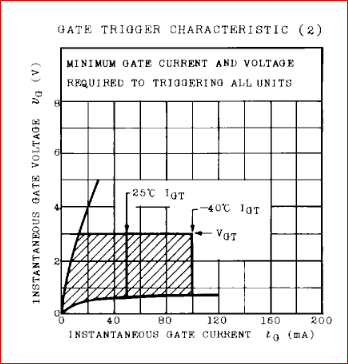
it's voltage between gate and T1 that fires(triggers) the triac by pushing current into the gate
guaranteed 3 volts and 50 milliamps will fire it at 25°C
but it might fire at much less, anywhere in the shaded area.
(You'll love your new SCR manual...)
You need a very few volts between gate (terminal 1) and T1 (terminal 2). That's where R409 is connected, from gate to T1. Gate current has to come in from above, via R408 and D402 (or D403).
Now - R408 is only 4.7 ohms. That you found D402 shorted suggests it saw excessive current. If it did, that current also went through R408.
Is R408 still 4.7 ohms ? I'd not be surprised to find it swollen , cracked and open circuit.
How's D403?
I'm still puzzled by source of gate drive for this thing.
See my sketch in post 40...
@meBigGuy
I need an AC source to top of R401 to make this thing go - what am i missing ?
old jim
it's voltage between gate and T1 that fires(triggers) the triac by pushing current into the gate
guaranteed 3 volts and 50 milliamps will fire it at 25°C
but it might fire at much less, anywhere in the shaded area.
(You'll love your new SCR manual...)
Do you mean between T1 and T2 ? Across the triac? That means it's not turning on, which you know already.Planobilly said:There is 120V AC at T1 and T2 of the triac
You need a very few volts between gate (terminal 1) and T1 (terminal 2). That's where R409 is connected, from gate to T1. Gate current has to come in from above, via R408 and D402 (or D403).
Now - R408 is only 4.7 ohms. That you found D402 shorted suggests it saw excessive current. If it did, that current also went through R408.
Is R408 still 4.7 ohms ? I'd not be surprised to find it swollen , cracked and open circuit.
How's D403?
I'm still puzzled by source of gate drive for this thing.
See my sketch in post 40...
@meBigGuy
I need an AC source to top of R401 to make this thing go - what am i missing ?
old jim
meBigGuy
Gold Member
- 2,325
- 406
@Jim
I wonder about how the triac is drawn. They don't label the pins.
R403 (10 ohms) to the power switch essentially breaks the path you drew, shorting the inputs to the darlingtons to neutral through the power switch.
I assume the gate current comes through R403, but I don't understand how the opto/bridge modulates the firing point.
They do call the transformer a "magnetic field coil". Maybe there is something special about it and the unlabeled pins.
I wonder about how the triac is drawn. They don't label the pins.
R403 (10 ohms) to the power switch essentially breaks the path you drew, shorting the inputs to the darlingtons to neutral through the power switch.
I assume the gate current comes through R403, but I don't understand how the opto/bridge modulates the firing point.
They do call the transformer a "magnetic field coil". Maybe there is something special about it and the unlabeled pins.
Science Advisor
Homework Helper
Dearly Missed
- 9,864
- 4,896
DatasheetmeBigGuy said:@Jim
I wonder about how the triac is drawn. They don't label the pins.
Carver schematic
you are right. I assumed it's drawn T2 left, T1 and gate right. I can't make it work any other way.
T1 and T2 are same size push-on terminals and i suppose they could get inadvertently swapped... Would that put line voltage across R409 ?
meBigGuy said:I don't understand how the opto/bridge modulates the firing point.
There's a lot of auctioneering. I don't know if it's phase control or just on-off, probably capable of either.
Planobill - In your mind move the optoisolator inside the bridge and it's more apparent it controls current . That's how you control AC current with a DC device.
will look up that opto, has a part# on schematic..tlp631
http://www.digikey.com/product-detail/en/toshiba-semiconductor-and-storage/TLP631(GB,F)/TLP631GBF-ND/871364
Toshiba, it's good for 55volts, 50 miliamps so they're not blocking line voltage with it
old jim
Last edited:
meBigGuy
Gold Member
- 2,325
- 406
http://carvermk2.com/Docs/Carver Magnetic Field Whitepaper.pdf talks about the features in the amp, including a high level of the power supply and the use of class G power rail switching. It also a great treatment regarding the real demands of high quality amplifier power supplies and the advantages of his design.
Planobilly:
I'd start here: (essentially poke around and look for anomalies, which is tricky given 1. I am here, 2. I don't completely understand the circuit, 3. You don't understand the circuit either) So we just do the best we can.
1. put meter or scope lead on neutral (non fused side of line input)
2. Measure voltage at top of r403 with power switch open. Then with power switch closed.
3. Measure voltage at top of R408 with power switch open, then closed
4. Measure resistance of the two thermal switches with power removed
5. Measure voltage on right side of lower thermal switch with power switch open. Should be line voltage if internal transformer fuse isn't blown
(is that fuse in the transformer accessible?)
Something in that process won't make sense and will provide a clue as to the problem.
Is there anything about the transformer that might explain what the lead that is common the the temp elements are? Maybe it is just a mounting point?
Planobilly:
I'd start here: (essentially poke around and look for anomalies, which is tricky given 1. I am here, 2. I don't completely understand the circuit, 3. You don't understand the circuit either) So we just do the best we can.
1. put meter or scope lead on neutral (non fused side of line input)
2. Measure voltage at top of r403 with power switch open. Then with power switch closed.
3. Measure voltage at top of R408 with power switch open, then closed
4. Measure resistance of the two thermal switches with power removed
5. Measure voltage on right side of lower thermal switch with power switch open. Should be line voltage if internal transformer fuse isn't blown
(is that fuse in the transformer accessible?)
Something in that process won't make sense and will provide a clue as to the problem.
Is there anything about the transformer that might explain what the lead that is common the the temp elements are? Maybe it is just a mounting point?
Science Advisor
Gold Member
- 5,661
- 4,509
Planobilly said:Diode D402 was shorted...
With D402 shorted, it is very likely that Q404 is also ready for burial. Might as well check/replace Q401, 402, 403 while you're at it.
BTW, is that Power Switch momentary contact type? It looks like it supplies trigger power thru the Q401 - Q404 structure when closed. That would be how the whole thing bootstraps at turn on. If this is correct, then holding the Power Switch closed "should" energize the transformer without any of the feedback loop functional.
meBigGuy
Gold Member
- 2,325
- 406
That makes sense that it could be momentary. Then, pulling the darlingtons toward neutral fires the triac, which would occur through the 15K on the right side of the bridge. Then I can see how the opto might regulate the supply through the bridge. But, it's all conjecture at this point. I'm just guessing.
Science Advisor
Homework Helper
Dearly Missed
- 9,864
- 4,896
Glad I'm not the only one confused.
Aha ! at 460% magnification, R404 is 6800 not 680K. There's how gate current gets into the four-transistor trigger circuit Q401-404, not through R401 like i drew it...
Planobilly - is R404 blue-bray-red not blue-gray-yellow?
so here's my first shot at the gate drive circuit - doubtless wrong but can be corrected and polished up.
C405 causes voltage at Q401& 403's emitters to lag that at their bases by a small fraction of a cycle..
Between zero and 90 degrees while voltage is rising,
...Q401 is held off , its eb is reverse biased.
...Q403 is turned ON but D403 blocks gate current.
After 90 degrees when voltage starts decreasing from peak the situation reverses.
...Q401 is now forward biased and Q403 reverse...
...Q401 and 402 deliver gate current to the triac
So it CAN bootstrap up
AND we have achieved phase control because
Current from the right, controlled by optocoupler, advances or retards the firing angle.
Closing power switch sinks all the current that can get in through R404 removing gate drive.
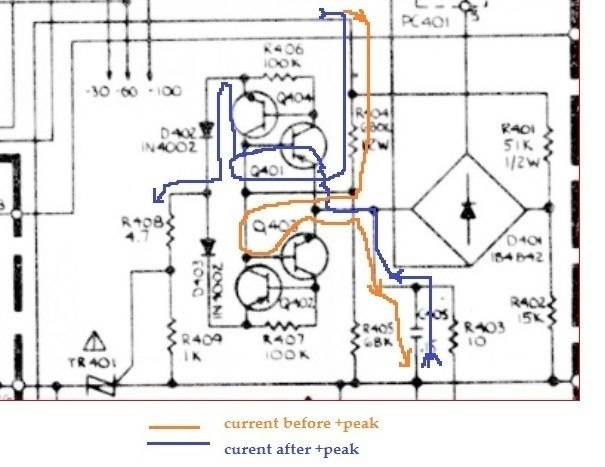 So - R404, C405 and D401/PC301 are the muscle of phase control. Brains are in that column of opamps above.
R404 sees full voltage when system is off. Likely candidate to be open.R401 and R402 drop voltage to something within the photocoupler's 55 volt rating?
Sound plausible guys? You were doubtless there already...
old jim
Edit back to drawing board
R404 is 680K per partslist

so i do not see how that circuit as drawn can deliver trigger current more than peak volts/R401,
170v/51k = about 3 milliamps.
Does it use the charge stored in C405 for a trigger pulse?
dv/dt = I/C , it could deliver 50 ma for 10 microseconds with a 3.3 volt drop...
?
How to check C405 in circuit ?
Check my arithmetic, not to mention the logic.
Good Troubleshooting...meBigGuy said:Something in that process won't make sense and will provide a clue as to the problem.
Aha ! at 460% magnification, R404 is 6800 not 680K. There's how gate current gets into the four-transistor trigger circuit Q401-404, not through R401 like i drew it...
Planobilly - is R404 blue-bray-red not blue-gray-yellow?
so here's my first shot at the gate drive circuit - doubtless wrong but can be corrected and polished up.
C405 causes voltage at Q401& 403's emitters to lag that at their bases by a small fraction of a cycle..
Between zero and 90 degrees while voltage is rising,
...Q401 is held off , its eb is reverse biased.
...Q403 is turned ON but D403 blocks gate current.
After 90 degrees when voltage starts decreasing from peak the situation reverses.
...Q401 is now forward biased and Q403 reverse...
...Q401 and 402 deliver gate current to the triac
So it CAN bootstrap up
AND we have achieved phase control because
Current from the right, controlled by optocoupler, advances or retards the firing angle.
Closing power switch sinks all the current that can get in through R404 removing gate drive.
R404 sees full voltage when system is off. Likely candidate to be open.R401 and R402 drop voltage to something within the photocoupler's 55 volt rating?
Sound plausible guys? You were doubtless there already...
old jim
Edit back to drawing board
R404 is 680K per partslist
so i do not see how that circuit as drawn can deliver trigger current more than peak volts/R401,
170v/51k = about 3 milliamps.
Does it use the charge stored in C405 for a trigger pulse?
dv/dt = I/C , it could deliver 50 ma for 10 microseconds with a 3.3 volt drop...
?
How to check C405 in circuit ?
Check my arithmetic, not to mention the logic.
Last edited:
Planobilly
Gold Member
- 451
- 118
Out until tonight.
Salvador
- 505
- 70
I apologize before that I will not be able to be helpful here with my post but I just wanted to say a few things, first of all , looks like the triac isn't much of a " regulated psu" after all than a mere safety thing implemented in such a rather puzzling way but maybe it's really useful and has good protection I think Planobilly will see after he solves this mystery.
second of all personally I find the schematic rather hard to read maybe the copy is bad quality but without extreme magnification the traces seem to connectet everywere , although I've seen worse so maybe isn't that bad except for the labeling , I struggled with Onkyo integra myself until i finished it and now it works , although it had a more classic approach when the outputs were blown it simply disconnected the speaker out and when powering up i was able to measure and see the faults easier due to the DC voltage being at the output and also input stages so I frankly knew then were to look for faults.
Well I think it's bla bla radio GA GA , the HI FI high end stuff has many unorthodox names simply for appearance and or any other magic that folks who buy them believe in or like.
For example what Carver meant with magnetic field amplifier as he calls some of his models like the one in question ?
second of all personally I find the schematic rather hard to read maybe the copy is bad quality but without extreme magnification the traces seem to connectet everywere , although I've seen worse so maybe isn't that bad except for the labeling , I struggled with Onkyo integra myself until i finished it and now it works , although it had a more classic approach when the outputs were blown it simply disconnected the speaker out and when powering up i was able to measure and see the faults easier due to the DC voltage being at the output and also input stages so I frankly knew then were to look for faults.
Big Guy saidThey do call the transformer a "magnetic field coil". Maybe there is something special about it and the unlabeled pins.
Well I think it's bla bla radio GA GA , the HI FI high end stuff has many unorthodox names simply for appearance and or any other magic that folks who buy them believe in or like.
For example what Carver meant with magnetic field amplifier as he calls some of his models like the one in question ?
meBigGuy
Gold Member
- 2,325
- 406
I guess you did not read the Carver white paper I linked to.
Too bad.
Too bad.
Planobilly
Gold Member
- 451
- 118
Update
After replacing almost everything around the triac and taking a good look at all the transistors without any change I jumped the triac. I lowered the input voltage to around 50V with my variac. One of the filter caps smoked so I removed the secondary connection and am checking the transformer which I think is most likely ok. Nothing got hot except the cap at 50V. I also had a light bulb in the circuit which came on and went off when the cap failed.
I need to order a couple of filter caps and there are a couple of diodes that I want to change. The idea is to find the fault in the amp and then go back to the input of the power supply to resolve the gate issue.
This is for sure not a easy amp to troubleshoot.
This is a link to the patent for the power supply. I really did not understand much of it...https://www.google.com/patents/US4218660
No matter, I am not designing the amp...so I guess I replace parts till get it right...lol
Onward through the frog...or fog or something like that..lol
Cheers,
Billy
After replacing almost everything around the triac and taking a good look at all the transistors without any change I jumped the triac. I lowered the input voltage to around 50V with my variac. One of the filter caps smoked so I removed the secondary connection and am checking the transformer which I think is most likely ok. Nothing got hot except the cap at 50V. I also had a light bulb in the circuit which came on and went off when the cap failed.
I need to order a couple of filter caps and there are a couple of diodes that I want to change. The idea is to find the fault in the amp and then go back to the input of the power supply to resolve the gate issue.
This is for sure not a easy amp to troubleshoot.
This is a link to the patent for the power supply. I really did not understand much of it...https://www.google.com/patents/US4218660
No matter, I am not designing the amp...so I guess I replace parts till get it right...lol
Onward through the frog...or fog or something like that..lol
Cheers,
Billy
Science Advisor
Gold Member
- 5,661
- 4,509
Planobilly said:This is a link to the patent for the power supply. I really did not understand much of it...https://www.google.com/patents/US4218660
That patent describes high frequency switching to the power xformer primary. For that to happen, the Triac (TR401) would have to be a Gate Turn Off (GTO) device. That makes sense when you notice that the polarity of D402 and D403 supply Positive and Negative voltage to TR401.
https://en.wikipedia.org/wiki/Gate_turn-off_thyristor
(Sounds like more confusion for this project!)
Salvador
- 505
- 70
I read the patent too and quite frankly I don't get were is the big fuss. Carver explains quite reasonably that bigh power HI FI home amps are heavy because of big heatsinks and big transformer.Ok that's true.He also says that heat in heatsinks is a waste product which again is true.
Ok I get his point of jerking the transformer primary to higher and lower power with respect to the input signal waveform with the help of a circuit that " reads" the input and then controls the primary current accordingly by the means of that triac.
But here's the point I don't get , his main points are the size and weight of such amps. with this circuit he hasn't got rid of much the weight only maybe of some of the waste heat in the heatsinks since they now have lower currents at lower signals levels and higher when they are needed. Ok that goes for smaller heatsinks , but the mains transformer being a iron core mains frequency transformer still needs to be as big as the max possible or predicted load of the amplifier will be , in other words it has to be as heavy and big as to be able to supply the amp when it's driven at it's max or near that.
since when a triac is fully open it becomes just a wire and so it simply let's through the whole mains sinus which is no more than 60hz
So where's the gain in that ?
Ok I get his point of jerking the transformer primary to higher and lower power with respect to the input signal waveform with the help of a circuit that " reads" the input and then controls the primary current accordingly by the means of that triac.
But here's the point I don't get , his main points are the size and weight of such amps. with this circuit he hasn't got rid of much the weight only maybe of some of the waste heat in the heatsinks since they now have lower currents at lower signals levels and higher when they are needed. Ok that goes for smaller heatsinks , but the mains transformer being a iron core mains frequency transformer still needs to be as big as the max possible or predicted load of the amplifier will be , in other words it has to be as heavy and big as to be able to supply the amp when it's driven at it's max or near that.
since when a triac is fully open it becomes just a wire and so it simply let's through the whole mains sinus which is no more than 60hz
So where's the gain in that ?
meBigGuy
Gold Member
- 2,325
- 406
There is a link to the triac spec sheet in the OP.Tom.G said:Gate Turn Off (GTO) device.
Science Advisor
Homework Helper
Dearly Missed
- 9,864
- 4,896
Sorry for my gaffes above. I've often said it - I'm a plodder.
In that document Mr Carver himself describes the power supply , albeit briefly.
It's just a phase control like a lamp dimmer but instead of a knob it uses that D401/PC401 to control firing angle.
Observe PC401 is under control of the opamp just above.
That opamp's inputs include power supply voltages, and via the heavy dark line a measure of the output.
So i'll correct my last sketch
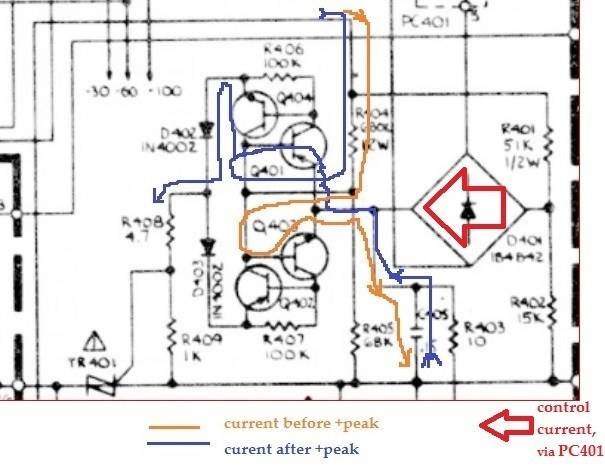 Good work PlanoBill
and a link to a Carver brag-sheet in one of meBigGuy's posts.meBigGuy said:There is a link to the triac spec sheet in the OP.
In that document Mr Carver himself describes the power supply , albeit briefly.
It's just a phase control like a lamp dimmer but instead of a knob it uses that D401/PC401 to control firing angle.
Observe PC401 is under control of the opamp just above.
That opamp's inputs include power supply voltages, and via the heavy dark line a measure of the output.
So i'll correct my last sketch
Salvador
- 505
- 70
Oh trust me Jim , I have added less to this thread than you could ever and I hope Planobilly isn't angry at me for that , I do wanted to say some stuff , I just read the white paper which Big guy desperately wanted me to read.
Much of it is talk-talk although true but still smart advertising then some of it's actual physics and electronics , the thing that still haunts me is were he talks about that a unregulated transformer passes current through only at the peaks of a sinus , isn't that BS? a transformer has the same sinus at it's secondary output the current may lag voltage but it can't simply be there when the voltage has risen to it's max.And with all the benefits at lower power levels and etc I still asked the question which big guy largely ignored dismissing me as a fool , is at full power when the psu is under it's heaviest load , what can the TRIAC help there but to be fully open and acting simply as a wire , so at full power the transformer in this design still becomes the very " dumb" unregulated transformer Carver himself talks about in the paper.So as any transformer it's power rating must be sufficient to deliver the load without dropping much voltage.
I wonder what does the TRIAC and all the fancy name calling (magnetic field etc) help in this case? My guess is nothing.
Also he talks about that a transformer " resists" the ac sine wave 4/5th's of it's time , that would probably be most of the rise and fall time of each cycle , but then how does his TRIAC solve this problem , the TRIAC turns on near the peak of each cycle ad that means that the rise that the transformer primary sees is even steeper almost vertical , ok I see that uses only the most powerful parts of each half cycle , but without that triac those parts are still there with the rest of the rise and fall of the half wave so at near max power again what reduces the very size vs power here ?the frequency is the same.
a genuine question of mine not a show off as some may think.
I also apologize for messing up tis thread but this question seemed very interesting to me.
Much of it is talk-talk although true but still smart advertising then some of it's actual physics and electronics , the thing that still haunts me is were he talks about that a unregulated transformer passes current through only at the peaks of a sinus , isn't that BS? a transformer has the same sinus at it's secondary output the current may lag voltage but it can't simply be there when the voltage has risen to it's max.And with all the benefits at lower power levels and etc I still asked the question which big guy largely ignored dismissing me as a fool , is at full power when the psu is under it's heaviest load , what can the TRIAC help there but to be fully open and acting simply as a wire , so at full power the transformer in this design still becomes the very " dumb" unregulated transformer Carver himself talks about in the paper.So as any transformer it's power rating must be sufficient to deliver the load without dropping much voltage.
I wonder what does the TRIAC and all the fancy name calling (magnetic field etc) help in this case? My guess is nothing.
Also he talks about that a transformer " resists" the ac sine wave 4/5th's of it's time , that would probably be most of the rise and fall time of each cycle , but then how does his TRIAC solve this problem , the TRIAC turns on near the peak of each cycle ad that means that the rise that the transformer primary sees is even steeper almost vertical , ok I see that uses only the most powerful parts of each half cycle , but without that triac those parts are still there with the rest of the rise and fall of the half wave so at near max power again what reduces the very size vs power here ?the frequency is the same.
a genuine question of mine not a show off as some may think.
I also apologize for messing up tis thread but this question seemed very interesting to me.
Science Advisor
Homework Helper
Dearly Missed
- 9,864
- 4,896
Salvador said:the thing that still haunts me is were he talks about that a unregulated transformer passes current through only at the peaks of a sinus , isn't that BS?
no, it's not BS...
Think about a transformer and simple bridge rectifier with capacitor filter
Current flows only during that portion of the cycle where voltage from the transformer exceeds voltage on the filter capacitor. Rest of the cycle the diode is reverse biased. That is the narrow shaded area under the sinewave peak in Carver's drawing.
Here's an example
http://arduino.stackexchange.com/questions/873/reading-a-varying-voltage-into-arduino
That sharp pointy waveform has a high RMS heating value for its average value so it requires big wire
which requires a big core to surround it
I suspect he uses a much smaller transformer than would be required for 1000 watts continuous, and his smart amplifier overloads it only for brief intervals.. hence thermal sensing on the transformer.
But that's only a suspicion - I've never seen the inside of a Carver.
read up on "Crest Factor"
old jim
Similar threads
Graduate Bi-directional transport of light
- bluetooth
- · Replies 5 ·
- Optics
- Replies
- 5
Creating a Bi-Directional Hydraulic Movement for a Personal Project
- mmmcheechy
- · Replies 3 ·
- Mechanical Engineering
- Replies
- 3