How to use magnets to float an object (Diagram)

Click For Summary

Discussion Overview

The discussion centers around the concept of using magnetism to float an object, with an interest in potentially allowing the object to rotate. Participants explore various methods of achieving this, including the use of neodymium magnets and electromagnets, while also considering alternative levitation techniques.

Discussion Character

  • Exploratory
  • Technical explanation
  • Debate/contested
  • Experimental/applied

Main Points Raised

  • One participant proposes using a neodymium rod inside the object with neodymium discs on opposite sides to create opposing magnetic forces for suspension.
  • Another participant suggests that mechanical constraints may be necessary to prevent the object from flipping or sticking to the sides of an enclosure during permanent magnet levitation.
  • AC eddy current levitation is mentioned as a method that uses current in coils to create a magnetic field that can levitate objects, though one participant expresses limited familiarity with this concept.
  • Alternative levitation methods are introduced, including acoustic levitation, which utilizes sound waves, and air bearings, which allow objects to slide with minimal friction on a film of pressurized air.
  • A unique approach called “orthosonic lift” is described, combining sound waves and air bearings to achieve levitation.
  • Participants are encouraged to seek additional resources, such as related threads and articles, for further information and ideas.

Areas of Agreement / Disagreement

Participants express various methods and ideas for achieving levitation, but there is no consensus on a single approach or solution. Multiple competing views and techniques remain under discussion.

Contextual Notes

Some methods mentioned may depend on specific conditions or setups, and the discussion does not resolve the technical details or assumptions related to each levitation technique.

gammzy98
Messages
2
Reaction score
0
Hey everyone, I have been doing some research in regards to floating an object, and possibly have it rotate. I am thinking magnetism is the way to accomplish this, but if anyone else knows another method I would love to hear it. I created a simple diagram on what I am trying to accomplish:
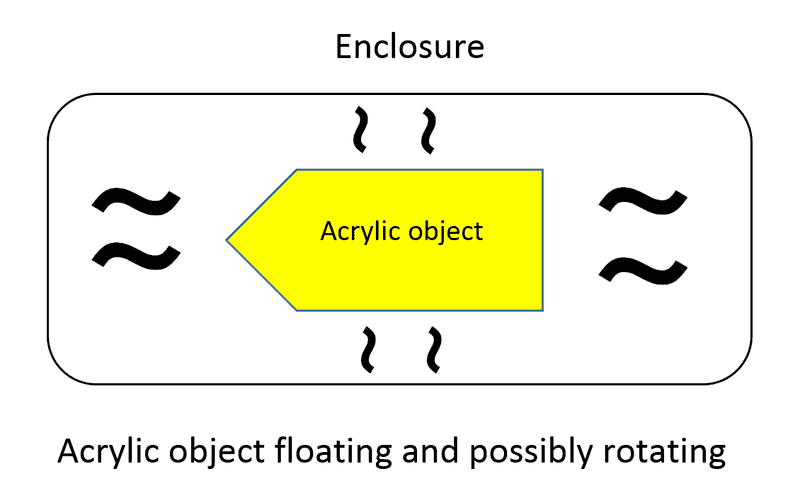
diagram.png


Not sure if it has to be completely enclosed, or it can be partially open. The direction I am leading in that might make this possible is putting a neodymium rod inside the object, then have neodymium discs on opposite sides with opposing poles to suspend the object. Or, some use of electromagnets?

If anyone can help me out more or point me in the right direction on how to do this, I would greatly appreciate it! Thanks!
 
Physics news on Phys.org
gammzy98 said:
Hey everyone, I have been doing some research in regards to floating an object, and possibly have it rotate. I am thinking magnetism is the way to accomplish this, but if anyone else knows another method I would love to hear it. I created a simple diagram on what I am trying to accomplish:

View attachment 204615

Not sure if it has to be completely enclosed, or it can be partially open. The direction I am leading in that might make this possible is putting a neodymium rod inside the object, then have neodymium discs on opposite sides with opposing poles to suspend the object. Or, some use of electromagnets?

If anyone can help me out more or point me in the right direction on how to do this, I would greatly appreciate it! Thanks!
Welcome to the PF.

From the list of "Similar Discussions" at the bottom of the page, this old thread may be of help.

https://www.physicsforums.com/threads/using-magnets-to-suspend-objects.527806/

For permanent magnet levitation, you may need some mechanical constraints "holding" the object to keep it from flipping or sticking to the sides of your enclosure.

Are you familiar with AC eddy current levitation?
 
  • Like
Likes   Reactions: gammzy98
berkeman said:
Welcome to the PF.

From the list of "Similar Discussions" at the bottom of the page, this old thread may be of help.

https://www.physicsforums.com/threads/using-magnets-to-suspend-objects.527806/

For permanent magnet levitation, you may need some mechanical constraints "holding" the object to keep it from flipping or sticking to the sides of your enclosure.

Are you familiar with AC eddy current levitation?

Thanks for the reply! I will check that thread out. I am not that familiar with AC eddy current levitation specifically. From what I know as a basic understanding, it is using a current on coils that can push an object to "defy gravity". If you have anymore info on this that you think would be helpful for this specific project I am working on, I would greatly appreciate it! Thanks!
 
Also, if you do a Google Images search on Magnetic Levitation, that should give you lots of ideas... :smile:
 
There is also acoustic levitation, which uses sound waves to levitate small objects at the nodes of standing waves.


Have you considered an air bearing? This is the method by which an air hockey puck slides with almost no friction across its table on a thin film of pressurized air.

I combined sound waves and air bearing in a new way called “orthosonic lift”. Here an exciter, oscillates air above a flat wing to suspend it on a thin film of depressurized air. You can download a free “function generator” app. and run the output through a small amp (or through a channel of your home-theater amplifier) to power the exciter. The wing is cut from a file folder (6 inch disk) and any smooth, flat surface can serve as a flight deck. (I used glass from a photo frame but even a book propped across two others will do.)


Happy experimenting!
 

Similar threads

  • · Replies 3 ·
Replies
3
Views
1K
  • · Replies 2 ·
Replies
2
Views
2K
  • · Replies 6 ·
Replies
6
Views
5K
  • · Replies 4 ·
Replies
4
Views
2K
  • · Replies 5 ·
Replies
5
Views
2K
  • · Replies 7 ·
Replies
7
Views
2K
  • · Replies 1 ·
Replies
1
Views
1K
  • · Replies 12 ·
Replies
12
Views
3K
  • · Replies 6 ·
Replies
6
Views
2K