I with this Circular Aperature Diffraction Problem please

Join the discussion
Registration is free. Ask a follow-up in this thread, or start your own.
7 replies · 2K views
AManFromSpace
Messages
2
Reaction score
0
Homework Statement
The headlights of a pickup truck are 1.15 m apart. What is the greatest distance at which these headlights can be resolved as separate points of light on a photograph taken with a camera whose aperture has a diameter of 13.5 mm? (Take wavelength = 531 nm.)
Relevant Equations
theta = 1.22*(wavelength)/(width of aperature0
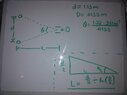
I know that in order for the two lights to be distinguishable from one another they have to be separated by an angle of at least theta = 1.22(wavelength)/(width of aperture). I tried drawing the given picture below and then using trig to find L in terms of d/2 and theta/2. However, this ended up not being the right answer, so now I am confused as to what to do next. Am I solving this in the correct way or is there something I'm missing?
 

Attachments

  • Lon Capa Question 1.jpg
    Lon Capa Question 1.jpg
    32.1 KB · Views: 154
Physics news on Phys.org
AManFromSpace said:
Relevant Equations:: theta = 1.22*(wavelength)/(width of aperature0

##~\dots~## and then using trig to find L in terms of d/2 and theta/2.
Why divide by 2? When L >> d the distance between headlights is, to a very good approximation, the same as an arc on a circle of radius L. How is the angle Δθ subtended by the arc related to the radius?
 
kuruman said:
Why divide by 2? When L >> d the distance between headlights is, to a very good approximation, the same as an arc on a circle of radius L. How is the angle Δθ subtended by the arc related to the radius?
@AManFromSpace used both the half angle and the half separation (see diagram), so the halving cancels out in the approximation.
 
haruspex said:
What answer did you get?
I got around 137300 meters
 
You haven’t shown all your working, which limits the amount of help we can provide. For example, you may have mixed up degrees and radians in your calculation.

And, to save you work, you may want to remember/use the ‘small angle approximation’: for a small angle (##\theta## expressed in radians), ##\theta ≈ tan(\theta) ≈ sin(\theta)##.