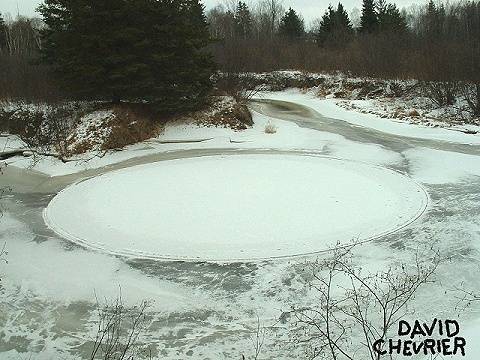
Ice Circles - Wild & Natural Wonders

  • Thread starter Thread starter DaveC426913
  • Start date Start date
  • Tags Tags
    Circles Ice
Click For Summary
SUMMARY

Ice circles are natural phenomena resulting from a unique combination of freezing ice and river eddies. They can be replicated in laboratory conditions, demonstrating their emergent and self-organizing properties. The formation process involves chunks of ice being caught in river eddies, where they rotate and freeze, creating a circular shape. This phenomenon is not a hoax or related to UFOs, but rather a fascinating example of physics in nature.

PREREQUISITES
  • Understanding of fluid dynamics and river eddies
  • Knowledge of ice formation processes
  • Familiarity with laboratory experimentation techniques
  • Basic principles of emergent phenomena in physics
NEXT STEPS
  • Research the physics of fluid dynamics and its applications in natural phenomena
  • Explore laboratory experiments that replicate ice circle formation
  • Study the role of temperature in ice formation and its effects on river ecosystems
  • Investigate other emergent phenomena in nature and their scientific explanations
USEFUL FOR

Scientists, environmental researchers, educators, and anyone interested in natural phenomena and the physics behind them will benefit from this discussion.

DaveC426913
Gold Member
2025 Award
Messages
24,258
Reaction score
8,383
You guys ever heard of these things?

I had no idea.

(No they're not hoaxes; they're completely natural.)
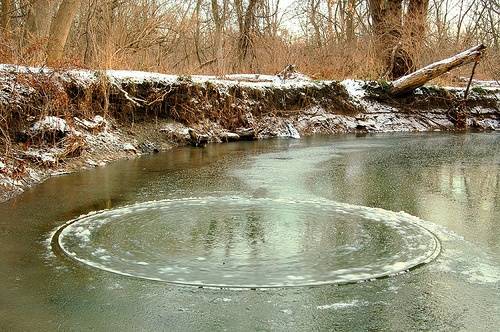
ice-circles.jpg

Here it is in motion:


ice-ring.jpg
 
Last edited by a moderator:
Earth sciences news on Phys.org
Very cool.
 
DaveC426913 said:
You guys ever heard of these things?

Haha, yes, the crop circle nuts have been talking about these for years!

Obviously UFOs land in ponds. :biggrin:
 
Ivan Seeking said:
Haha, yes, the crop circle nuts have been talking about these for years!

Obviously UFOs land in ponds. :biggrin:

Ha ha yeah. But these are not hoaxes. They're a natural and self-organizing property of a unique combination of freezing ice and river eddies. They can be recreated in a lab under the right conditions.
 
DaveC426913 said:
Ha ha yeah. But these are not hoaxes. They're a natural and self-organizing property of a unique combination of freezing ice and river eddies. They can be recreated in a lab under the right conditions.

Yes, but it can be pretty amusing reading alternative... ideas. Anyway, you asked, and yes I had seen them. :biggrin:
 
Ivan Seeking said:
Yes, but it can be pretty amusing reading alternative... ideas. Anyway, you asked, and yes I had seen them. :biggrin:
Ah. Wasn't sure what your take on them was.
 
DaveC426913 said:
Ah. Wasn't sure what your take on them was.

Oh Lord!
 
I've never seen anything like this. People see all kind of weird stuff - UFOs, aliens, etc. I've never seen anything weird. I feel unlucky.
 
Upisoft said:
I've never seen anything like this. People see all kind of weird stuff - UFOs, aliens, etc. I've never seen anything weird. I feel unlucky.
The beauty* of these is that they are repeatable in a lab.

*depending on your definition of beauty. Beauty is usually reserved for things that are ephemeral and/or fleeting. In this case, beauty means we can directly tie something very cool and strange to the physics of the universe instead of to some white-bearded guy with a staff. It is beautiful because it is emergent and spontaneous.
 
  • #10
So no one sees the metal ring at the outer edge of the circle? The water inside the ring isn't circulating so it cools more than the free-flowing stream and freezes. Duh.
DC
 
  • #11
DarioC said:
So no one sees the metal ring at the outer edge of the circle? The water inside the ring isn't circulating so it cools more than the free-flowing stream and freezes. Duh.
DC

No metal ring is required to explain this.

This is not an unexplained phenomenon; it is simply an awfully cool, naturally emergent process.

And what makes you think that the circle is freezing faster? That's not even part of the observed phenomenon. In fact, the reason this circle appears is because the ice in free water is growing out from the shore at the same time as it is growing out from the kernel of the circle. When they meet, they grind each other smooth even while continuing to grow.
 
Last edited:
  • #12
Not that any picture on the Internet means anything nowadays, but there is an obvious artificial (man-made) ring on the outside of both of these circles.

I am not implying that some kind of natural ice rings do not occur, even though I have never seen one. There are lots of things I haven't seen. But these rings, in these pictures, have a definite non-ice mechanical ring on the outside.

I wouldn't even care to venture a guess as to why you cannot see them.
 
  • #13
Bigger picture here:

http://img12.imageshack.us/f/3106547552f454d954e3o.jpg/"

I can't see a metal ring
 
Last edited by a moderator:
  • #14
willem2 said:
Bigger picture here:

http://img12.imageshack.us/f/3106547552f454d954e3o.jpg/"

I can't see a metal ring

How can you not see it?
 
Last edited by a moderator:
  • #15
DarioC said:
I wouldn't even care to venture a guess as to why you cannot see them.

Integral said:
How can you not see it?

Because I do not have "magic eyes" like you two do. My eyes see only an image, they cannot tell that the dark ring is made out of metal atoms. Would you guys mind telling me what type of metal atoms they are? Or do your magic eyes have limits?

Seriously. Ice circles have been replicated in labs under these conditions. There is nothing mysterious here; they're just really cool.
 
  • #16
OK, in the big picture it still looks like there is a mechanical ring, but there is a video of one in "Cinnamon Creek" where I can see a very precise little unfrozen water ring around the outside of the circle. It sure does look like there is a metal edge with a slope to it in the picture(s), but it is very possible, likely, that it is that same little water separation as in the Video. The lighting or something sure makes it look like the edge of a an artificial ring to me even when I know what it must be.

I stand corrected, good thing I looked at the video, sure makes a precise circle.

Pretty interesting.
DC
 
Last edited:
  • #17
DaveC426913 said:
Because I do not have "magic eyes" like you two do. My eyes see only an image, they cannot tell that the dark ring is made out of metal atoms. Would you guys mind telling me what type of metal atoms they are? Or do your magic eyes have limits?

Seriously. Ice circles have been replicated in labs under these conditions. There is nothing mysterious here; they're just really cool.

I have no problem with the existence of ice rings. It is not difficult to visualize the processes which will produce them.

However, the one in that pic is not what you are talking about, it is ice accumulating on a metal ring. Note that there is no significant ice anywhere but on that ring ie no shore ice. The material of the ring is plainly visible in the pic. Not sure what the problem is.

I would suggest that you not use that pic as an example of ice rings.
 
  • #18
Integral said:
The material of the ring is plainly visible in the pic. Not sure what the problem is.

Occam's razor. A metal ring existing where no metal ring is required. The presence of a metal ring is harder and more awkward to explain than simply accepting the known phenomenon as it is, with an odd illusion that there's a dark ring which might be open water or some such.

You're seeing a UFO and thinking ET, rather than secret government craft. You're hearing hoof beats and thinking zebra instead of horse.


BTW, are we still talknig about the large pic?

This one?
http://img12.imageshack.us/f/3106547552f454d954e3o.jpg/

I don't see any metal ring, I see a moat of open water a few inches wide. I would bet water is welling up through the crack; the water below there is quite active. Note also btw, that it is a long shutter shot - the ice sheet is blurred in circular motion. This means any movement in the water-moat is blurred as well. That may affect what you expect to see.

See pic for the part I'm examining. What are you seeing exactly?
 

Attachments

  • icecircle_closeup.jpg
    icecircle_closeup.jpg
    22.7 KB · Views: 575
Last edited:
  • #19
How would you let that imaginary metal ring float in the first place?

some more here.

I wonder where you buy these metal rings
 
  • #20
Yep that one.


I am not sure where that stream is, I do not know who's land it crosses, I do not know why they put the ring there. But there it is visible for anyone who wishes to see it.

Unless you have superior knowledge about the pic you will have to explain to me why the ring is there without the support of shore ice.

Believe what you want Dave.
 
  • #21
Integral, Dave, ah a fresh morning and I can see the problem clearly now. If I look at the narrow (sorry I have to use the word ring) around the ice circle and picture it as the flat ribbon on water between the circle inside and the ice outside, I see it that way. A flat narrow circular band of water. The marks that make it look like the edge of a metal band are the reflections off the trees in the background.

If I chose to see it as a ring of shiny material, like the top of a huge drain pipe, I see it that way. I can flip it back and forth. I am sure now that it is just a flat water separator between the two areas of ice.

Integral, you might want to look at the video that comes up on the side at the link to the bigger picture. I think it is labeled "Cinnamon creek." You can see pretty clearly what is going on.

Dave, I suggest that you look at the pic in a different light and realize how easy it is for us to think there's some solid ring surrounding the center circular plane of ice, because when we are not familiar with the thing we are seeing we all make it what fits with our visual experience.
DC
 
Last edited:
  • #22
What is really funny is that the first thing that went through my mind when I saw what was really going on was: Is there a possibility for using this phenomenon as a controlled manufacturing process?

One can retire, but one cannot get away from one's calling. chuckle.
 
  • #23
So an 'counter inituitive" natural phenomonon triggers an interesting optical illusion. I tried but I really can't see a metal ring, only open water.

But maybe it's also something of a lesson for the UFO branch? In this case of course, the Unidentified Floating Object.

 
Last edited by a moderator:
  • #24
Note that in the Cinnamon Creek video there is a ice sheet surrounding the disk. This is a natural ice ring.

Once again in this pic :

http://img12.imageshack.us/f/3106547552f454d954e3o.jpg/

there is no supporting ice sheet, there has to be something keeping that ice in place, a ring.

Andre, why you think it is a floating ring is beyond me, clearly it is stationary therefore must be anchored in the stream bed. Once again I have no knowledge about the whys, all I know is what I can see in the pic. Even if there is a vortex in the stream at that position there will be a net flow and the ring, if it is free floating, would end up against the edge of the stream.
 
  • #25
So now we know. The guy that supposedly invented the wheel stole the idea from Mother Nature!
 
  • #26
Integral said:
Once again in this pic :

http://img12.imageshack.us/f/3106547552f454d954e3o.jpg/

there is no supporting ice sheet, there has to be something keeping that ice in place, a ring.
The above makes no sense. What is a 'supporting ice sheet'? What do you mean 'keeping the ice in place'?

We have a single, large, solid ice sheet that has been ground to a circle even as it expanded while freezing, we have a surrounding surface of river that may be solid ice or may be a loose-packed layer of smaller chunks. Either way, it too is ground along its boundary into a circle.

The ice sheet is stable because it is sitting on the very river eddy vortex that spawned it in the first place.


Integral said:
all I know is what I can see in the pic.

No you're not; you are making all sorts of assumptions about what you think you see.
 
  • #27
This is not speculation. I watched the entire experiment done in a lab on TV.

http://www.yourdiscovery.com/video/weird-or-what-ice-circles/
The show itself is dumb, granted, but they showed a solid ten minutes of the lab experiment, doen in a warehouse-sized scale model riverscape. The scientist goes into great detail about conditions. He does get the ice circle to form, though it is not as pretty or convincing as the natural ones.


They key is that these ice sheets always occur where there are eddies in the river. There's a semi-blockage at the outlet, so the ice comes in faster than it can leave. They also only occur when the temperature is juuuust right that ice is forming at a certain speed. Too fast, and the river simply gets jammed and freezes over. Too slow and the sheets do not grow faster than they are dissipated.

Here's how it happens:

  • Chunks or small sheets of ice float down from upriver.
  • They get caught in the eddy and circle. Some stay, some escape downriver.
  • The eddy acquires a small nucleus of loosely packed sheets (think of this nucleus like a Lagrange point - small, loose chunks gently bumping into each other).
  • The ice sheet grows as more material comes downstream. It continues rotate gently in the vortex. It can freeze solid now, since its component parts are stationary wrt each other.
  • Simultaneously, ice is growing out from the banks of the river.
  • Eventually, the ice sheet and the shore ice will touch, initially at a single point. The circular motion of the ice sheet grinds against the outcrop and knocks it off.
  • The ice sheet, large and sitting in its vortex, has enough to momentum to stay in place (This was tough to control in the lab. The sheet skept getting locked.)
  • Both ice sheet and shore ice grow. They grind at each other, even while the gap betweem then is narrowing. Eventually the gap will be quite narrow, and thus, since the ice sheet is still spinning, the gap will have to be virtually circular.
  • If things proceed just right, the gap gets down to just a couple of inches, thus the ice sheet is no more than a couple of inches from truly circular.
That's it.

The balance is delicate, and there are many places where it can fail (such as the temperature constraints, and the rotational 'locking'). So that explains why they are so rare.

Inconsistencies in temperature will result in various flavours of outcome. For example, you can see that some ice sheets have formed then frozen over completely, whether because of a temperature drop or just that they are more advanced.
 
Last edited:
  • #28
Integral said:
Note that in the Cinnamon Creek video there is a ice sheet surrounding the disk. ... clearly it is stationary therefore must be anchored in the stream bed. ...

The Cinnamon creek circle is not stationary. You can see the displacement due to rotation from the red line on the right:

124bsdu.jpg
 
  • #29
Looks to me like a band of water that is separating the still ice from the rotating ice.

What gets me though, is, has this area of water any properties that differ from the normal (ice, water, steam) solid, liquid, gas?

I mean, why is the band so wide if its only friction that's wearing away the ice edge?
 
  • #30
scupydog said:
I mean, why is the band so wide if its only friction that's wearing away the ice edge?

The ice puck is slowly spinning because one half of it is in a stronger current than the other half. Typical water wheel logic, right? The downstream portion of the puck is pushed against the sheet attached to the bank which acts like a tool, slowly grinding the edge as it spins in the current (no exotic "vortices" are needed, BTW). Any eddies or turbulence will move the spinning puck in ways such that it contacts other parts of the ice sheet, grinding there as well as the downstream site. It appears that about an inch or two spacing is developed by this turbulence.

Mother Nature's lathe!
 

Similar threads

  • · Replies 11 ·
Replies
11
Views
5K
  • · Replies 18 ·
Replies
18
Views
4K
  • · Replies 15 ·
Replies
15
Views
9K
  • · Replies 3 ·
Replies
3
Views
1K
Replies
6
Views
2K
Replies
2
Views
2K
  • · Replies 15 ·
Replies
15
Views
9K
  • · Replies 1 ·
Replies
1
Views
2K
  • · Replies 9 ·
Replies
9
Views
1K
  • · Replies 1 ·
Replies
1
Views
3K