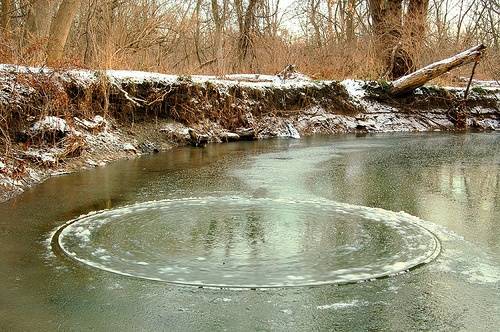
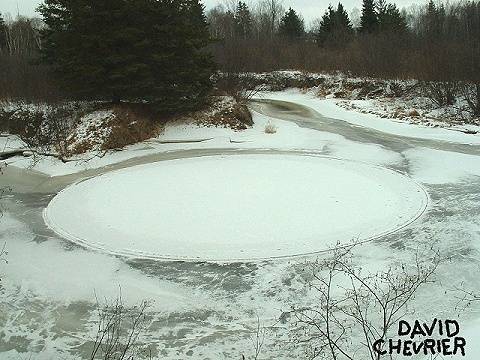
This is not speculation. I watched the entire experiment done in a lab on TV.
http://www.yourdiscovery.com/video/weird-or-what-ice-circles/
The show itself is dumb, granted, but they showed a solid ten minutes of the lab experiment, doen in a warehouse-sized scale model riverscape. The scientist goes into great detail about conditions. He does get the ice circle to form, though it is not as pretty or convincing as the natural ones.
They key is that these ice sheets always occur where there are eddies in the river. There's a semi-blockage at the outlet, so the ice comes in faster than it can leave. They also only occur when the temperature is juuuust right that ice is forming at a certain speed. Too fast, and the river simply gets jammed and freezes over. Too slow and the sheets do not grow faster than they are dissipated.
Here's how it happens:
- Chunks or small sheets of ice float down from upriver.
- They get caught in the eddy and circle. Some stay, some escape downriver.
- The eddy acquires a small nucleus of loosely packed sheets (think of this nucleus like a Lagrange point - small, loose chunks gently bumping into each other).
- The ice sheet grows as more material comes downstream. It continues rotate gently in the vortex. It can freeze solid now, since its component parts are stationary wrt each other.
- Simultaneously, ice is growing out from the banks of the river.
- Eventually, the ice sheet and the shore ice will touch, initially at a single point. The circular motion of the ice sheet grinds against the outcrop and knocks it off.
- The ice sheet, large and sitting in its vortex, has enough to momentum to stay in place (This was tough to control in the lab. The sheet skept getting locked.)
- Both ice sheet and shore ice grow. They grind at each other, even while the gap betweem then is narrowing. Eventually the gap will be quite narrow, and thus, since the ice sheet is still spinning, the gap will have to be virtually circular.
- If things proceed just right, the gap gets down to just a couple of inches, thus the ice sheet is no more than a couple of inches from truly circular.
That's it.
The balance is delicate, and there are many places where it can fail (such as the temperature constraints, and the rotational 'locking'). So that explains why they are so rare.
Inconsistencies in temperature will result in various flavours of outcome. For example, you can see that some ice sheets have formed then frozen over completely, whether because of a temperature drop or just that they are more advanced.