Ideal Gas Behavior: Choose the Right Diagram

Click For Summary
SUMMARY

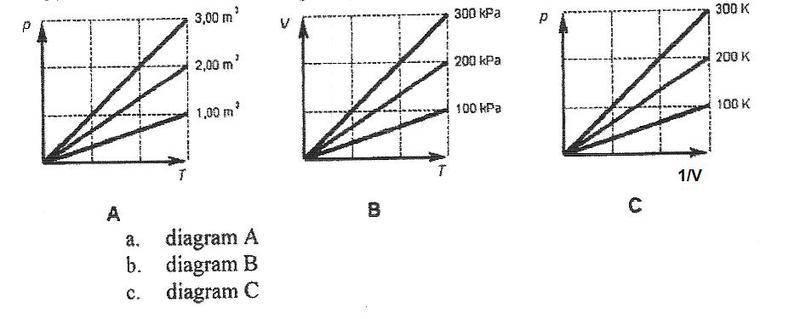
The discussion centers on identifying the correct diagram that represents the behavior of an ideal gas, specifically diagram C. The ideal gas law, expressed as PV = nRT, is fundamental to understanding the relationships between pressure (P), volume (V), and temperature (T). The participants clarify that diagram C accurately illustrates how a larger temperature results in a steeper slope, while diagrams A and B incorrectly depict the relationships between the variables. The key takeaway is that understanding the slopes in relation to the ideal gas law is essential for interpreting these diagrams correctly.

PREREQUISITES
  • Understanding of the Ideal Gas Law (PV = nRT)
  • Familiarity with graph interpretation in physics
  • Knowledge of the relationships between pressure, volume, and temperature
  • Basic algebra for manipulating equations
NEXT STEPS
  • Study the derivation and applications of the Ideal Gas Law (PV = nRT)
  • Learn about graphical representations of gas laws and their slopes
  • Explore the implications of changing temperature on gas behavior
  • Investigate real gas behavior versus ideal gas behavior
USEFUL FOR

This discussion is beneficial for physics students, educators, and anyone interested in thermodynamics and gas laws, particularly those studying the behavior of ideal gases in various conditions.
b_andries
Messages
13
Reaction score
0
Hi guys,

Can someone explain me please how to find the following question?
Which diagram represents the behavior of an ideal gas the most?

attachment.php?attachmentid=35606&d=1305538124.jpg


I know it's C but I don't know why. They all seem to represent the behavior of a ideal gas.
But why C mor than the others?

Thanks
 

Attachments

  • diagram.jpg
    diagram.jpg
    27.2 KB · Views: 525
Physics news on Phys.org
What is the equation that relates P, V and T for an ideal gas?

What is the relationship between P and T if V is constant (first graph)?

What is the relationship between V and T if P is constant (second graph)?

What is the relationship between P and 1/V if T is constant (third graph)?

AM
 
What is the equation that relates P, V and T for an ideal gas?

P.V = n.R.T

What is the relationship between P and T if V is constant (first graph)?
==>T instead of V is constant here no(same values on x-axis)?

P.V = n.R. = constant so this should be wrong because there is a slope

What is the relationship between V and T if P is constant (second graph)?
isn't here also T constant instead of P?

V = n.R /P
So if V rises than P has to decline
This graph would not be possible because T is constant and P and V both rise.What is the relationship between P and 1/V if T is constant (third graph)?

Volume here is constant(same values on x-axis)
P= n.R.T (So if P rises T has to Rise too)
In this case they both rise so it would also be possible
 
b_andries said:
What is the equation that relates P, V and T for an ideal gas?

P.V = n.R.T
You don't need the .'s. Just: PV = nRT
What is the relationship between P and T if V is constant (first graph)?
==>T instead of V is constant here no(same values on x-axis)?
No. P is on the y-axis and T is on the x axis. Each line represents the points (P,T) for which V has the same value (that value is stated at the end of the line).

What is the relationship between V and T if P is constant (second graph)?
isn't here also T constant instead of P?
No. V is on the y-axis and T is on the x axis. Each line represents the points (V,T) for which P has the same value (that value is stated at the end of the line).

What is the relationship between P and 1/V if T is constant (third graph)?

Volume here is constant(same values on x-axis)
No. P is on the y-axis and 1/V is on the x axis. Each line represents the points (P,1/V) for which T has the same value (that value is stated at the end of the line).

AM
 
Ok thanks,

Now i know what I've done wrong
 
b_andries said:
Ok thanks,

Now i know what I've done wrong
Can you explain why c) is the correct answer (and why a) and b) do not fit: PV=nRT?)

AM
 
P(1/V)= nRT 1/V (function P with respect to 1/V)
So here nRT represents the slope of the graph
A larger Temperature gives a larger slope, which is what diagram C shows
So diagram C is correct.


P(T) = nR/V T(function P with respect to T)
So nR/V represents the slope of the graph
A Larger volume should give smaller slope, but in diagram A, larger V gives larger slope.
So diagram A is wrong.


V(T) = nR/P T(function V with respect to T)
So nR/P represents the slope of the graph
A Larger Pressure should give a smaller slope, but in diagram B, larger Pressure gives a larger slope.
Thus diagram B is wrong.

Am I correct?
 
b_andries said:
P(1/V)= nRT 1/V (function P with respect to 1/V)
So here nRT represents the slope of the graph
A larger Temperature gives a larger slope, which is what diagram C shows
So diagram C is correct.


P(T) = nR/V T(function P with respect to T)
So nR/V represents the slope of the graph
A Larger volume should give smaller slope, but in diagram A, larger V gives larger slope.
So diagram A is wrong.


V(T) = nR/P T(function V with respect to T)
So nR/P represents the slope of the graph
A Larger Pressure should give a smaller slope, but in diagram B, larger Pressure gives a larger slope.
Thus diagram B is wrong.

Am I correct?
Yes. Very well explained.

AM
 

Similar threads

  • · Replies 33 ·
2
Replies
33
Views
2K
  • · Replies 2 ·
Replies
2
Views
2K
  • · Replies 17 ·
Replies
17
Views
7K
  • · Replies 9 ·
Replies
9
Views
912
Replies
2
Views
2K
Replies
10
Views
2K
  • · Replies 4 ·
Replies
4
Views
2K
  • · Replies 3 ·
Replies
3
Views
4K
Replies
16
Views
4K
Replies
11
Views
3K