If the speed of light depended on the source's velocity

Click For Summary

Discussion Overview

The discussion revolves around the implications of light speed in relation to the motion of its source, particularly in the context of the Doppler effect and observations of celestial bodies. Participants explore theoretical aspects, mathematical formulations, and interpretations of course notes from a relativity class.

Discussion Character

  • Exploratory
  • Technical explanation
  • Debate/contested
  • Mathematical reasoning

Main Points Raised

  • Some participants discuss the observation of a star in circular motion, noting that light emitted while the star is moving toward the observer can arrive before light emitted earlier when the star is moving away.
  • There is a contention regarding the classical Doppler effect, where one participant argues that classical formulations of light speed adding with the source's velocity are incorrect compared to relativistic observations.
  • Another participant expresses confusion about the 'Doppler effect' being proportional to acceleration, suggesting that the course notes lack clarity on this topic.
  • One participant describes how the "ballistic Doppler shift" could vary with the emitter's acceleration, affecting the timing of light reaching the observer.
  • Several participants share links to external resources, including animations and explanations related to the emission theory and Doppler effect.
  • There are discussions about the quality of course materials, with some participants expressing dissatisfaction and suggesting alternative resources for learning relativity.

Areas of Agreement / Disagreement

Participants express differing views on the interpretation of the Doppler effect and the adequacy of the course notes. There is no consensus on the correct formulation of the Doppler effect in accelerated frames, and the discussion remains unresolved regarding the implications of acceleration on light emission.

Contextual Notes

Some participants note that the course notes are lacking in detail, particularly regarding the mathematical treatment of the Doppler effect in accelerated frames. There are references to additional readings and resources that may provide further insight.

Who May Find This Useful

This discussion may be useful for students and enthusiasts of relativity, particularly those interested in the nuances of the Doppler effect and the implications of light speed in varying contexts. It may also benefit those seeking alternative learning resources in physics.

homer
Messages
46
Reaction score
0
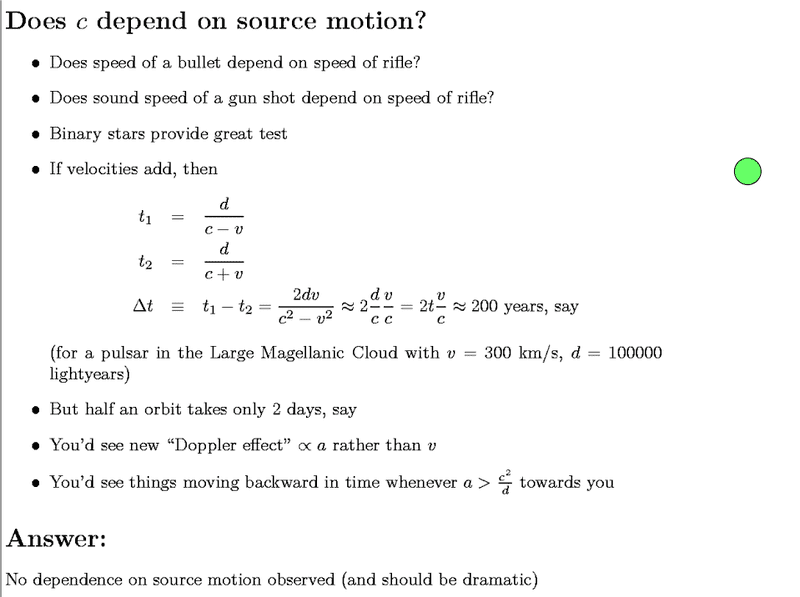
This from a page of notes on MIT's Relativity course 8.033:

http://ocw.mit.edu/courses/physics/8-033-relativity-fall-2006/

Can someone please explain a bit what's going on in the last two bullet points? I'm not sure where they come from.
Oqy2XLp.png
 
Physics news on Phys.org
I guess the point of the last bullet is that suppose you observe a shining star in a circular orbit. During the part of the orbit where the star is moving toward you, it "throws" the light A in your direction, and the light overtakes and passes the light B that had been previously emitted. So you'd receive light A first, followed by light B which actually was emitted earlier.
 
  • Like
Likes   Reactions: 1 person
Thanks Bill! That makes sense for the last one.
 
homer said:
Thanks Bill! That makes sense for the last one.

the "Doppler bullet" is rather weirdly phrased. I believe that what he wants to say is the following:

1. In the classical theory, light speed "adds" with the speed of the source, so, the two stars appear blue/red shifted by:

[tex]f_r=(1-v/c)f_0[/tex]
[tex]f_b=(1+v/c)f_0[/tex]

2. By contrast, what we observe is:

[tex]f'_r=\sqrt{\frac{1-v/c}{1+v/c}}f_0=\gamma(1-v/c)f_0>f_r[/tex]

[tex]f'_b=\sqrt{\frac{1+v/c}{1-v/c}}f_0=\gamma(1+v/c)f_0>f_b[/tex]

The difference is small but not negligible. So, 1. is wrong.

I started looking at the class notes, they are pretty bad.
 
Last edited:
  • Like
Likes   Reactions: 1 person
Bill_K said:
I guess the point of the last bullet is that suppose you observe a shining star in a circular orbit. During the part of the orbit where the star is moving toward you, it "throws" the light A in your direction, and the light overtakes and passes the light B that had been previously emitted. So you'd receive light A first, followed by light B which actually was emitted earlier.
You would also see two images sometimes. Here is a nice animation on this:
http://en.wikipedia.org/wiki/Emission_theory#Astronomical_sources
 
  • Like
Likes   Reactions: 1 person
xox said:
the "Doppler bullet" is rather weirdly phrased. I believe that what he wants to say is the following:

1. In the classical theory, light speed "adds" with the speed of the source, so, the two stars appear blue/red shifted by:

[tex]f_r=(1-v/c)f_0[/tex]
[tex]f_b=(1+v/c)f_0[/tex]

2. By contrast, what we observe is:

[tex]f'_r=\sqrt{\frac{1-v/c}{1+v/c}}f_0=\gamma(1-v/c)f_0>f_r[/tex]

[tex]f'_b=\sqrt{\frac{1+v/c}{1-v/c}}f_0=\gamma(1+v/c)f_0>f_b[/tex]

The difference is small but not negligible. So, 1. is wrong.

I started looking at the class notes, they are pretty bad.

I'm totally at a loss for the 'doppler effect' proportional to acceleration. The notes are pretty thin at times. I looked ahead to the notes on Calculus of Variations and there is absolutely nothing on it in the notes! Though I have been reading Goldstein and doing the NTNU Classical Mechanics course based on it, so I'll survive without that part in 8.033 I guess. Oh well, can still do the suggested readings from Resnick's book.
 
Last edited:
homer said:
I'm totally at a loss for the 'doppler effect' proportional to acceleration.

Tegmark's course notes aren't very good on this subject

The notes are pretty thin at times.

You can safely ignore his bullet. It should be replaced with what you see in my post.


I looked ahead to the notes on Calculus of Variations and there is absolutely nothing on it in the notes! Though I have been reading Goldstein and doing the NTNU Classical Mechanics course based on it, so I'll survive without that part in 8.033 I guess. Oh well, can still do the suggested readings from Resnick's book.

You can see a good explanation of Doppler in accelerated frames here. If I were you, I would drop Tegmark's class altogether.
 
  • #10
homer said:
I'm totally at a loss for the 'doppler effect' proportional to acceleration.
When you look at the animation, you see that the "ballistic Doppler shift" would change during propagation, when faster light would catch up to previously emitted slower light. The greater the emitter acceleration, the greater the speed difference between light emitted with a certain time difference would be. So the "ballistic Doppler shift" would depend on the acceleration. And also on the distance to the emitter, which would give the fast light more time to catch up.

You can view the expected "visual time reversal" in the last point, as an extreme form of Doppler shift, where the wave would be squashed beyond zero, into a mirrored image of the original waveform. So it would arrive backwards at the receiver.
 
  • #11
xox said:
If I were you, I would drop Tegmark's class altogether.

xox, do you have any recommendations for free relativity courses that you think are pretty good? I saw a video course on NPTEL and have really liked some of their math courses, but the SR course has no assignments posted. The main reason I have been following 8.033 is to have good homework assignments to work on while doing the suggested readings. As bad as the notes are, the first two homework assignments have been pretty fun. I loved the one on estimating the speed of light from 6 months of accumulated period excesses for Io around Jupiter as the Earth moves from opposition away to conjunction.

Thanks!
 
  • #12
homer said:
xox, do you have any recommendations for free relativity courses that you think are pretty good? I saw a video course on NPTEL and have really liked some of their math courses, but the SR course has no assignments posted. The main reason I have been following 8.033 is to have good homework assignments to work on while doing the suggested readings. As bad as the notes are, the first two homework assignments have been pretty fun. I loved the one on estimating the speed of light from 6 months of accumulated period excesses for Io around Jupiter as the Earth moves from opposition away to conjunction.

Thanks!

I am very partial to the Feynman Lectures on Physics. It has the great advantage that you have classical and relativistic mechanics side by side.
 

Similar threads

  • · Replies 22 ·
Replies
22
Views
2K
  • · Replies 33 ·
2
Replies
33
Views
4K
  • · Replies 53 ·
2
Replies
53
Views
7K
  • · Replies 45 ·
2
Replies
45
Views
7K
  • · Replies 21 ·
Replies
21
Views
2K
  • · Replies 5 ·
Replies
5
Views
2K
  • · Replies 146 ·
5
Replies
146
Views
11K
  • · Replies 15 ·
Replies
15
Views
3K
  • · Replies 34 ·
2
Replies
34
Views
4K
  • · Replies 13 ·
Replies
13
Views
3K