Imaginary factor in WAVE guide TE field

Click For Summary
SUMMARY

The discussion centers on the impact of the imaginary factor in the TE10 mode field equations of waveguides, specifically using the equations derived from Pozar's microwave textbook. The key equation presented is E_{y} = \frac{-jωμm\pi}{k^{2}a} A sin\frac{mx\pi}{a} e^{-jβz}, where the imaginary factor \frac{-jωμm\pi}{k^{2}a} is crucial in determining the phase shift of the electric field. The conclusion drawn is that this factor introduces a 90° phase delay in the electric field as it propagates along the z direction, confirmed through the application of complex number identities.

PREREQUISITES
  • Understanding of TE modes in waveguides
  • Familiarity with Maxwell's equations
  • Knowledge of complex numbers and their application in electromagnetic fields
  • Proficiency in using Pozar's microwave engineering concepts
NEXT STEPS
  • Study the derivation of TE modes in waveguides using Pozar's Microwave Engineering
  • Learn about the implications of phase shifts in electromagnetic wave propagation
  • Explore the mathematical treatment of complex fields in electromagnetic theory
  • Investigate the effects of boundary conditions on waveguide modes
USEFUL FOR

Electrical engineers, microwave engineers, and students studying electromagnetic theory who are focused on waveguide design and analysis.

FrankJ777
Messages
140
Reaction score
6
Hey guys. I'm trying to comprehend the TEmn EM fields in wave guides. I've gone through the derivation, using Pozar's microwave textbook, and for the most part it's straight forward. I am having a hard time though determining what the effect of the imaginary factor in the field equations are.
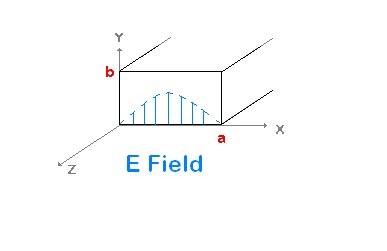
Here is the simplest case, a TE10 wave propagating in the z direction, with a picture of the waveguide dimentions and the E field as I would imagine it to be.
The E and H fields are given as:

E[itex]_{y}[/itex] = [itex]\frac{-jωμm\pi}{k^{2}a}[/itex] A sin[itex]\frac{mx\pi}{a}[/itex] e[itex]^{-jβz}[/itex]

H[itex]_{x}[/itex] = [itex]\frac{jβm\pi}{k^{2}a}[/itex] A sin[itex]\frac{mx\pi}{a}[/itex] e[itex]^{-jβz}[/itex]
k1an3a.jpg


I understand there is a dependency on z from the e[itex]^{-jβz}[/itex] factor.
I also understand there is a time and frequency dependancy (not shown) from e[itex]^{jωt}[/itex] factor.
But what I'm really trying to understand is, how does the factor, [itex]\frac{-jωμm\pi}{k^{2}a}[/itex] , effect the fields?
I'm not sure how I should tread the imaginary factor in this case.
Thanks a lot.
 
Engineering news on Phys.org
When we use complex numbers to describe real quantities, such as amplitudes of fields along a waveguide, the real value is found by multiplying by e^jωt then taking the real part.

Ey(x,y,z,t) = [itex]Re[\frac{-jωμm\pi}{k^{2}a}[/itex] A sin[itex]\frac{mx\pi}{a}[/itex] e[itex]^{-jβz}[/itex]e[itex]^{jωt}][/itex]:

These steps are not written explicitly but are understood.
 
Thanks emi guy, but I think you missunderstood what part I was asking about. I got that there is an assumed factor e[itex]^{jωt}[/itex], but what I didn't understand was the first factor, colored red, in the Ey field equation below.

Ey(x,y,z,t) = Re [itex][\frac{-jωμm\pi}{k^{2}a}[/itex] A sin[itex]\frac{mx\pi}{a}[/itex] e[itex]^{-jβz}[/itex]e[itex]^{jωt}][/itex]:

I've been thinking about it though, about what it's affect on the E field is. If you could tell me if I'm right or not I'd be grateful.
Using the identity: j = e[itex]^{j\frac{\pi}{2}}[/itex]

The Ey field becomes:
Ey(x,y,z,t) = Re [itex][\frac{ωμm\pi}{k^{2}a}[/itex] A sin[itex]\frac{mx\pi}{a}[/itex] e[itex]^{-jβz}[/itex]e[itex]^{jωt}[/itex] e[itex]^{-j\frac{\pi}{2}}[/itex] ]

which is
[itex][\frac{ωμm\pi}{k^{2}a}[/itex] A sin[itex]\frac{mx\pi}{a}[/itex] cos([itex]\omega[/itex]t - βz - 90°)

which will just delay the phase 90° as the wave propagates along the z direction.

Hope I'm on the right track. Thanks!
 

Similar threads

  • · Replies 1 ·
Replies
1
Views
2K
  • · Replies 15 ·
Replies
15
Views
3K
  • · Replies 1 ·
Replies
1
Views
2K
Replies
8
Views
2K
  • · Replies 5 ·
Replies
5
Views
1K
  • · Replies 11 ·
Replies
11
Views
4K
Replies
92
Views
6K
  • · Replies 16 ·
Replies
16
Views
2K
  • · Replies 1 ·
Replies
1
Views
1K
  • · Replies 2 ·
Replies
2
Views
2K