qbar
- 2
- 0
- TL;DR
- Let $$Y(t)=tanh(ln(1+Z(t)^2))$$ where Z(t) is the Hardy Z function; How to calculate the implicit derivative of the curve defined by $$Re(Y(t(u)+is(u)))=0$$?
Let $$Y(t)=tanh(ln(1+Z(t)^2))$$ where Z is the Hardy Z function; I'm trying to calculate the pedal coordinates of the curve defined by $$L = \{ (t (u), s (u)) : {Re} (Y (t (u) + i s (u)))_{} = 0 \}$$ and $$H = \{ (t (u), s (u)) : {Im} (Y (t (u) + i s (u)))_{} = 0 \}$$ , and for that I need to calculate the derivative of $$t(u)$$ and $$s(u)$$ for which the parametric form is not available. When I tried to apply the chain rule, I ended up with
$$\frac{dy}{dx} = - \frac{\frac{d}{dx} Y(x + iy)}{\frac{d}{dy}(Y(x + iy))} = i$$
which I don't think is correct. I have written an article about it with more information at https://github.com/crowlogic/Y/blob/master/tanhln1plusZsquared.pdf
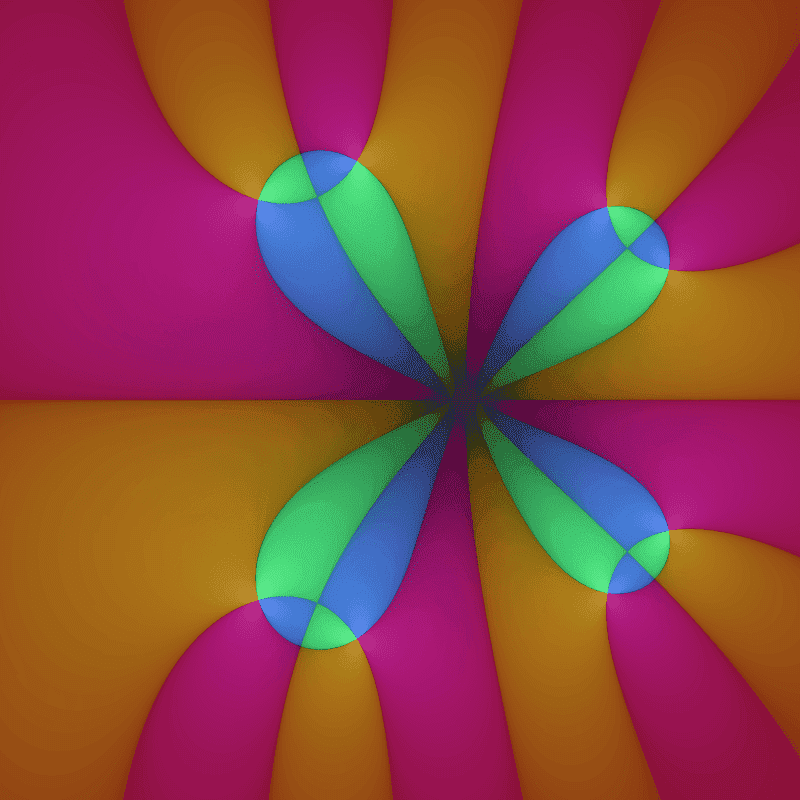
Here is a composite image generated by the real and imaginary parts of Y from 7004.5-0.5i to 7005.5+0.5i (showing a region of the neighborhood surrounding the first Lehmer pair) generated with https://github.com/crowlogic/Y/blob/master/src/complex_plot.c:
Here is the imaginary part vanishing alone over the same range, with aspect ratio maintained
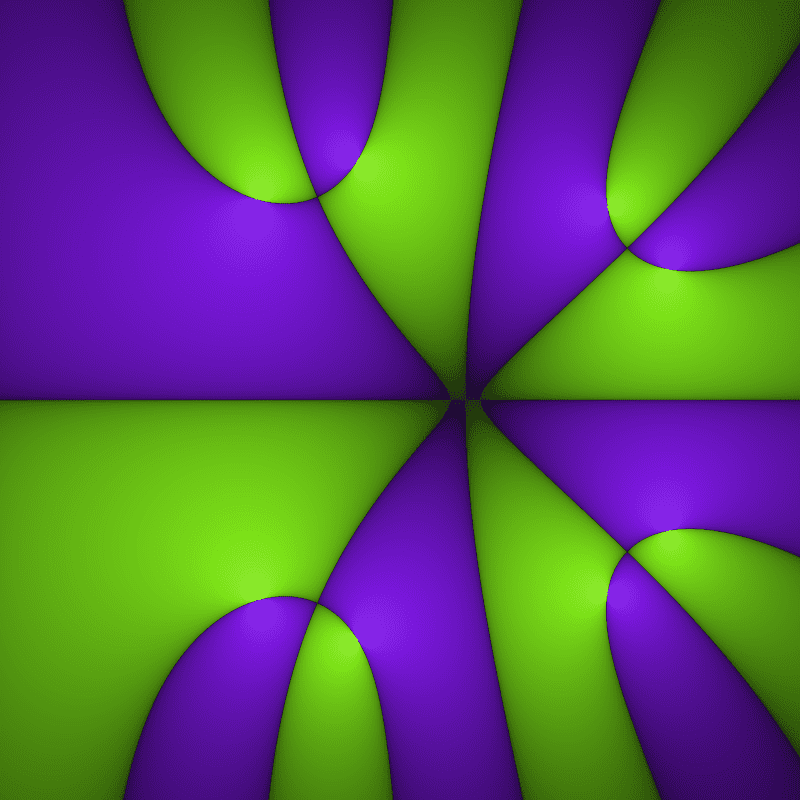
Here is the same range where the real part vanishes

Does anyone have any ideas on how to differentiate these curves ? Specifically, where the real part of Y vanishes?
Does there exist an expression for the tangent line of $$L = \{ (t (u), s (u)) : {Re} (Y (t (u) + i s (u))) = 0 \}$$ ?
There is a maple procedure to calculate the path at https://github.com/crowlogic/Y/blob/master/tracecurve.mplActually, I just realized I can use finite differences.. it doesn't appear that they are pedal curves of one another.. or if they are, the pedal point is not the root
$$\frac{dy}{dx} = - \frac{\frac{d}{dx} Y(x + iy)}{\frac{d}{dy}(Y(x + iy))} = i$$
which I don't think is correct. I have written an article about it with more information at https://github.com/crowlogic/Y/blob/master/tanhln1plusZsquared.pdf
Here is a composite image generated by the real and imaginary parts of Y from 7004.5-0.5i to 7005.5+0.5i (showing a region of the neighborhood surrounding the first Lehmer pair) generated with https://github.com/crowlogic/Y/blob/master/src/complex_plot.c:
Here is the imaginary part vanishing alone over the same range, with aspect ratio maintained
Here is the same range where the real part vanishes
Does anyone have any ideas on how to differentiate these curves ? Specifically, where the real part of Y vanishes?
Does there exist an expression for the tangent line of $$L = \{ (t (u), s (u)) : {Re} (Y (t (u) + i s (u))) = 0 \}$$ ?
There is a maple procedure to calculate the path at https://github.com/crowlogic/Y/blob/master/tracecurve.mplActually, I just realized I can use finite differences.. it doesn't appear that they are pedal curves of one another.. or if they are, the pedal point is not the root
Last edited: