How to Calculate Impulse and Average Net Force in a Baseball Collision

  • Thread starter Thread starter SohailS
  • Start date Start date
  • Tags Tags
    Baseball Impulse
Click For Summary
SUMMARY

The discussion focuses on calculating impulse and average net force during a baseball collision. The baseball, with a mass of 0.152 kg, initially moves at 32.0 m/s [E] and, after being struck, reaches a velocity of 52.0 m/s [W 20° N]. The impulse is calculated as 12.6 Ns [W 78° N], and the average net force is determined to be 6300 N [W 78° N]. Key calculations involve breaking down the velocity vectors and applying the impulse-momentum theorem.

PREREQUISITES
  • Understanding of impulse and momentum concepts
  • Ability to decompose vectors into components
  • Familiarity with Newton's second law of motion
  • Basic proficiency in trigonometry for angle calculations
NEXT STEPS
  • Study the impulse-momentum theorem in detail
  • Learn how to resolve vectors into their components
  • Explore applications of Newton's second law in collision scenarios
  • Practice problems involving impulse and average force calculations
USEFUL FOR

Students studying physics, particularly those focusing on mechanics and collision analysis, as well as educators seeking to clarify concepts of impulse and force in practical scenarios.

SohailS
Messages
5
Reaction score
0
Hello, I am taking physics 12U through correspondence. I am having issues with this problem. I don't know why but I feel like I made a mistake in this. Can you guys check this question and verify my results.

Thanks, very much. :smile:

Homework Statement


A baseball with a mass of 0.152 kg is moving horizontally at 32.0 m/s [E], when it is struck by a bat for 0.00200 seconds. The velocity of the ball just after the collision is 52.0 m/s [W 20° N].

a) Find the impulse experienced by the ball. (6 marks)​

b) Find the average net force of the ball. (2 marks)​

Given:

m_{} = 0.152 kg​
v_{1} = 32.0 m/s [E]​
t{} = 0.00200 s​
v_{2} = 52 m/s [W 20° N]​

Homework Equations


\vec{ΔP}=\vec{F}_{NET}Δt​
F_{NET}Δt=m(v_{2}-v_{1})​

The Attempt at a Solution


a)​
\vec{ΔP}=?​
F_{NET}Δt=m(v_{2}-v_{1})​

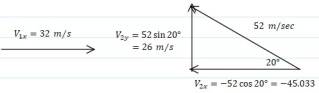
Break down vectors into components
2i6nkfo.jpg


solve for components

\vec{P}_{x}=0.152(-45.033-32)=-11.7 Ns​
\vec{P}_{y}=0.152(26-0)=39.52 Ns​

P=\sqrt{(-11.7)^{2}+(39.52)^{2}}=41.2 Ns​
θ=tan^{-1}\frac{39.52}{11.7}=73°​

∴\vec{ΔP}=41.2 Ns [W 73° N]​

b)​
F_{NET}Δt=41.2 Ns​
\vec{F}_{NET}=\frac{41.2}{0.002}=20,609 N [W 73° N]​
 
Physics news on Phys.org
SohailS said:
\vec{P}_{y}=0.152(26-0)=39.52 Ns​
Check your arithmetic here.
 
SohailS said:
\vec{P}_{y}=0.152(26-0)=39.52 Ns​

Doc Al said:
Check your arithmetic here.

Thanks for pointing that out. I have corrected that error.
Is there anything else wrong with the solution?

solve for components

\vec{P}_{x}=0.152(-45.033-32)=-11.7 Ns​
\vec{P}_{y}=0.152(26-0)=3.952 Ns​

P=\sqrt{(-11.7)^{2}+(3.952)^{2}}=12.4 Ns​
θ=tan^{-1}\frac{3.952}{11.7}=19°​

∴\vec{ΔP}=12.4 Ns [W 19° N]​

b)​
F_{NET}Δt=12.4 Ns​
\vec{F}_{NET}=\frac{12.4}{0.002}=6179 N [W 19° N]​
 
Last edited:
SohailS said:
Break down vectors into components
2i6nkfo.jpg
Check your computation of those components of the final velocity.
 
SohailS said:
Break down vectors into components
2i6nkfo.jpg
Doc Al said:
Check your computation of those components of the final velocity.

Wow, I can't believe I did that. I used 30 degrees instead of 20 there. hah!
I need to pay attention when I input the values into the calculator.

I have made the changes. Please let me know if you see anything else wrong with it. particularly part b) I don't know if that is how it is supposed to be calculated.

solve for components

\vec{P}_{x}=0.152(-48.86-32)=-12.29 Ns​
\vec{P}_{y}=0.152(17.79-0)=2.703 Ns​

P=\sqrt{(-12.29)^{2}+(2.703)^{2}}=12.58 Ns​
θ=tan^{-1}\frac{12.29}{2.703}=78°​

∴\vec{ΔP}=12.6 Ns [W 78° N]​

b)​
F_{NET}Δt=12.6 Ns​
\vec{F}_{NET}=\frac{12.6}{0.002}=6300 N [W 78° N]​
 
SohailS said:
θ=tan^{-1}\frac{12.29}{2.703}=78°​
I think you mixed up your components when calculating the angle.

Other than that, your solution looks good. (Since the force of the bat is so much greater than the weight of the ball, it's OK to ignore the weight of ball in calculating the net force from the bat.)
 
Thanks, I am going to get some sleep and then do the rest of the questions. I really botched that lol.
I really appreciate your help.
 

Similar threads

  • · Replies 5 ·
Replies
5
Views
2K
  • · Replies 4 ·
Replies
4
Views
5K
  • · Replies 13 ·
Replies
13
Views
3K
  • · Replies 5 ·
Replies
5
Views
6K
  • · Replies 2 ·
Replies
2
Views
3K
  • · Replies 29 ·
Replies
29
Views
2K
  • · Replies 20 ·
Replies
20
Views
8K
Replies
13
Views
5K
  • · Replies 1 ·
Replies
1
Views
2K
  • · Replies 23 ·
Replies
23
Views
3K