Inelastic collision in two dimensions

Click For Summary
SUMMARY

The discussion centers on simulating inelastic collisions in two dimensions, specifically for 2D balls. The user seeks clarification on the velocity components before and after the collision, referencing the Wikipedia page on elastic collisions. The confusion arises from the interpretation of x1 and x2, which are indeed vector representations of the ball's positions, not scalars. Understanding these vectors is crucial for accurately calculating the resulting velocities post-collision.

PREREQUISITES
  • Understanding of vector mathematics, particularly in two dimensions.
  • Familiarity with collision physics, specifically inelastic collisions.
  • Knowledge of programming concepts for simulating physical interactions.
  • Experience with mathematical modeling and simulations in programming environments.
NEXT STEPS
  • Study the principles of inelastic collisions in physics.
  • Learn about vector operations, including dot products and their applications in collision detection.
  • Explore simulation frameworks that support 2D physics, such as Unity or Box2D.
  • Research mathematical modeling techniques for simulating real-world physics in programming.
USEFUL FOR

Programmers and game developers interested in implementing realistic 2D physics simulations, particularly those focusing on collision mechanics and vector mathematics.

Christopher Munroe
Messages
1
Reaction score
0
I am a programmer trying to simulate some 2D balls bouncing about and colliding with each other. I have both the ball's velocity components before the collision and I am trying to solve for them. I went to wikipedia to find a formula to satisfy my needs and ran into this section: https://en.wikipedia.org/wiki/Elastic_collision#Two-dimensional_collision_with_two_moving_objects
I am attempting to use an angle free representation as it is more convenient for my current design:
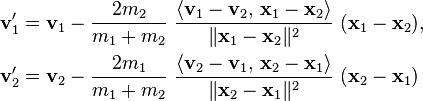
3a70e57f4a5cc0e5e0e11be153aa4b10.png


I am somewhat confused by it. The passage states the changed velocities are computed using the centers x1 and x2 at the time of contact. Isn't x1 and x2 scalars, I'm not sure what x1 and x2 are to be quite honest. If they are scalars, then we cannot perform a dot product. I am sorry if this is trivial, I appreciate any guidance.
 
Physics news on Phys.org
They are vectors, with the two components of ##\mathbf{x}_i## corresponding to ##(x_i,y_i)##.
 

Similar threads

  • · Replies 8 ·
Replies
8
Views
2K
  • · Replies 6 ·
Replies
6
Views
2K
  • · Replies 1 ·
Replies
1
Views
2K
  • · Replies 9 ·
Replies
9
Views
2K
  • · Replies 2 ·
Replies
2
Views
6K
  • · Replies 10 ·
Replies
10
Views
5K
  • · Replies 14 ·
Replies
14
Views
4K
  • · Replies 4 ·
Replies
4
Views
2K
  • · Replies 6 ·
Replies
6
Views
2K
  • · Replies 13 ·
Replies
13
Views
3K