Infinitely stretchable elastic band

  • Context: Graduate 
  • Thread starter Thread starter orlan2r
  • Start date Start date
  • Tags Tags
    Band Elastic
Click For Summary
SUMMARY

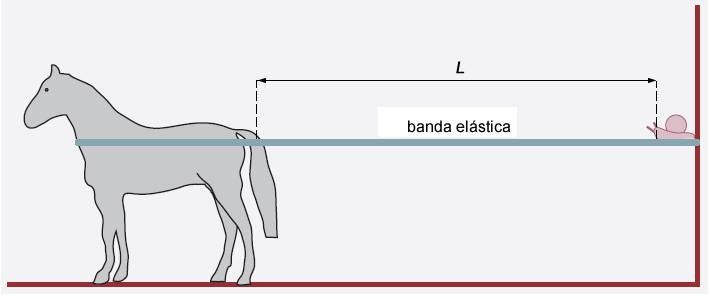
The discussion revolves around a physics brain teaser involving an infinitely stretchable elastic band attached to a wall and a horse, with a snail positioned near the wall. The initial length of the band is denoted as L, and the horse and snail move at constant speeds v and u, respectively, where v > u. The key question is determining the time it takes for the snail to reach the horse, emphasizing the composition of movements between the snail and the elastic band. This problem has been previously referenced in a similar mathematical context on Physics Forums.

PREREQUISITES
  • Understanding of kinematics and relative motion
  • Familiarity with concepts of infinite series and limits
  • Basic knowledge of elastic properties and stretching mechanics
  • Experience with mathematical problem-solving techniques
NEXT STEPS
  • Research the mathematical principles behind infinite series and convergence
  • Explore kinematic equations for relative motion in variable systems
  • Study the properties of elastic materials and their behavior under tension
  • Investigate similar brain teasers and their solutions for deeper insight
USEFUL FOR

Students, educators, and physics enthusiasts interested in problem-solving, particularly in the realms of kinematics and mathematical physics.
orlan2r
Messages
31
Reaction score
0
Imagine an infinitely stretchable elastic band where one end is attached to a vertical wall and the other on a horse, as shown in figure. On the elastic band, very close to the wall, there is a snail. If we assume that the initial length of the band is L, and the horse and snail start moving with constant rapideces v y u (v > u), respectively, how long time the snail reached the horse?
caballo_caracol.jpg
 
Physics news on Phys.org
Is this a brain teaser or for schoolwork? It doesn't really fit in the Classical Physics forum.
 
The problem referred by AlephZero is simliar but is purely mathematical.
I propuse a physics brain teaser.
In this case we can say the snail's movement respect to the Earth result of composition of movements: their own movement respect of the elastic band and the movement of the point of the elastic band on which is located
 

Similar threads

  • · Replies 3 ·
Replies
3
Views
3K
  • · Replies 3 ·
Replies
3
Views
5K
  • · Replies 6 ·
Replies
6
Views
533
  • · Replies 25 ·
Replies
25
Views
3K
  • · Replies 3 ·
Replies
3
Views
2K
  • · Replies 3 ·
Replies
3
Views
1K
  • · Replies 9 ·
Replies
9
Views
4K
  • · Replies 5 ·
Replies
5
Views
3K
  • · Replies 11 ·
Replies
11
Views
2K
  • · Replies 1 ·
Replies
1
Views
2K