Inner working of a linear actuator

Click For Summary
SUMMARY

The discussion focuses on the operational principles of linear actuators, specifically how current applied to a solenoid generates magnetic fields that move the plunger. The mechanism relies on Ampere’s Law, where the high permeability of the plunger enhances the magnetic fields, producing a force that facilitates horizontal movement. The conversation also delves into the relationship between energy, force, and the plunger's position within the coil, emphasizing that the energy of the magnetic field decreases as the plunger is inserted, thus requiring less energy to maintain the field. Additionally, the role of dissipation, particularly through the Joule effect, is acknowledged but deemed secondary to understanding the actuator's primary function.

PREREQUISITES
  • Ampere’s Law
  • Magnetic field theory
  • Understanding of solenoids
  • Basic principles of energy and force
NEXT STEPS
  • Research the principles of solenoid design and operation
  • Study the relationship between magnetic fields and force generation in actuators
  • Explore the effects of permeability on magnetic field strength
  • Investigate the Joule effect and its implications in electrical systems
USEFUL FOR

Engineers, physicists, and students interested in electromechanical systems, particularly those working with linear actuators and solenoid mechanisms.

geft
Messages
144
Reaction score
0
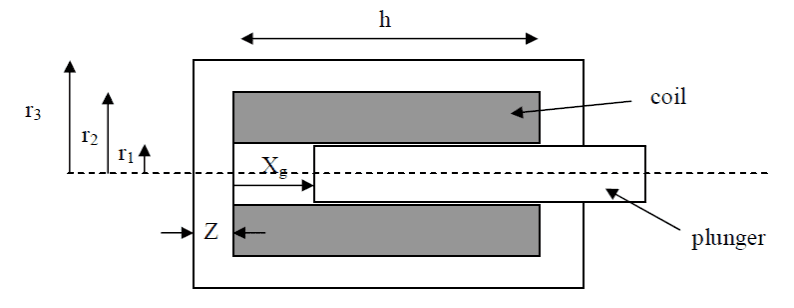
I need to describe the working mechanism for the following actuator.
gswl6.png


Here's what I've written so far:
Current is applied to the solenoid in order to induce magnetic fields within the actuator in accordance to Ampere’s Law. Since the plunger has high permeability, the magnetic fields produced would be strengthened and confined to the actuator. The fields produce a force which in turn moves the plunger horizontally.

However, I feel that I'm missing something. In particular, how is the force that moves the plunger generated? Is it really due to the magnetic fields? I know of the right hand rule where force points away in the direction of the palm but according to that rule, the force should actually point in the direction perpendicular to the supposed plunger movement. Is it driven by the mmf?
 
Physics news on Phys.org
The simplest way to consider it is through energy: the more "plunger" you have inside the coil, the lower the energy. Force is just the spatial derivative of the energy, so it enters. In fact, in absence of friction, it will just come out the other side and oscillate.

An "Ampere law" version is more complicated, seriously.
 
But where does that energy come from? Since this actuator is driven by current, how does the total electrical energy change with respect to the size of the plunger inside?
 
When putting current through the coil, you need some energy to fight dissipation, and also some energy to create the external magnetic field. The energy of the magnetic field is proportional to the permeability times B^2, integrated to all the volume. When you put the plunger inside the coil, the magnetic field is cheaper to maintain.
 
I see, but why do we need energy to fight dissipation? I thought dissipation is due to energy?
 
Don't worry about dissipation to understand this, even if it is not present, the plunger will feel the force inwards.

In any case, dissipation is due to Joule effect: dissipated power = intensity times voltage drop...
 

Similar threads

Replies
18
Views
2K
Replies
6
Views
1K
  • · Replies 7 ·
Replies
7
Views
2K
  • · Replies 9 ·
Replies
9
Views
3K
  • · Replies 2 ·
Replies
2
Views
2K
Replies
11
Views
2K
  • · Replies 3 ·
Replies
3
Views
4K
  • · Replies 1 ·
Replies
1
Views
5K
  • · Replies 3 ·
Replies
3
Views
2K
  • · Replies 4 ·
Replies
4
Views
3K