Inner working of a linear actuator

Click For Summary

Discussion Overview

The discussion focuses on the working mechanism of a linear actuator, particularly how the force that moves the plunger is generated. Participants explore concepts related to magnetic fields, energy, and dissipation within the context of the actuator's operation.

Discussion Character

  • Exploratory
  • Technical explanation
  • Conceptual clarification
  • Debate/contested

Main Points Raised

  • One participant describes the actuator's mechanism involving the application of current to a solenoid, which induces magnetic fields that move the plunger horizontally.
  • Another participant suggests considering the actuator's operation through energy principles, stating that the force is related to the spatial derivative of energy and that the plunger may oscillate in the absence of friction.
  • A question is raised about the source of energy when the actuator is driven by current and how it relates to the plunger's position within the coil.
  • Another participant explains that energy is required to maintain the external magnetic field and to counteract dissipation, noting that the energy of the magnetic field is proportional to the permeability and the square of the magnetic field strength.
  • A participant questions the need for energy to combat dissipation, expressing confusion about the relationship between dissipation and energy.
  • One reply reassures that understanding dissipation is not necessary for grasping the force felt by the plunger, while also mentioning the Joule effect in relation to dissipated power.

Areas of Agreement / Disagreement

Participants express differing views on the mechanisms of force generation and the role of energy and dissipation, indicating that multiple competing perspectives remain without consensus.

Contextual Notes

There are unresolved questions regarding the relationship between energy, dissipation, and the plunger's position, as well as the implications of applying Ampere's Law in this context.

geft
Messages
144
Reaction score
0
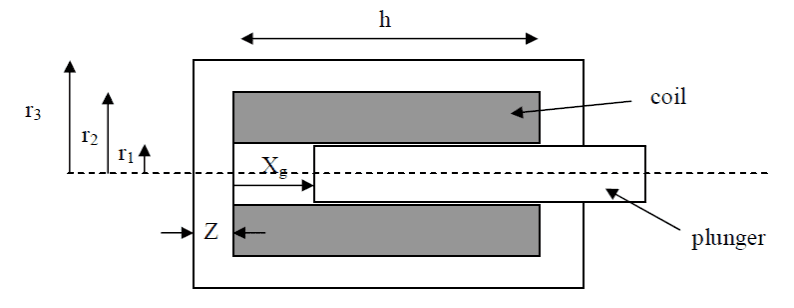
I need to describe the working mechanism for the following actuator.
gswl6.png


Here's what I've written so far:
Current is applied to the solenoid in order to induce magnetic fields within the actuator in accordance to Ampere’s Law. Since the plunger has high permeability, the magnetic fields produced would be strengthened and confined to the actuator. The fields produce a force which in turn moves the plunger horizontally.

However, I feel that I'm missing something. In particular, how is the force that moves the plunger generated? Is it really due to the magnetic fields? I know of the right hand rule where force points away in the direction of the palm but according to that rule, the force should actually point in the direction perpendicular to the supposed plunger movement. Is it driven by the mmf?
 
Physics news on Phys.org
The simplest way to consider it is through energy: the more "plunger" you have inside the coil, the lower the energy. Force is just the spatial derivative of the energy, so it enters. In fact, in absence of friction, it will just come out the other side and oscillate.

An "Ampere law" version is more complicated, seriously.
 
But where does that energy come from? Since this actuator is driven by current, how does the total electrical energy change with respect to the size of the plunger inside?
 
When putting current through the coil, you need some energy to fight dissipation, and also some energy to create the external magnetic field. The energy of the magnetic field is proportional to the permeability times B^2, integrated to all the volume. When you put the plunger inside the coil, the magnetic field is cheaper to maintain.
 
I see, but why do we need energy to fight dissipation? I thought dissipation is due to energy?
 
Don't worry about dissipation to understand this, even if it is not present, the plunger will feel the force inwards.

In any case, dissipation is due to Joule effect: dissipated power = intensity times voltage drop...
 

Similar threads

Replies
18
Views
2K
Replies
6
Views
2K
  • · Replies 7 ·
Replies
7
Views
3K
  • · Replies 9 ·
Replies
9
Views
3K
  • · Replies 2 ·
Replies
2
Views
2K
Replies
11
Views
2K
  • · Replies 3 ·
Replies
3
Views
4K
  • · Replies 1 ·
Replies
1
Views
5K
  • · Replies 3 ·
Replies
3
Views
2K
  • · Replies 4 ·
Replies
4
Views
3K