Insight/Intuition into rotations in R²

Click For Summary
The discussion focuses on understanding rotation matrices in R², specifically the equations x' = x cos(θ) - y sin(θ) and y' = x sin(θ) + y cos(θ). The user seeks a visual and intuitive explanation of how the terms -y sin(θ) and x sin(θ) affect the values along the axes, questioning whether these contributions maintain the correct distance from the origin. They express frustration with algebraic proofs and prefer geometric interpretations to clarify their understanding. The conversation also touches on the relationship between the components of the rotation and the orientation in the plane, emphasizing the need for visual aids to grasp the concepts effectively. Visual explanations are essential for a better understanding of rotation matrices.
STENDEC
Messages
21
Reaction score
0
I've been using rotation matrices for quite some time now without fully grasping them. Whenever I tried to develop an intuitive understanding of...<br /> x&#039; = x\cos\theta - y\sin\theta \\<br /> y&#039; = x\sin\theta + y \cos\theta<br />... I failed and gave up. I've looked at numerous online texts and videos, but following the step-by-step explanations didn't lead to me seeing the whole picture as I had hoped.

Could someone explain to me (like I'm 5 years old), why -y\sin\theta and x\sin\theta are used to affect the value along the other axis?

Looking at the following picture (pardon the quality):
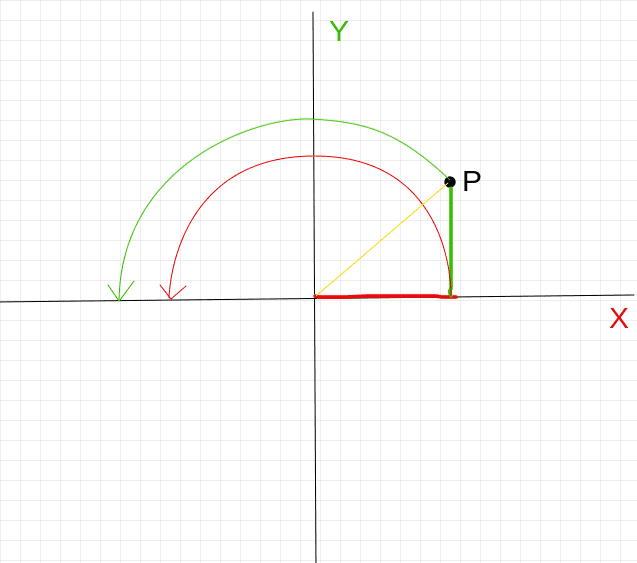
drawing.png

Is the contribution of y to x and vice versa there, to ensure that P maintains the correct distance to the origin, or is that a misguided simplification of mine? The yellow line cannot be sin + cos (Pythagorean theorem) yet I may combine these two to get x&#039; and y&#039;. Do you see where my gap in understanding lies? Is there a drawing that could clarify how these terms combine to give the correct value we observe? Algebraic proofs don't work with me I'm afraid, I need a geometric/visual explanation.
 
Last edited:
Mathematics news on Phys.org
The component ##\left(\begin{smallmatrix}x\cos\theta\\y\cos\theta\end{smallmatrix}\right)## represents the projection of ##\left(\begin{smallmatrix}x'\\y'\end{smallmatrix}\right)## onto the original vector ##\left(\begin{smallmatrix}x\\y\end{smallmatrix}\right)##. The other component (the "rejection") should therefore have magnitude ##|\sqrt{x^2+y^2}\sin\theta|## and be orthogonal to the projection. There are two unique solutions for such a vector.

Finally, when ##\theta## is nonzero but less than a straight angle, an increase in ##y'## corresponds to a decrease in ##x'##; i.e., the x-component of the rejection should be negative. (This condition is equivalent to a choice of orientation on ##\mathbb{R}^2##.) This tells us which solution is the desired one.

As for your drawing, I don't quite understand what you mean. Could you elaborate?
 
Here is a little puzzle from the book 100 Geometric Games by Pierre Berloquin. The side of a small square is one meter long and the side of a larger square one and a half meters long. One vertex of the large square is at the center of the small square. The side of the large square cuts two sides of the small square into one- third parts and two-thirds parts. What is the area where the squares overlap?

Similar threads

  • · Replies 1 ·
Replies
1
Views
2K
  • · Replies 1 ·
Replies
1
Views
2K
  • · Replies 1 ·
Replies
1
Views
1K
  • · Replies 4 ·
Replies
4
Views
2K
  • · Replies 1 ·
Replies
1
Views
3K
  • · Replies 1 ·
Replies
1
Views
4K
  • · Replies 13 ·
Replies
13
Views
6K
  • · Replies 4 ·
Replies
4
Views
1K
  • · Replies 2 ·
Replies
2
Views
2K
  • · Replies 27 ·
Replies
27
Views
3K