Discussion Overview
The discussion revolves around calculating the volume of a solid of revolution formed by revolving a parabola, specifically the function y = ax², around the x-axis. Participants explore different methods for deriving the volume and express concerns about dimensional consistency and the correctness of their approaches.
Discussion Character
- Technical explanation
- Mathematical reasoning
- Debate/contested
Main Points Raised
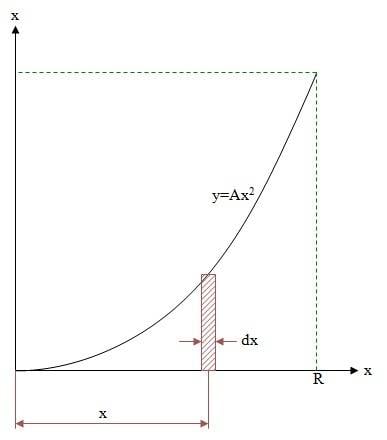
- One participant proposes a formula for volume as $$V=\int_0^R\pi xdx\cdot y=\pi A\frac{R^4}{4}$$ and asserts that the volume should be proportional to R³.
- Another participant questions the formula used, suggesting it should be $$V=\int_{0}^{R}\pi f^{2}(x)\,d\,x$$ instead.
- Concerns are raised about the interpretation of the formula, particularly regarding the inclusion of the term ##x\cdot y##.
- A participant describes the volume as the sum of vertical tubes with changing height and infinitesimal thickness, emphasizing the need to consider the area of disks when revolving the parabola.
- Multiple methods are presented, with one participant calculating the volume using different approaches and arriving at the same result, but questioning the dimensional consistency of their findings.
- Another participant highlights the importance of the dimension of the constant A, suggesting it must have a specific unit to ensure the volume calculation yields correct dimensional results.
Areas of Agreement / Disagreement
Participants express differing views on the correct formula and approach for calculating the volume of the solid of revolution. There is no consensus on the best method or the dimensional interpretation of the constant A.
Contextual Notes
Participants note potential issues with dimensional consistency in their calculations, particularly regarding the units of the constant A and the resulting volume expressions.