Ιntegral calculation : (sin(x))^4 * (cos(x))^6

Click For Summary
SUMMARY

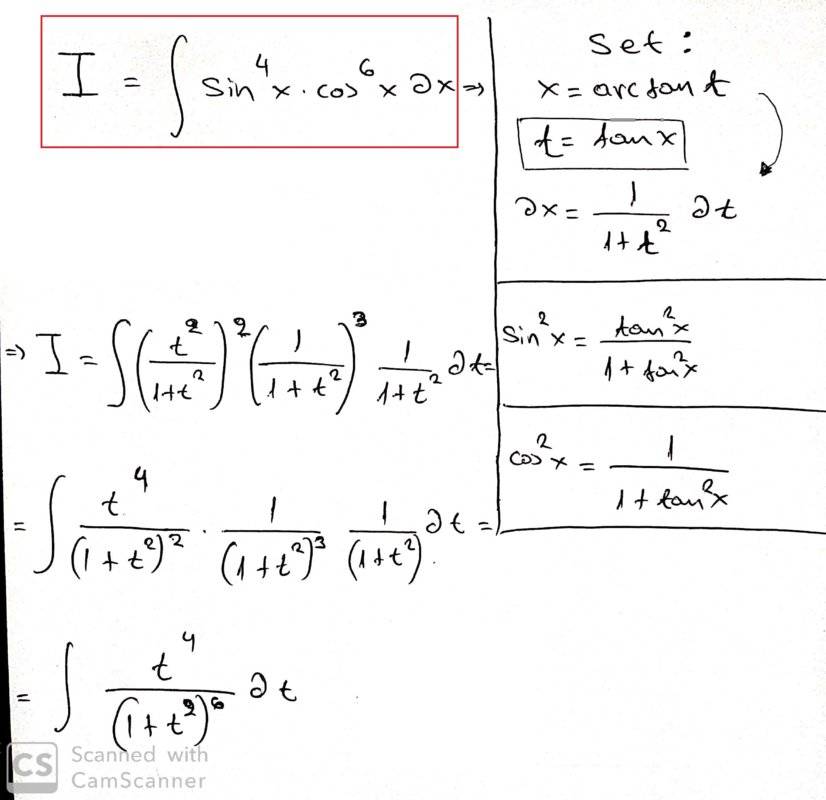
The discussion focuses on calculating the integral of the function (sin(x))^4 * (cos(x))^6. Participants suggest using the substitution x=arctan(t) and applying integration by parts, specifically the formula for integrating sin^n x and cos^m x. The integration by parts method is emphasized as a reliable approach, leading to a recursive formula that simplifies the calculation. The conversation highlights the importance of having standard integrals readily available for such calculations.

PREREQUISITES
  • Understanding of trigonometric identities and transformations
  • Familiarity with integration techniques, particularly integration by parts
  • Knowledge of recursive formulas in calculus
  • Ability to manipulate and simplify trigonometric functions
NEXT STEPS
  • Study the derivation and applications of the integration by parts formula
  • Explore the use of trigonometric identities in integral calculus
  • Learn about recursive methods for solving integrals involving powers of trigonometric functions
  • Review standard integrals of sin^n x and cos^m x for quick reference
USEFUL FOR

Students, educators, and professionals in mathematics or engineering fields who are working on integral calculus, particularly those dealing with trigonometric integrals.
Michael_0039
Messages
59
Reaction score
7
Summary: Ιntegral calculation : (sin(x))^4 * (cos(x))^6

Hi all,
I tried to solve it, but I got stuck. An advice from my professor is to set: x=arctan(t)

Τhanks.
New Doc 2019-09-26 18.01.07.jpg
 
Physics news on Phys.org
Alternatively, you can get a formulas for the integral of ##\sin^n x## and ##\cos^n x## from repeated integration by parts.

They are on my list of standard integrals.
 
Since both trigonometric functions lead to one another and back by differentiation and integration, integration by parts is usually how they are solved. Doing it twice should reduce the power of one while keeping the other one stable. This leads to a recursion, or can just be repeated until a single function is left.

I have found the formula on Wikipedia.
 
  • Like
Likes   Reactions: Michael_0039
Thanks for your answers! I tried another way using the following trigonometric transformation formulas:

New Doc 2019-09-26 19.48.48_3.jpg


Now it's in simple format:
New Doc 2019-09-26 19.48.48_1.jpg


New Doc 2019-09-26 19.48.48_2.jpg


Do you know a better - faster way to solve it ?

Thanks.
 
Yes, integration by parts. Still.
$$
\int \sin^n x \cos^m x \,dx = -\dfrac{\sin^{n-1}x \cos^{m+1}x}{n+m} +\dfrac{n-1}{n+m}\int \sin^{n-2} x \cos^m x \,dx
$$
 
  • Like
Likes   Reactions: PeroK and Michael_0039
Michael_0039 said:
Do you know a better - faster way to solve it ?

Thanks.

I would have started with ##\sin^4 x = (1 - \cos^2 x)^2 = 1 - 2\cos^2x + cos^4x##.

Then used parts to calculate the integral of the various powers of ##\cos x##.

This is so useful and common that I keep the recursion formula in my list of standard integrals.
 
  • Like
Likes   Reactions: fresh_42 and Michael_0039
fresh_42 said:
Yes, integration by parts. Still.
$$
\int \sin^n x \cos^m x \,dx = -\dfrac{\sin^{n-1}x \cos^{m+1}x}{n+m} +\dfrac{n-1}{n+m}\int \sin^{n-2} x \cos^m x \,dx
$$
A thing of beauty!
 

Similar threads

  • · Replies 5 ·
Replies
5
Views
2K
  • · Replies 3 ·
Replies
3
Views
2K
Replies
3
Views
2K
  • · Replies 15 ·
Replies
15
Views
2K
  • · Replies 40 ·
2
Replies
40
Views
4K
Replies
5
Views
2K
Replies
4
Views
2K
  • · Replies 5 ·
Replies
5
Views
2K
  • · Replies 11 ·
Replies
11
Views
2K
  • · Replies 5 ·
Replies
5
Views
2K