SUMMARY
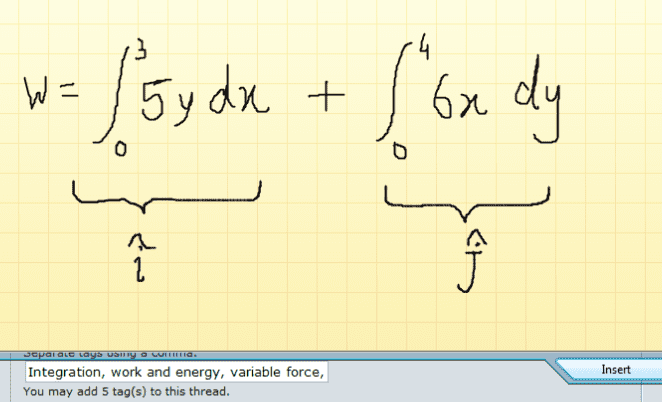
The discussion focuses on calculating work done by a force vector F = 5y i + 6x j when displacing from the point (0,0) to (3,4). The work is expressed as W = ∫F ds, leading to W = ∫5y dx + ∫6x dy with limits set from (0,0) to (3,4). A critical point raised is the dependency of work on the path taken if the force vector is not conservative. The participants conclude that assuming a straight-line path simplifies the integration process, allowing for straightforward calculation of work done.
PREREQUISITES
- Understanding of vector calculus and force vectors
- Familiarity with line integrals and their applications
- Knowledge of conservative and non-conservative forces
- Basic proficiency in calculus, particularly integration techniques
NEXT STEPS
- Study the properties of conservative vector fields and their implications on work done
- Learn about line integrals in vector calculus
- Explore potential functions and their relationship with force vectors
- Practice integration along different paths to understand work calculation variations
USEFUL FOR
Students in physics or engineering, particularly those studying mechanics, as well as educators looking to enhance their understanding of work calculations in vector fields.