Integration of partials, specifically Euler to Bernoulli Equation

Click For Summary

Discussion Overview

The discussion revolves around the mathematical derivation from Euler's Equation to Bernoulli's Equation, focusing specifically on the integration of partial derivatives and the interpretation of terms within the equations.

Discussion Character

  • Technical explanation
  • Mathematical reasoning

Main Points Raised

  • One participant expresses difficulty in understanding the integration of partial derivatives in the transition from Euler's to Bernoulli's Equation.
  • Another participant suggests using the chain rule to clarify how dp can be expressed in terms of partial derivatives.
  • A third participant proposes that the term gH represents a constant that has a physical interpretation, specifically relating to the concept of "Head" in fluid mechanics.
  • There is a suggestion that the notation could be improved for clarity regarding the constant and its physical meaning.

Areas of Agreement / Disagreement

Participants generally agree on the use of the chain rule for partial derivatives, but there is uncertainty regarding the interpretation of gH and its derivation from boundary conditions.

Contextual Notes

There are unresolved aspects regarding the definition of H and the specific boundary conditions that lead to the inclusion of gH in the equations.

zuppi
Messages
5
Reaction score
0
Hi!

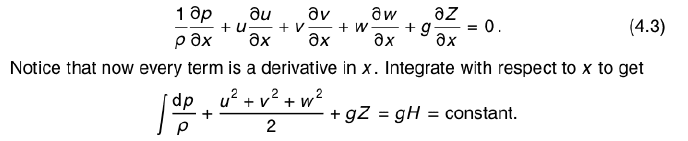
I am having trouble following the derivation from Euler's Equation to Bernoulli's Equation. The trouble lies in the math, not the physics part. Especially the step when partial derivatives are being integrated.
I have attached the relevant part as a screenshot.
Euler.PNG


How does the partial dp/dx change into dp? And where does gH come from?

Any help will be much appreciated!
 
Physics news on Phys.org
You can simply note that, by the chain rule [itex]dp=\frac{\partial p}{\partial x}dx[/itex]. As far as gH is concerned, I think it should probably come from your boundary conditions. You need some information to determine the constant.
However, I don't know what H is so I can't really answer your question.
 
  • Like
Likes   Reactions: 1 person
Thanks, that makes sense, I forgot about the chain rule for partials.
Concerning gH I believe it is just another way of expressing the constant to give it a more physical meaning. With H being the "Head" measured in meters. They should have written ... = constant = g*H to make it more clear.
 
Sounds reasonable.
 

Similar threads

  • · Replies 1 ·
Replies
1
Views
3K
  • · Replies 4 ·
Replies
4
Views
2K
Replies
2
Views
1K
Replies
1
Views
2K
  • · Replies 6 ·
Replies
6
Views
5K
  • · Replies 4 ·
Replies
4
Views
3K
Replies
5
Views
2K
  • · Replies 6 ·
Replies
6
Views
3K
Replies
1
Views
4K
  • · Replies 13 ·
Replies
13
Views
3K