Integration of x^2/(xsinx+cosx)^2

  • Thread starter Thread starter JasonHathaway
  • Start date Start date
  • Tags Tags
    Integration
Click For Summary
SUMMARY

The integral \(\int\frac{x^{2}}{(x\sin x+\cos x)^{2}} dx\) can be transformed into \(\int x\sec x \frac{x\cos x}{(x\sin x+\cos x)^{2}} dx\) through the multiplication of the numerator and denominator by \(\frac{\cos x}{\cos x}\). This manipulation utilizes the identity \(\cos(x)\cdot\sec(x) = 1\), allowing for simplification in the integration process. The discussion confirms that the approach is valid and provides insight into the underlying calculus techniques involved.

PREREQUISITES
  • Understanding of integral calculus
  • Familiarity with trigonometric identities
  • Knowledge of integration techniques such as integration by parts
  • Experience with substitution methods in calculus
NEXT STEPS
  • Study trigonometric substitutions in integral calculus
  • Learn about integration by parts with specific examples
  • Explore advanced techniques for simplifying integrals
  • Investigate the properties of secant and cosine functions in calculus
USEFUL FOR

Students and professionals in mathematics, particularly those studying calculus, as well as educators looking for examples of integration techniques and trigonometric manipulation.

JasonHathaway
Messages
113
Reaction score
0
Hi everyone,

First of all, this isn't really a "homework", I've completed my calculus course and I'm just curious about this problem.

Homework Statement


\int\frac{x^{2}}{(xsinx+cosx)^{2}} dx

Homework Equations


Trigonometric substitutions, integration by parts maybe?

The Attempt at a Solution


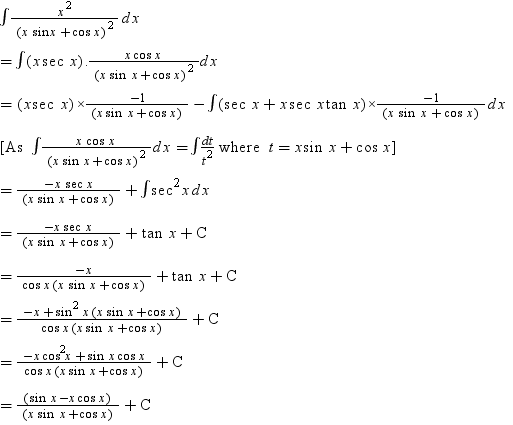
This is a solved problem.

iK9Z0GF.png


How does \int\frac{x^{2}}{(xsinx+cosx)^{2}} dx become \int xsecx \frac{xcosx}{(xsinx+cosx)^{2}} dx?
 
Physics news on Phys.org
Just because sec(x)=\frac{1}{cos(x)}
 
Did it multiply the numerator and denominator by \frac{cosx}{cosx}, which is cosx secx, and then both of cosx and secx took one "x" from the original numerator?
 
JasonHathaway said:
Did it multiply the numerator and denominator by \frac{cosx}{cosx}, which is cosx secx, and then both of cosx and secx took one "x" from the original numerator?
Yes.

In other words, ##\ \cos(x)\cdot\sec(x) = 1 \ .##
 

Similar threads

Replies
3
Views
2K
  • · Replies 1 ·
Replies
1
Views
2K
  • · Replies 3 ·
Replies
3
Views
2K
  • · Replies 4 ·
Replies
4
Views
6K
  • · Replies 11 ·
Replies
11
Views
3K
  • · Replies 5 ·
Replies
5
Views
1K
  • · Replies 105 ·
4
Replies
105
Views
7K
Replies
4
Views
8K
  • · Replies 22 ·
Replies
22
Views
3K
Replies
7
Views
2K