Integration to calculate centre of mass

Click For Summary
SUMMARY

This discussion focuses on the integration required to calculate the center of mass for a cone and a rod with varying density. The formula for the radius of the disk, r, is derived as r=R(1-z/h), where R is the radius at the base and h is the height of the cone. The confusion arises from understanding the linear interpolation between the maximum radius at z=0 and the minimum radius at z=h. Additionally, the parameter 'a' in the context of the rod's density is discussed, indicating its role in expressing density ρ as a function of x.

PREREQUISITES
  • Understanding of integration techniques
  • Familiarity with the geometry of cones
  • Knowledge of linear interpolation
  • Basic concepts of density functions
NEXT STEPS
  • Study the derivation of the formula for the radius of a cone in integration problems
  • Learn about linear interpolation in calculus
  • Explore density functions and their applications in physics
  • Investigate the use of differential elements in integration
USEFUL FOR

Students and educators in physics and mathematics, particularly those focusing on integration techniques and applications in calculating centers of mass.

MathewsMD
Messages
430
Reaction score
7
There are two problems I am facing, and in each one, they are introducing new terms in the integration but I don't understand how.

Problem #1
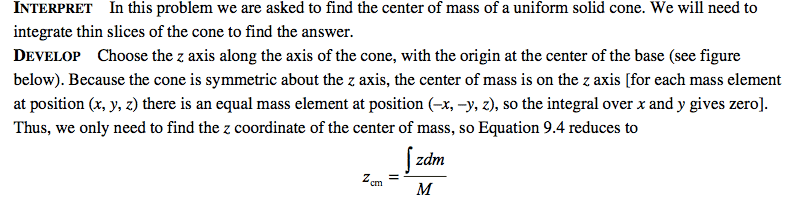
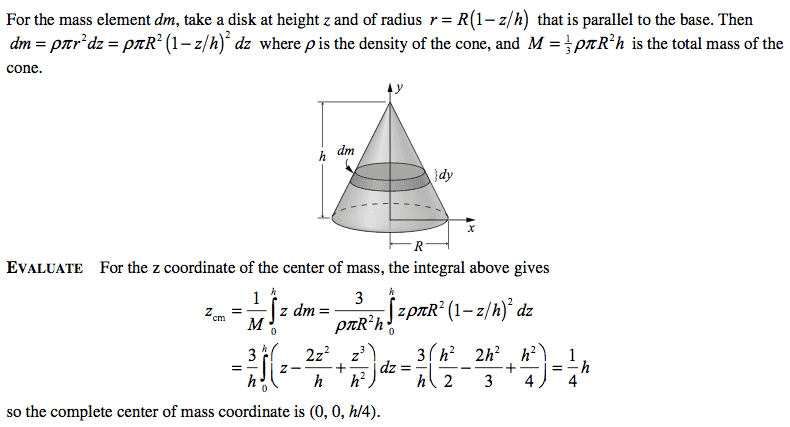
XrNAO5o.png

mL8p9IS.png


Where I become lost is r=R(1-z/h)
Why is this not just r=R(z/h)? Where does the 1-z come from?

tDZREWM.png

2EPankq.png


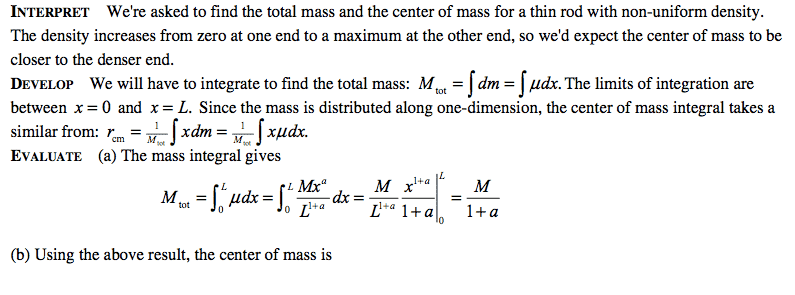
In this question, there is an integration for part b. Where I become confused is when they pull 1+a out of the integral. Where does this 1+a come from? I am relatively new to integration but know the basics. I guess I just can't seem to reason why some of these steps are being done.

Any guidance would be great! :)
 
Physics news on Phys.org
MathewsMD said:
Problem #1

Where I become lost is r=R(1-z/h)
Why is this not just r=R(z/h)? Where does the 1-z come from?
Note that the base of the cone is at z = 0, which is where the radius of the disk will be greatest and equal to R. r is the radius of the disk as a function of z.
 
In the diagram, change the y-axis to the z axis and turn 'dy' into 'dz'. Whoever wrote the text and drew the diagram apparently didn't compare notes.
 
Doc Al said:
Note that the base of the cone is at z = 0, which is where the radius of the disk will be greatest and equal to R. r is the radius of the disk as a function of z.

Okay. I'm still a little confused on how they derived r=R(1-z/h) though. Any more clarification would be very helpful.

Any assistance on the second problem would be great too!

Thanks :)

SteamKing said:
In the diagram, change the y-axis to the z axis and turn 'dy' into 'dz'. Whoever wrote the text and drew the diagram apparently didn't compare notes.

And yes. I eventually caught on since they introduced z instead of the y in the image. Thanks for pointing it out.
 
When z = 0, r = R and when z = h, r = 0. What you want to do is set up a linear interpolation to determine r between these two values of z. If r = R*z/h, then r = 0 when z = 0; or, in other words, the cone would be turned upside down with the pointy end at the bottom.

As far as the rod is concerned, the explanation in the text is lacking in describing what the parameter 'a' is supposed to mean. Since the density of the rod varies with length, 'a' must have something to do with expressing the density ρ as a function of x.
 
SteamKing said:
When z = 0, r = R and when z = h, r = 0. What you want to do is set up a linear interpolation to determine r between these two values of z. If r = R*z/h, then r = 0 when z = 0; or, in other words, the cone would be turned upside down with the pointy end at the bottom.

As far as the rod is concerned, the explanation in the text is lacking in describing what the parameter 'a' is supposed to mean. Since the density of the rod varies with length, 'a' must have something to do with expressing the density ρ as a function of x.

Okay, that makes sense. I'm just confused as to why there is a 1-z in the solution instead of just ±z (depending on our definition of z=0).

I feel like I'm missing something obvious right now.
 
Last edited:
If it helps, draw a sketch.
 
Doc Al said:
Note that the base of the cone is at z = 0, which is where the radius of the disk will be greatest and equal to R. r is the radius of the disk as a function of z.
To add to the top answer: Imagine a 2D cut of the cone: the cone defines a right triangle such tan Q = R /h. But the position of the differential disk defines a second right triangle with same angle: tan Q = r / h'. Where r is the base radius and h' the height of the inner triangle. Now h' the height of the second triangle is h the total height minus z the position of the differential disk : h' = h-z.

Finally : tan Q = (R / h) = (r /h') = (r /h-z) --> r = (R /h) ( h - z) = R (1 - z/h )
 

Similar threads

Replies
16
Views
2K
Replies
11
Views
3K
  • · Replies 13 ·
Replies
13
Views
3K
  • · Replies 3 ·
Replies
3
Views
1K
  • · Replies 8 ·
Replies
8
Views
2K
  • · Replies 8 ·
Replies
8
Views
3K
  • · Replies 13 ·
Replies
13
Views
3K
  • · Replies 16 ·
Replies
16
Views
1K
Replies
7
Views
3K
Replies
5
Views
2K