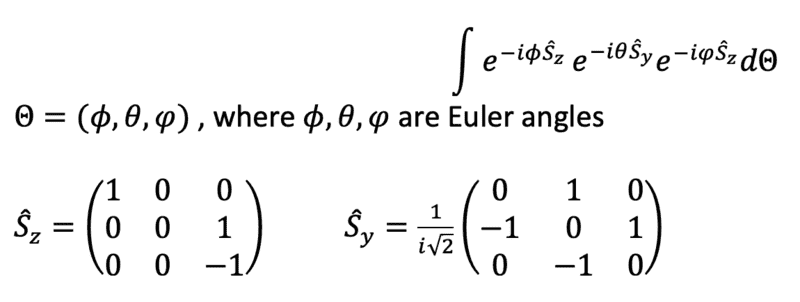
Graduate Integration with Euler angle of rotation matrixes

Click For Summary
The discussion centers on the challenges of integrating exponential matrices related to Euler angles and their implications in quantum mechanics. Participants identify issues with the determinant of matrices representing spin operators, noting that both matrices have a determinant and trace equal to zero. This leads to the conclusion that the rotations are non-invertible when applied to spin states. One participant expresses confusion about how to properly derive the Euler angle vector for integration. The conversation highlights the intersection of quantum mechanics and coordinate transformations, emphasizing the complexities involved in these mathematical representations.
RiceSweet
Messages
5
Reaction score
2
Hello, I was struggling with solving a specific integral. I know that I can rewrite the exponential matrices and the range of the three Euler angles. However, I am not sure I should I write
Screenshot 2018-11-24 00.08.05.png
in terms those three Euler angles.

Screenshot 2018-11-24 00.10.35.png
 

Attachments

  • Screenshot 2018-11-24 00.08.05.png
    Screenshot 2018-11-24 00.08.05.png
    1.1 KB · Views: 950
  • Screenshot 2018-11-24 00.10.35.png
    Screenshot 2018-11-24 00.10.35.png
    9.7 KB · Views: 1,606
Physics news on Phys.org
There is something fishy here. Both your matrices have determinant 0!
 
RiceSweet said:
Hello, I was struggling with solving a specific integral. I know that I can rewrite the exponential matrices and the range of the three Euler angles. However, I am not sure I should I write View attachment 234555 in terms those three Euler angles.

View attachment 234556
Sorry that I made a mistake for one of mine matrix. The matrix of Sz should like as follows
Screenshot 2018-11-30 13.39.10.png
 

Attachments

  • Screenshot 2018-11-30 13.39.10.png
    Screenshot 2018-11-30 13.39.10.png
    3.8 KB · Views: 832
Svein said:
There is something fishy here. Both your matrices have determinant 0!
Hello, thanks for your reply. I made a mistake of Sz matrix, and I just updated the correct matrix. Those two matrices do have a determine as well as trace equal to 0 because those matrices are the matrix representation of Sz and S^2 operator of spin 1/2 1/2 system in Quantum Mechanics. The three exponential inside the integral represents the rotation.
 
So your rotations are non-invertible?
 
Svein said:
So your rotations are non-invertible?
Yes, because those rotations are acting on spins. For example, if We act this rotation operator related to Sz on an eigenstate |00>, we will get e^(0) = 1 as our result, and we can not reverse our process. Since our eigenvalue of |00> corresponding to the Sz operator is just 0.
 
Svein said:
So your rotations are non-invertible?
I have the general expansion form of the rotation operator already. The problem that I am struggling with is that I didn't know how to break down the derivative of this Euler angle vector (theta), and do the right integral.
Screenshot 2018-11-30 16.11.55.png
 

Attachments

  • Screenshot 2018-11-30 16.11.55.png
    Screenshot 2018-11-30 16.11.55.png
    3.6 KB · Views: 764
Mathematically your expression does not make sense.

Since I never studied quantum mechanics, I cannot comment on whatever goes on backstage. I have, however, spent a couple of years working on robot arm coordinate transforms and I am therefore fully conversant with coordinate transform matrices.
 

Similar threads

  • · Replies 2 ·
Replies
2
Views
2K
Replies
2
Views
6K
  • · Replies 1 ·
Replies
1
Views
3K
  • · Replies 1 ·
Replies
1
Views
1K
  • · Replies 18 ·
Replies
18
Views
2K
  • · Replies 1 ·
Replies
1
Views
2K
Replies
4
Views
2K
  • · Replies 7 ·
Replies
7
Views
2K
  • · Replies 6 ·
Replies
6
Views
2K
  • · Replies 1 ·
Replies
1
Views
2K