Intensity and Interference Patterns (double slit)

Click For Summary
The discussion centers on the calculation of intensity in a double-slit interference pattern, specifically addressing confusion around the correct interpretation of the variable I_0 in the intensity formula. The user initially used the equation I = 4(I_0)cos^2(Φ/2) but was unsure if I_0 represented the intensity at the central maximum or from a single slit. Clarification was provided that I_0 should reflect the intensity from one slit at the central maximum, leading to a total intensity at the central maximum being four times that of a single slit. The user is encouraged to verify their understanding of the single-slit intensity as it relates to the double-slit model. Understanding these distinctions is crucial for accurately calculating interference patterns.
garthenar
Messages
35
Reaction score
8
Homework Statement
Two slits spaced 0.0720 mm apart are 0.800 m from a screen. Coherent light of wavelength λ passes through the two slits. In their interference pattern on the screen, the distance from the center of the central maximum to the first minimum is 3.00 mm. The intensity at the peak of the central maximum is 0.0900 W/m2.

a) What is the intensity at point on the screen that is 2.00 mm from the center of the central maximum?

b) What is the intensity at point on the screen that is 1.50 mm from the center of the central maximum?
Relevant Equations
λ=(ax)/D
a = distance between the two slits
x = the distance between maximums
m = which maximum your looking at (from the center)
D = the distance between the "source" (slits) and the screen

path difference
Δp = asin(θ)
= atan(θ)
= (ay/D)
y = vertical distance

phase difference
Φ = Δp (2π / λ)
= Δp k

I = 4(I_0)cos^2(Φ/2)
I'm still on part a.
I think that i may have the wrong equation for intensity.
I'm not sure I'm using the right numbers for the "first minimum".

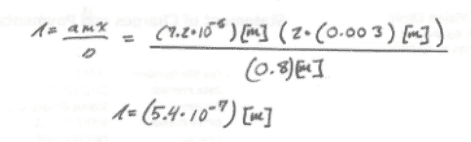
I started with getting the wavelength


λ=(ax)/D
since the first minimum occurs at m = 0.5 I multiplied the distance to the first minimum by 2 to get the distance to the first "fringe". (point of maximum constructive interference)
1587957737071.png


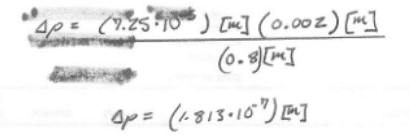
I then got the path difference

Δp = (ay/D)
I used the distance to the point I want the intensity at for y
1587957768984.png


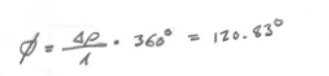
Then the phase difference

Φ = Δp (2π / λ)
1587957790177.png


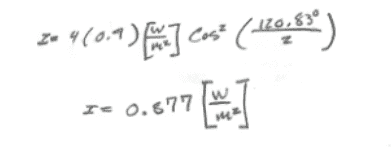
And finally my intensity

I = 4(I_0)cos^2(Φ/2)
1587957819458.png


Which was wrong.
Can you help me figure out where I went wrong. I've tried several variation on this.

Thank you
 

Attachments

  • 1587957714796.png
    1587957714796.png
    5 KB · Views: 238
Physics news on Phys.org
Your work looks good up to here:
garthenar said:
And finally my intensity

I = 4(I_0)cos^2(Φ/2)
View attachment 261531
Be sure you understand the meaning of I_0 in the formula. Is it the intensity of the central max of the double-slit pattern, or is it the intensity that one slit alone would produce at y = 0 on the screen?
 
TSny said:
Your work looks good up to here:
Be sure you understand the meaning of I_0 in the formula. Is it the intensity of the central max of the double-slit pattern, or is it the intensity that one slit alone would produce at y = 0 on the screen?
Wait, I though the central max was at y =0. Where is the central max?
 
garthenar said:
Wait, I though the central max was at y =0. Where is the central max?
Yes, the central max is at y = 0. The question is, what does the symbol I_0 represent in the formula?
 
TSny said:
Yes, the central max is at y = 0. The question is, what does the symbol I_0 represent in the formula?
I'm not entirely sure. My professor said that I should use the equation (I_0)cos^2(Φ/2) with I_0 equaling the intensity at the origin of the two slit model. So I'm assuming that the 4(I_0) has something to do with the the intensity one slit would produce. We haven't done single slits so I'll have to go check that out.
 
garthenar said:
I'm not entirely sure. My professor said that I should use the equation (I_0)cos^2(Φ/2) with I_0 equaling the intensity at the origin of the two slit model. So I'm assuming that the 4(I_0) has something to do with the the intensity one slit would produce. We haven't done single slits so I'll have to go check that out.
Yes. In the 4(I_0) formula, I_0 is the intensity that one slit alone would produce at the location of the central max. The total amplitude at the central maximum due to both slits is twice the amplitude due to one slit alone. Intensity is proportional to the square of the amplitude. So, the intensity of the central max due to both slits together is 4 times the intensity that one slit alone would produce.

If you leave out the factor of 4 in the formula, then I_0 would be the intensity of the central max due to both slits together.
 
The book claims the answer is that all the magnitudes are the same because "the gravitational force on the penguin is the same". I'm having trouble understanding this. I thought the buoyant force was equal to the weight of the fluid displaced. Weight depends on mass which depends on density. Therefore, due to the differing densities the buoyant force will be different in each case? Is this incorrect?

Similar threads

  • · Replies 3 ·
Replies
3
Views
987
  • · Replies 1 ·
Replies
1
Views
3K
  • · Replies 8 ·
Replies
8
Views
3K
  • · Replies 3 ·
Replies
3
Views
2K
Replies
13
Views
2K
  • · Replies 6 ·
Replies
6
Views
8K
  • · Replies 4 ·
Replies
4
Views
5K
  • · Replies 3 ·
Replies
3
Views
1K
  • · Replies 9 ·
Replies
9
Views
7K
  • · Replies 5 ·
Replies
5
Views
4K