henrco
- 46
- 2
Hi,
I haven't posted an Astronomy question before. I did see some Astronomy questions in this section so I posted it here. But if it's in the wrong place, for future reference, please let me know where it should be posted.
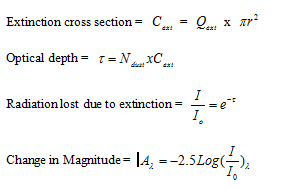
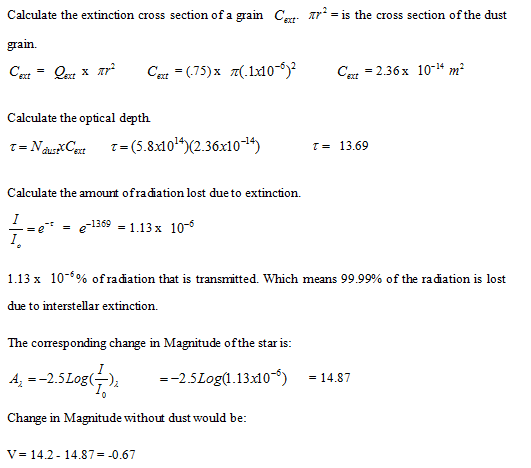
1) The first problem I need guidance on is the value I have obtained for the optical depth. It seems very high, but checking my calculations carefully I'm sure I haven't made a mistake.
2) The other problem I have is if I am correct in obtaining the final answer by subtracting the change in magnitude from the stars apparent magnitude. Since I need to obtain the magnitude without dust I subtracted the change in magnitude value.
Any guidance very welcome!
1. Homework Statement
A hypothetical interstellar cloud consists of a large number of identical dust grains of radius0.1 μm and which have an extinction efficiency factor 0.75 at wavelengths corresponding to the standard V filter. A star is observed through this cloud and its apparent magnitude is V = 14.2 mag.
The column density of the sightline is Ndust = 5.8 × 10^14 m2.
Suppose that all the grains ofdust were to be removed from the sightline. What would the star’s
apparent V magnitude then be?
I haven't posted an Astronomy question before. I did see some Astronomy questions in this section so I posted it here. But if it's in the wrong place, for future reference, please let me know where it should be posted.
1) The first problem I need guidance on is the value I have obtained for the optical depth. It seems very high, but checking my calculations carefully I'm sure I haven't made a mistake.
2) The other problem I have is if I am correct in obtaining the final answer by subtracting the change in magnitude from the stars apparent magnitude. Since I need to obtain the magnitude without dust I subtracted the change in magnitude value.
Any guidance very welcome!
1. Homework Statement
A hypothetical interstellar cloud consists of a large number of identical dust grains of radius0.1 μm and which have an extinction efficiency factor 0.75 at wavelengths corresponding to the standard V filter. A star is observed through this cloud and its apparent magnitude is V = 14.2 mag.
The column density of the sightline is Ndust = 5.8 × 10^14 m2.
Suppose that all the grains ofdust were to be removed from the sightline. What would the star’s
apparent V magnitude then be?