Interpreting a scale factor vs. distance graph

Click For Summary

Discussion Overview

The discussion revolves around interpreting a graph that relates scale factors and distances in a hypothetical universe, particularly in the context of Type Ia supernovae and cosmological measurements. Participants explore concepts such as redshift, the Hubble constant, and the implications of the graph for understanding the universe's structure and expansion.

Discussion Character

  • Exploratory
  • Technical explanation
  • Debate/contested
  • Mathematical reasoning

Main Points Raised

  • Some participants discuss the meaning of the scale factor in the context of the graph and its implications for cosmology.
  • One participant suggests that the graph can be used to find the Hubble distance and Hubble constant, assuming the speed of light is the same in that universe.
  • Another participant mentions calculating redshift and velocities but expresses uncertainty about further interpretations.
  • There is a claim that the graph indicates a linear relationship between redshift and distance, referencing Hubble's observations.
  • Participants debate the interpretation of redshift, with one noting that it is not a general property of space but specific to objects at certain distances.
  • One participant raises a question about how to convert redshift to recession velocity, emphasizing the need to consider cosmological factors.

Areas of Agreement / Disagreement

Participants express various interpretations and calculations related to the graph, but there is no consensus on the correct approach to deriving values or the implications of the findings. Multiple competing views remain regarding the interpretation of redshift and its relationship to distance.

Contextual Notes

Participants note the importance of unit consistency when calculating the Hubble constant and the need to consider the cosmological context when interpreting redshift values.

naushaan
Messages
20
Reaction score
2
TL;DR
Hi guys, I'm having trouble with interpreting scale-factor and distance graphs of Type 1a supernovae.
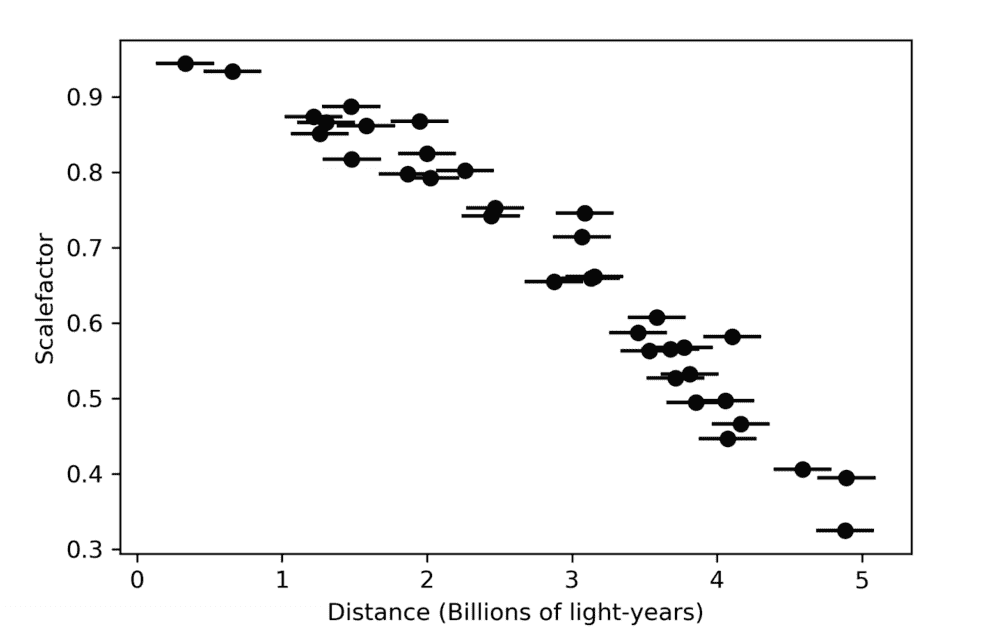
'Imagine that you live in a different universe, which may have a different cosmology to our own. You measure the distances to and redshifts of a large number of Type Ia supernovae, and you use the redshifts to calculate the scale-factor of the universe at the time when the supernova exploded. You get the following graph of distances and scale-factors.'
The question is asking to deduce as much as you can from the plot below:
1571830658934.png
 
Astronomy news on Phys.org
So what have you come up with so far?
 
What is the meaning of scale factor here?
 
From the graph you can find the Hubble distance and, if the speed of light is same for that universe, you can extract the Hubble constant for that universe. And by using Hubble constant you can find the Hubble Time. And that's all I guess
 
  • Like
Likes   Reactions: naushaan
phinds said:
So what have you come up with so far?
i've calculated redshift and velocities so far, but haven't really gotten far with the question otherwise
 
Last edited:
Arman777 said:
From the graph you can find the Hubble distance and, if the speed of light is same for that universe, you can extract the Hubble constant for that universe. And by using Hubble constant you can find the Hubble Time. And that's all I guess
will do that! thank you
 
  • Like
Likes   Reactions: Arman777
naushaan said:
i've calculated redshift and velocities so far, but haven't really gotten far with the question otherwise
And are you going to tell us what you got for those things?
 
naushaan said:
will do that! thank you
I guess you find the answer. I think that from the graph we can also assume that universe is homogenous and isotropic (?). But I am not sure ..
 
phinds said:
And are you going to tell us what you got for those things?
so for redshift i got 0.53, and from then i calculated the Hubble constant to be 7.6e24m/s. I am struggling with how to interpret these findings.
 
  • #10
Arman777 said:
I guess you find the answer. I think that from the graph we can also assume that universe is homogenous and isotropic (?). But I am not sure ..
how would we know that?
 
  • #11
naushaan said:
i calculated the Hubble constant to be 7.6e24m/s.

you have missed an important bit off the end of that
 
  • Like
Likes   Reactions: sophiecentaur
  • #12
naushaan said:
so for redshift i got 0.53, and from then i calculated the Hubble constant to be 7.6e24m/s. I am struggling with how to interpret these findings.

Thats not quite right. First redshift value for what object ? Redshift is not some sort of a general property of space. You can find the corresponding redshift for an object, that has a distance d.

From the graph its clear that there's a linear relationship between ##z## and ##d##. This was what Hubble observed in 1920.

1571988418280.png


Here the y axis, velocity, is just ##cz## since ##z = v/c##. The x-axis represents the distance in parsecs.So the graph that you are given can be turned into Redshift vs Distance (##z## vs ##d##) graph. (You don't have to do that of course). And from that it can be turned into velocity vs distance graph which that is what Hubble did.

And you also know that, this linear relationship can be written as,

##cz = H_0d##

So from your graph we can find the value of the ##H_0/c## or the Hubble distance by turning the scale factor into redshift for 2 points and measuring the slope of the line that connects these two points.

Now, if we assume that ##c## is the same in this imaginary universe as well, we can find the ##H_0## (If we cannot assume that ##c## is the same, then the only information you can get is ##H_0/c##)

Do your calculations again. But be careful about the units. In your graph the distance is given as billion light years. However Hubble constant has units of ##kms^{-1}Mpc^{-1}##.
 
Last edited:
  • Like
  • Informative
Likes   Reactions: naushaan, davenn and sophiecentaur
  • #13
Arman777 said:
Thats not quite right. First redshift value for what object ? Redshift is not some sort of a general property of space. You can find the corresponding redshift for an object, that has a distance d.

From the graph its clear that there's a linear relationship between ##z## and ##d##. This was what Hubble observed in 1920.

View attachment 251791

Here the y axis, velocity, is just ##cz## since ##z = v/c##. The x-axis represents the distance in parsecs.So the graph that you are given can be turned into Redshift vs Distance (##z## vs ##d##) graph. (You don't have to do that of course). And from that it can be turned into velocity vs distance graph which that is what Hubble did.

And you also know that, this linear relationship can be written as,

##cz = H_0d##

So from your graph we can find the value of the ##H_0/c## or the Hubble distance by turning the scale factor into redshift for 2 points and measuring the slope of the line that connects these two points.

Now, if we assume that ##c## is the same in this imaginary universe as well, we can find the ##H_0## (If we cannot assume that ##c## is the same, then the only information you can get is ##H_0/c##)

Do your calculations again. But be careful about the units. In your graph the distance is given as billion light years. However Hubble constant has units of ##kms^{-1}Mpc^{-1}##.
this makes so much sense, thank you very much!
 
  • #14
I have looked at this question for some time. We are given redshift for SN1a. From that there is not a simple velocity calculation v=cz unless the SN1a is close by. Cosmology and the scale factor need to be taken into account. Does anyone have a simple way to go from redshift to recession velocity? Thanks.
 

Similar threads

  • · Replies 6 ·
Replies
6
Views
13K
  • · Replies 1 ·
Replies
1
Views
2K
  • · Replies 9 ·
Replies
9
Views
1K
  • · Replies 27 ·
Replies
27
Views
2K
  • · Replies 5 ·
Replies
5
Views
3K
  • · Replies 23 ·
Replies
23
Views
4K
  • · Replies 1 ·
Replies
1
Views
2K
  • · Replies 13 ·
Replies
13
Views
2K
  • · Replies 10 ·
Replies
10
Views
3K
  • · Replies 30 ·
2
Replies
30
Views
7K