Interrupted air flow at fan inlet, resulting in fan stall

Click For Summary
SUMMARY

The discussion focuses on the topic of "Interrupted air flow at fan inlet, resulting in fan stall," specifically regarding ducted fans such as centrifugal, axial, and mixed-flow types. The user seeks resources that explain the impact of inlet designs, particularly non-bell shaped inlets like "S" shaped or louvered grilles, on fan performance. They express a desire to understand the fundamentals of inlet distortion and its effects on efficiency ratios and design thresholds in various applications, including aerospace and automotive contexts. Recommendations include exploring NASA's document server for comprehensive studies on inlet distortion.

PREREQUISITES
  • Understanding of fan types: centrifugal, axial, and mixed-flow fans
  • Familiarity with airflow dynamics and inlet design principles
  • Basic knowledge of efficiency ratios in fluid dynamics
  • Awareness of aerospace and propulsion systems
NEXT STEPS
  • Research "NASA inlet distortion studies" for in-depth technical papers
  • Explore "fan performance testing methodologies" for practical insights
  • Learn about "aerodynamic principles in ducted fan design"
  • Investigate "efficiency ratios in propulsion systems" for comparative analysis
USEFUL FOR

Aerospace engineers, mechanical engineers, architects interested in airflow dynamics, and anyone looking to enhance their understanding of fan performance and inlet design.

kach22i
Messages
51
Reaction score
0
I'm looking for an on-line paper/article/pdf about ducted fans; "Interrupted air flow at fan inlet (subsonic), resulting in fan stall" which I can print out and read. Centrifugal, axial and or mixed-flow fans included.

I have not had much luck doing a Google search on my own, perhaps I'm using the wrong search terms.

I'm interested in non-bell shape inlets, something "S" shaped, or with a louvered grille up ahead of the fan. I'm assuming inlet plenum volume, drag and shape also come into play.

I see inlets (on cars, airplanes, helicopters) for circulation, cooling air and auxiliary power generation which are not like those used for thrust (which are tube/foil-like). I also see on hovercraft, lift fans at right angle of flow, but thrust fans in-line with direction of motion. Is there an efficiency ratio here, what's the design threshold?

I just want to learn a little (get me to fist base so I don't sound so stupid), and maybe it will help put me to sleep at night too.:wink:

EDIT: something with pictures would be nice.
http://www.free-online-private-pilot-ground-school.com/turbine-engines.html
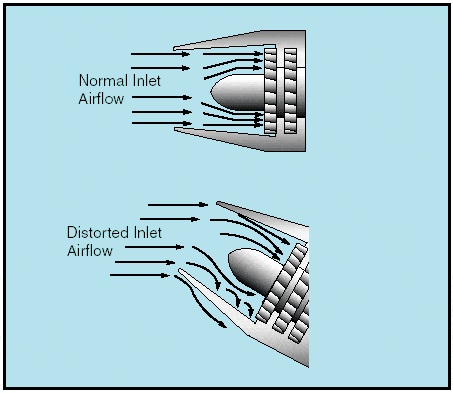
compressor-airflow.gif
 
Last edited:
Physics news on Phys.org
Inlet distortion is a very prominent field/specialization of study in aerospace and propulsion. I can't imaging a one page paper giving you everything you need to know about the topic. Do you have a specific paper in mind? We do all sorts of real world distortion testing on our fans and compressors to ensure operability and performace for various inlet configurations and inlet flow patterns. I am highly doubtful that this is going to be as easy as you think.

You might want to look at NASA's document server:
http://gltrs.grc.nasa.gov/
 
Last edited by a moderator:
Thanks for the link.

I want to get the fundamentals right, then slowly move on to specific situations and see what makes them work or fail.

Something general at a high school level would be fine. If a professional level paper, I'll read it a few times and maybe 20% will soak in.

I took college calculus (up to 4) with engineering students 20 years ago, but being an architect I've displaced that temporary memory long ago.:wink:
 

Similar threads

  • · Replies 17 ·
Replies
17
Views
3K
Replies
3
Views
2K
  • · Replies 3 ·
Replies
3
Views
3K
  • · Replies 2 ·
Replies
2
Views
2K
  • · Replies 4 ·
Replies
4
Views
3K
  • · Replies 1 ·
Replies
1
Views
3K
Replies
2
Views
20K
  • · Replies 3 ·
Replies
3
Views
2K
  • · Replies 5 ·
Replies
5
Views
7K
Replies
3
Views
3K