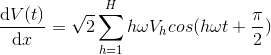
Intgration of a harmonic function help please

  • Thread starter Thread starter lordcx
  • Start date Start date
  • Tags Tags
    Function Harmonic
Click For Summary
SUMMARY

The discussion centers on the integration of a harmonic function, specifically addressing the confusion surrounding the powers of omega (ω) in the integration process. The user encountered an issue where their solution yielded ω², while the expected result was ω¹. The explanation provided clarifies that during a change of variable in the integral, one ω from the numerator cancels with one in the denominator, resulting in the correct power of ω in the final answer. The user also expressed confusion regarding the relationship between the variables h and ω in the cosine function.

PREREQUISITES
  • Understanding of harmonic functions and their properties
  • Familiarity with integration techniques and variable substitution
  • Knowledge of trigonometric functions, specifically cosine
  • Basic grasp of mathematical notation and equations
NEXT STEPS
  • Study the principles of variable substitution in integrals
  • Explore the properties of harmonic functions in depth
  • Review trigonometric identities and their applications in integration
  • Learn about the implications of changing variables in integrals
USEFUL FOR

Mathematics students, researchers in applied mathematics, and anyone involved in the study of harmonic functions and integration techniques.

lordcx
Messages
2
Reaction score
0
intgration of a function*** help please***

actually this is not a homework, I found this explanation in a journal paper but I could not understand it. Can someone give me an explanation or possibly a proof that:


Homework Statement


if:
e;x}=\sqrt{2}\sum_{h=1}^{H}h\omega&space;V_{h}cos%28h\omega&space;t+\frac{\pi&space;}{2}%29.png


then why integration over whole period is:
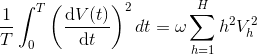
t%29}{\mathrm{d}&space;t}&space;\right&space;%29^{2}dt=\omega&space;\sum_{h=1}^{H}h^{2}V_{h}^{2}.png


Homework Equations


I have problem with the power of omega, my solution returns w with power 2, while the power of omega in answer is one, Can someone help me for the reason?
 
Last edited:
Physics news on Phys.org


Well, when you do a change of variable in the integral in the LHS, one omega pops up in the denominator, canceling one of the 2 from the numerator. That's why the RHS contains omega only to the power 1.


bigubau said:
Well, when you do a change of variable in the integral in the LHS, one omega pops up in the denominator, canceling one of the 2 from the numerator. That's why the RHS contains omega only to the power 1.

thank you, but as you see cos(hwt) contains both h and w. means by changing the variable the power of w and h should be equal. I'm confused:cry:

png.png


and over whole period:

png.png


then we will have

png.png


not

png.png


am I wrong??
 
Last edited:

Similar threads

Replies
8
Views
3K
Replies
7
Views
2K
Replies
1
Views
1K
  • · Replies 3 ·
Replies
3
Views
2K
  • · Replies 3 ·
Replies
3
Views
3K
Replies
2
Views
2K
  • · Replies 5 ·
Replies
5
Views
2K
  • · Replies 10 ·
Replies
10
Views
2K
  • · Replies 5 ·
Replies
5
Views
2K
  • · Replies 2 ·
Replies
2
Views
2K